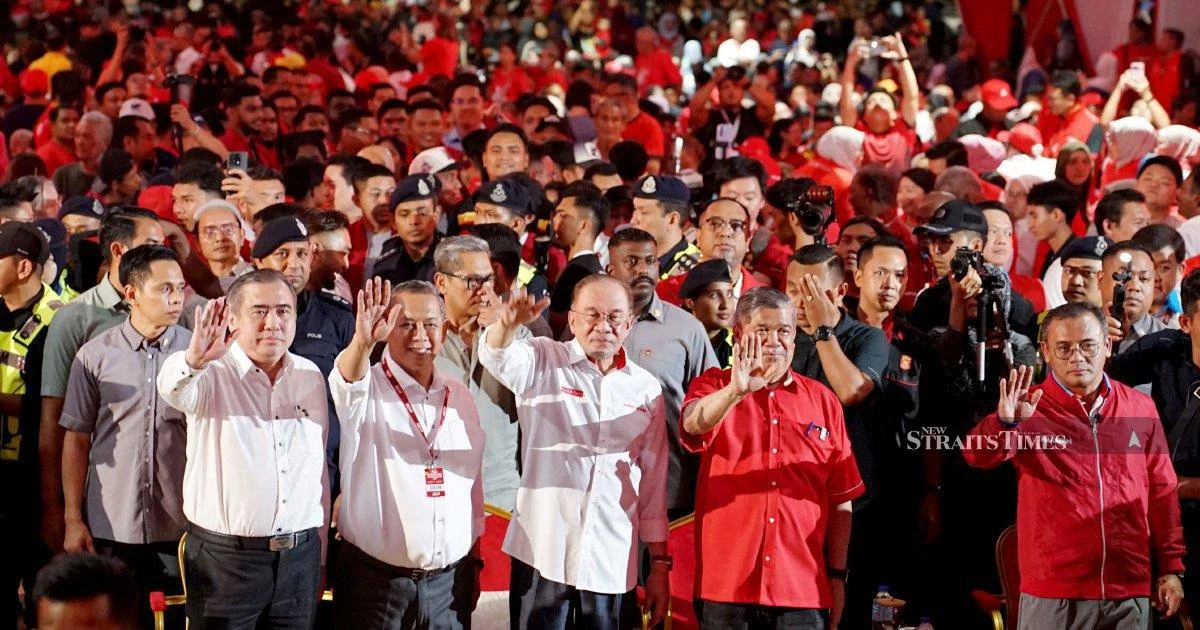
Prime Minister Datuk Seri Anwar Ibrahim has issued a firm reminder to the political establishment that the royal institution must remain insulated from electoral contests, a statement he delivered in Kuala Pilah that carries implications far beyond Negri Sembilan's upcoming election campaign.
The warning reflects a broader concern about the intersection of Malaysia's constitutional monarchy and partisan politics—a tension that has periodically surfaced throughout the nation's democratic history. By explicitly cautioning against dragging royalty into campaign discourse, Anwar underscores a principle fundamental to Malaysia's political stability: the separation of institutional respect from electoral competition. The monarchy, enshrined in the Federal Constitution as a symbol of national unity, functions most effectively when it stands above the partisan fray.
In Southeast Asia's context, where constitutional monarchies serve as anchors for democratic legitimacy, the politicisation of royal institutions poses particular risks. Thailand's turbulent political history demonstrates how erosion of monarchical neutrality can destabilise governance. Malaysia's own experience, whilst more stable, has seen moments when royal prerogatives became entangled with factional disputes, creating constitutional confusion. Anwar's admonition thus addresses a genuine institutional vulnerability that demands constant vigilance from political actors.
The timing of this statement carries weight. State elections in Malaysia frequently witness intensified political rhetoric and competitive tactics that test democratic boundaries. Negri Sembilan, a state with a reigning Sultan, presents a context where the temptation to invoke royal authority or symbolism might prove particularly acute for contending parties. By speaking directly to this issue before such tactics potentially emerge, Anwar seeks to establish clear expectations about acceptable campaign conduct.
For Malaysian readers attuned to constitutional niceties, the statement reflects a maturation in political discourse. Rather than allowing disputes over royal involvement to metastasise during elections, the Prime Minister preemptively establishes that such manoeuvres fall beyond the pale of legitimate political competition. This approach treats politicians as capable of self-regulation when boundaries are clearly articulated, though it implicitly acknowledges that such clarity sometimes requires explicit reminders.
The underlying constitutional principle is straightforward: Malaysia's Yang di-Pertuan Agong and state Sultans occupy positions of profound symbolic importance specifically because they transcend partisan divisions. Electoral campaigns, by definition, divide the electorate along lines of preference and ideology. When political actors attempt to harness royal imagery or authority for campaign advantage, they muddy this crucial distinction and risk compromising the very neutrality that makes the monarchy constitutionally potent.
Anwar's warning also signals something about his administration's approach to governance standards. His tenure has witnessed efforts to establish clearer ethical frameworks and institutional guardrails across government. This intervention regarding royal neutrality in elections fits that pattern—an attempt to elevate the baseline of political behaviour through principled leadership rather than regulatory enforcement alone.
The statement carries particular resonance for Negri Sembilan specifically. As a state with a Sultan, the institution occupies a visible role in public consciousness. Campaign strategists might calculate that references to the reigning Sultan, expressions of loyalty to the throne, or invocations of royal heritage could resonate with voters. Anwar's preemptive caution removes such calculations from the permissible toolkit, signalling that parties seeking electoral legitimacy must build their cases on policy platforms and leadership credentials rather than royal symbolism.
For the broader Malaysian electorate, this intervention reinforces a civic lesson: democracy functions most robustly when different institutional spheres maintain their distinct identities and purposes. The royal institution derives its authority from constitutional position and historical legitimacy, not from electoral validation. Conversely, electoral legitimacy flows from the ballot box, not from proximity to royal favour. Conflating these sources of authority corrupts both.
The Prime Minister's caution extends beyond mere etiquette. It speaks to the health of Malaysia's constitutional democracy. When political competition respects institutional boundaries, voters can distinguish between evaluating parties on their merits and expressing deference toward national symbols. When those boundaries blur, democratic choice becomes muddied with considerations of protocol and loyalty, potentially distorting electoral judgement.
Regionally, Malaysia's experience offers lessons for other Southeast Asian democracies wrestling with similar questions about monarchy and elections. Nations with constitutional monarchies must continually negotiate the relationship between popular sovereignty and institutional tradition. Anwar's intervention exemplifies how clear leadership communication can reinforce institutional norms without resorting to formal legal mechanisms.
Looking forward, whether political parties heed this caution during the Negri Sembilan campaign will reveal much about the state of Malaysian political culture. Compliance would demonstrate that party leaders recognise the value of maintaining institutional boundaries even when electoral advantage might seem to beckon. Conversely, any attempts to exploit royal symbolism would suggest that some actors still view institutional norms as negotiable when strategic advantage calls.
The statement ultimately reflects confidence in Malaysia's political maturity—the assumption that explicit reminders about constitutional boundaries can reshape behaviour without legal sanctions. It is an approach that places faith in the rationality and patriotism of political leaders to recognise that the nation's long-term stability depends on respecting the constitutional architecture that has served it for nearly seven decades.

