Prime Minister Datuk Seri Anwar Ibrahim used traditional Malay verse on social media today to deliver a carefully crafted message about the importance of unity, discipline and collective consensus—a symbolic gesture that observers interpret as an attempt to maintain cohesion within Malaysia's Federal Unity Government during a period of intensified political competition. The premier posted a four-line pantun on his official Facebook account, coupling the classical poetic form with a 1980s musical reference, generating substantial online engagement within hours of publication.
The post carried particular significance given the timing and political context. While the Federal Government operates as a coalition between Pakatan Harapan and Barisan Nasional, the two major blocs are currently locked in vigorous electoral competition in Negeri Sembilan, where voters will decide the fate of 36 state seats on August 1. This apparent contradiction—governing together at the national level while competing aggressively in a state election—has created tension within Malaysia's delicate political arrangements, making Anwar's call for solidarity especially noteworthy.
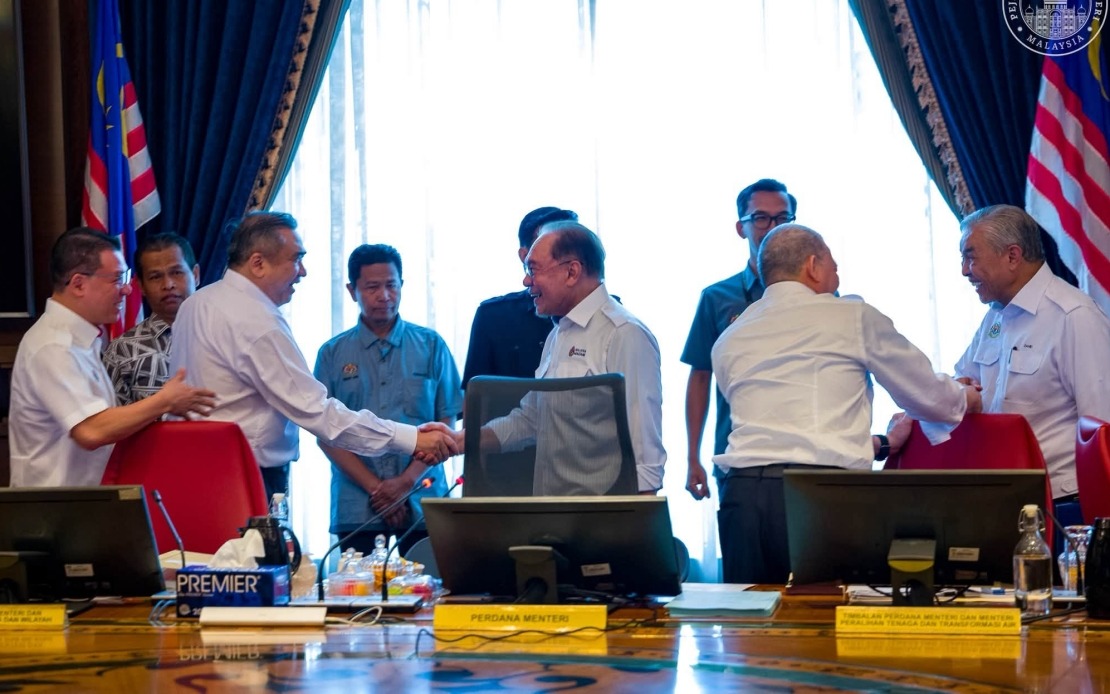
Anwar accompanied his poetic message with photographs from a recent Cabinet meeting featuring Deputy Prime Minister Datuk Seri Dr Ahmad Zahid Hamidi, Transport Minister Anthony Loke, and other senior government figures. The images deliberately conveyed a sense of relaxation and cordiality among the assembled ministers, visually reinforcing the textual message about governmental harmony. This combination of poetry, music nostalgia, and carefully curated imagery reflects a sophisticated approach to political communication designed to reach Malaysia's social media-savvy population.
The online response proved overwhelmingly positive, with the post accumulating more than 11,500 likes within a two-hour window. The comments section swelled to over 1,700 responses, demonstrating genuine public engagement rather than passive scrolling. Notably, several commenters replied in traditional pantun form, indicating that Anwar's choice of medium resonated culturally with segments of the Malaysian electorate. Many responses praised what observers characterized as the Prime Minister's conciliatory approach and statesmanship, suggesting receptivity to messages emphasizing national cohesion.
The Negeri Sembilan electoral contest itself reflects the complexities facing Malaysia's ruling coalition. Pakatan Harapan, chaired by Anwar, is fielding candidates across all 36 state constituencies, effectively competing for every available seat. Barisan Nasional, led by Ahmad Zahid, is contesting 25 seats while simultaneously negotiating a pact with Perikatan Nasional for the remaining constituencies. This arrangement underscores the mathematical realities of Malaysian electoral politics, where coalition partners must sometimes compete to maintain relevance and satisfy their respective party bases.
The Negeri Sembilan State Assembly was dissolved on June 5, initiating the formal election cycle. The Election Commission has scheduled early voting for July 28, with general polling occurring on August 1. This compressed timeline has intensified campaign activity, with both PH and BN mobilizing resources and messaging to secure voter support. Against this backdrop of heightened political activity, Anwar's call for unity can be read as a subtle reminder that fierce electoral competition need not undermine the structural stability that the Federal Government requires to function effectively.
For Malaysian political observers and analysts, the post reflects an understanding that governing coalitions built on pragmatic power-sharing arrangements require constant symbolic reinforcement. The use of traditional pantun—a form deeply embedded in Malay cultural and literary traditions—suggests an attempt to elevate the message beyond partisan politics into the realm of national values and shared heritage. By invoking cultural touchstones rather than policy announcements or partisan rhetoric, Anwar positioned himself as defending broader national interests rather than narrow factional advantage.
The inclusion of an 1980s musical reference added an unexpected contemporary dimension to the classically-styled verse, potentially appealing to middle-aged voters with nostalgic attachments to that era. This cross-generational approach to messaging—combining traditional cultural forms with modern popular culture—demonstrates awareness that political communication must operate across multiple registers simultaneously to reach diverse audiences. The strategy reflects how Malaysian leaders increasingly navigate between digital-native and traditional constituencies.
The tension between coalition cohesion and electoral competition has become a defining feature of Malaysian politics in the post-2018 era. The Federal Unity Government, formed following the 2022 general election, represents an unprecedented arrangement where former political adversaries govern together while remaining organizationally distinct and electorally competitive. Anwar's pantun can be understood as a high-profile effort to normalize this paradox—to convince Malaysians that simultaneous cooperation and competition represent normal governance, not contradictory impulses.
For Southeast Asian observers, the episode illuminates how Malaysia's multi-ethnic, multi-religious context shapes political communication at the highest levels. Anwar's recourse to traditional Malay poetic forms carries symbolic weight within Malay-Muslim communities while remaining culturally accessible to other populations. The post demonstrates how Malaysian political leaders leverage cultural specificity to send messages that operate on multiple simultaneous levels—addressing immediate political concerns while tapping deeper cultural reservoirs.
Looking forward, the success of this particular social media strategy will likely influence how Anwar and other senior Malaysian politicians communicate with the public. The substantial engagement metrics suggest that messages combining cultural authenticity with contemporary media formats resonate effectively with Malaysian audiences. As Negeri Sembilan voters prepare to cast their ballots, Anwar's poetic call for unity will inevitably feature in the political narrative surrounding the election, framing the competition as fundamentally compatible with the broader imperative of maintaining national governmental stability.

