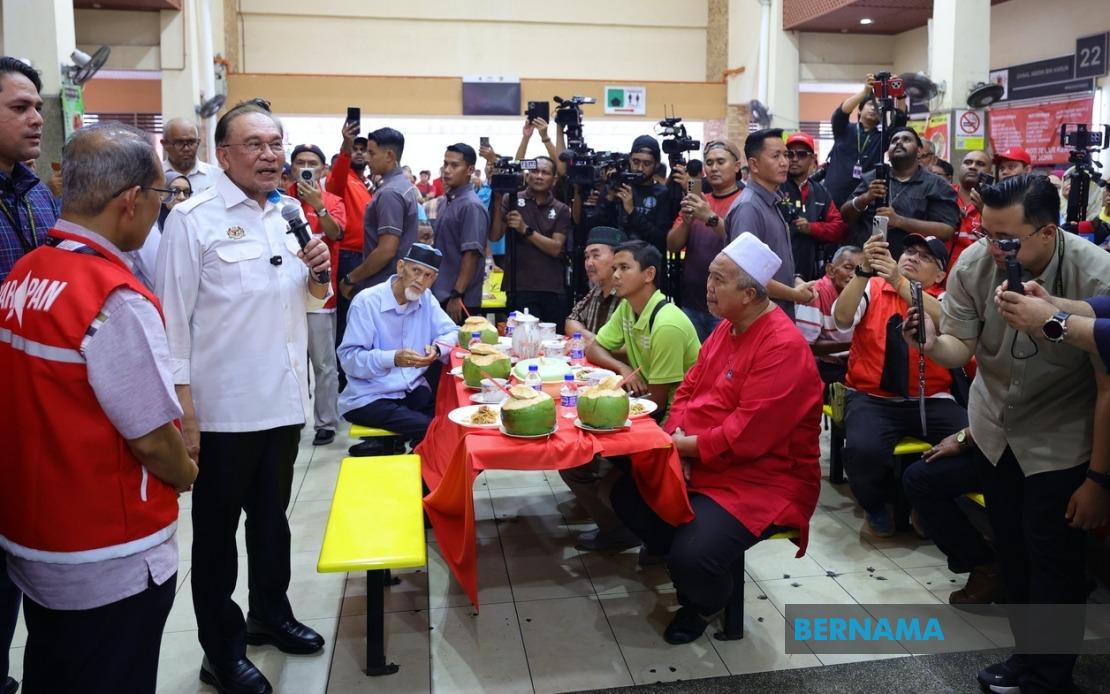
Prime Minister Datuk Seri Anwar Ibrahim has made a direct appeal to voters in Negeri Sembilan to sustain their confidence in Pakatan Harapan ahead of the state election, framing a renewed electoral mandate as essential for preserving political stability and ensuring coordinated governance at both state and federal levels. Speaking at a series of campaign events in Seremban, Anwar emphasised that alignment between the state administration and the Federal Government would facilitate the smooth execution of development initiatives and public welfare programmes, particularly benefiting ordinary Malaysians seeking tangible improvements in their living standards and access to government services.
As both Prime Minister and chairman of Pakatan Harapan, Anwar positioned political unity and consensus as foundational principles for sustainable progress in Negeri Sembilan. He highlighted the track record of the state's Menteri Besar Datuk Seri Aminuddin Harun, crediting the administration's stability over the preceding three years to constructive cooperation among political stakeholders. This messaging reflects a broader PH strategy of associating incumbency with competent governance, particularly relevant in a state where political transitions could potentially disrupt ongoing projects or alter administrative priorities.
The Prime Minister acknowledged that the state government's performance remained imperfect, a candid admission that appears calibrated to address voter concerns about implementation gaps whilst simultaneously inviting continued public engagement. By framing governance as a collaborative process between elected representatives and constituents, Anwar positioned feedback mechanisms as integral to policy refinement rather than markers of systemic failure. This rhetorical approach attempts to neutralise criticism whilst maintaining that PH's direction deserves sustained electoral support despite room for improvement.
Anwar's campaign push reflects the strategic importance of Negeri Sembilan within PH's broader political calculations. With the Election Commission having scheduled polling day for August 1 and early voting for July 28, the campaign timeline becomes compressed, requiring intensive grassroots mobilisation and high-profile leadership engagement. The Prime Minister's personal presence underscores the contest's significance for PH's national positioning; retaining or expanding influence in the state reinforces the coalition's federal mandate and parliamentary stability.
The composition of PH's candidate slate—16 representatives from PKR, 11 from DAP, and nine from Amanah across 36 contested seats—demonstrates the coalition's commitment to contesting the entire state assembly, rejecting tactical withdrawal that might otherwise free resources for marginal battlegrounds. This all-in approach signals confidence in PH's organisational capacity and suggests internal coalition partners have resolved potential seat-sharing disputes, a prerequisite for presenting unified messaging to voters sceptical of political fractures.
Negeri Sembilan's electoral context carries implications extending beyond state-level administration. The peninsula state serves as a political barometer reflecting broader public sentiment toward PH's federal stewardship, particularly regarding economic management, cost-of-living pressures, and infrastructure delivery. Voter behaviour in this contest will offer insight into whether PH's federal governing coalition maintains sufficient popular traction to weather ongoing political challenges and policy controversies at the national level, concerns that resonate among Southeast Asian observers monitoring Malaysia's democratic trajectory.
The timing of the Negeri Sembilan election also positions it as a preliminary indicator of public appetite ahead of the next federal general election, expected within the coming years. Electoral performance here may influence internal coalition dynamics, party leadership calculations, and strategic coalitional adjustments. A strong PH showing would strengthen Anwar's political standing and validate his governance model, while unexpected setbacks could embolden internal critics or opposition forces seeking to exploit perceived vulnerability.
Anwar's framing of the election as a choice between continuity and uncertainty resonates with a particular voter demographic—those prioritising stability and risk-averse governance over alternatives promising structural change. This positioning appeals to middle-income professionals, business owners, and established constituencies concerned about economic volatility and institutional uncertainty. Conversely, this messaging may prove less persuasive among younger voters, lower-income groups, or communities feeling left behind by current development trajectories, segments potentially attracted to opposition messaging of systemic reform.
The campaign's emphasis on federal-state coordination highlights evolving governance dynamics within Malaysia's federal structure. Unlike Westminster systems with strict separation between central and sub-national spheres, Malaysian politics increasingly blurs these boundaries, with federal governments leveraging financial and administrative leverage to incentivise state-level alignment. Anwar's campaign essentially argues that voters benefit materially from choosing state representatives aligned with federal leadership, a pragmatic yet potentially controversial assertion about the prerequisites for effective governance.
Beyond electoral mechanics, the Negeri Sembilan contest reflects broader questions about PH's capacity to maintain coalition cohesion whilst delivering material improvements in living standards and public services. Each coalition partner brings distinctive constituencies and ideological commitments; managing these tensions whilst presenting unified governance requires skilful political navigation. Performance in Negeri Sembilan will signal whether PH possesses such capacity, with relevance for coalition stability at federal level and investor confidence in Malaysia's institutional continuity.

