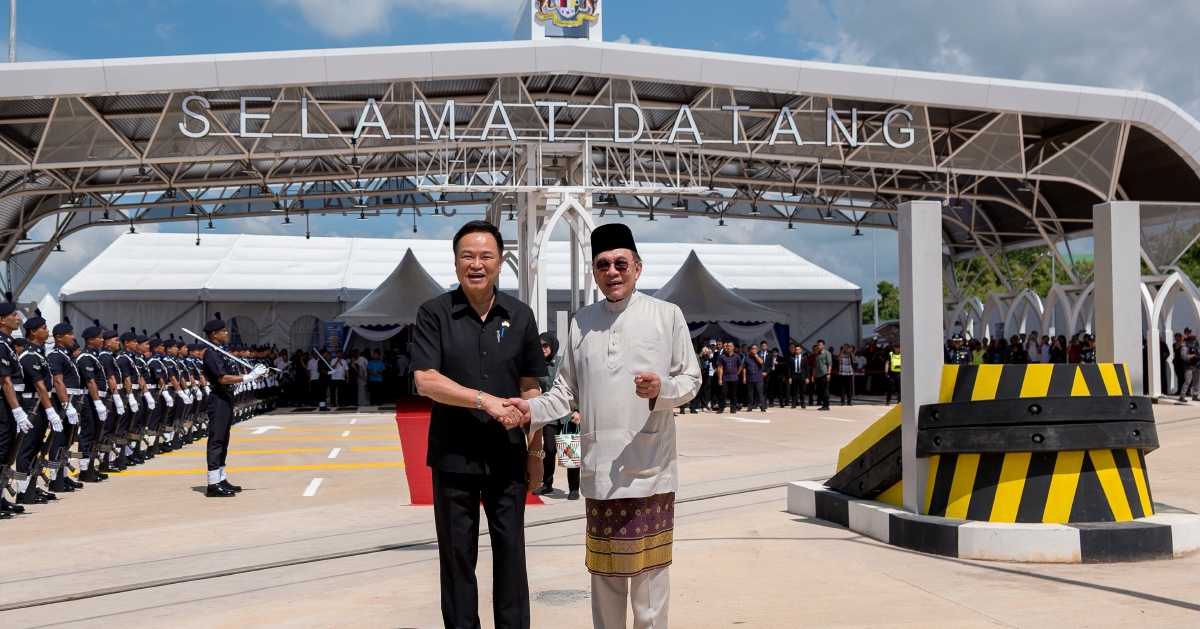
Prime Minister Datuk Seri Anwar Ibrahim and Thai Prime Minister Anutin Charnvirakul jointly inaugurated a new road corridor connecting Malaysia's Bukit Kayu Hitam border complex with Thailand's Sadao Customs, Immigration and Quarantine facility at a ceremony in Bukit Kayu Hitam. The opening represents a significant step in enhancing cross-border connectivity and streamlining trade and travel between the two neighbouring nations along their shared frontier.
The new thoroughfare addresses longstanding infrastructure challenges at one of Southeast Asia's busiest land border crossings. Previously, travellers and commercial vehicles navigating between the two countries faced congestion and inefficient routing through older access roads. By creating a direct, purpose-built link between the corresponding checkpoint facilities on each side of the border, planners expect the route to substantially reduce transit times and operational friction for the hundreds of thousands of people and tonnes of goods that cross this frontier annually.
For Malaysian commerce, the improved infrastructure holds particular significance. The Bukit Kayu Hitam complex serves as a critical gateway for domestic businesses conducting trade with Thailand and points beyond. Manufacturers, logistics companies, and agricultural exporters have long cited border crossing delays as a constraint on competitiveness. A smoother, more efficient passage enables Malaysian enterprises to reach Thai and broader Southeast Asian markets more reliably, potentially lowering supply chain costs and improving delivery predictability—factors increasingly important as regional trade intensifies.
Thailand's interest in the project reflects reciprocal economic calculations. Northern Thailand generates substantial revenue from trade with Malaysia and ASEAN, while serving as a distribution hub for Thai goods moving southward. The Sadao complex, upgraded in recent years, positions Chumphon Province as a modern, capable entry point. Enhanced road infrastructure multiplies the return on that investment by facilitating faster clearances and higher throughput. Both governments recognise that marginal improvements in border efficiency compound significantly over months and years.
The project also carries symbolic weight in Malaysia-Thailand relations. Despite occasional diplomatic tensions and maritime boundary discussions, both nations have consistently prioritised practical cooperation on economic and infrastructure matters. Border facility improvements, when pursued jointly, demonstrate shared commitment to mutual benefit and regional stability. They signal to investors and business operators that institutional frameworks exist to resolve operational challenges collaboratively—an important confidence factor in an era of geostrategic uncertainty across Southeast Asia.
For Malaysian travellers, particularly residents of Kedah and Perlis, the new road eases access to Thailand's attractions and services. Tourism flows in both directions along this corridor contribute meaningfully to local economies on either side. More efficient travel infrastructure encourages leisure visits, business trips, and cross-border shopping, generating employment and tax revenue in border towns that depend heavily on this traffic. The project therefore has tangible implications for ordinary Malaysians and Thai nationals engaged in everyday cross-border movement.
The opening also contextualises Malaysia's broader infrastructure ambitions. Kuala Lumpur has emphasised connectivity as central to its development strategy, particularly linking the northern and southern regions more effectively. The Bukit Kayu Hitam project forms part of a wider pattern of investment in border gateways and arterial routes. Such initiatives support the government's vision of Malaysia as a well-connected hub within Southeast Asia, attractive to investors and conducive to seamless regional commerce.
From Thailand's perspective, the road enhancement aligns with Bangkok's aspiration to deepen integration with Malaysia and ASEAN partners. Thai policymakers recognise that competitive advantages emerge partly from infrastructure quality and border efficiency. By collaborating on this project, Thailand strengthens its position as a reliable, professional trading partner, potentially attracting more cross-border commerce and investment into northern provinces. The initiative reflects strategic thinking about how incremental improvements in physical infrastructure translate into competitive and economic gains.
The joint ceremony underscored the diplomatic warmth between Anwar and Anutin's administrations. Both leaders have demonstrated willingness to address practical bilateral issues through direct engagement and cooperative problem-solving. This approach contrasts with periods when Malaysia-Thailand relations centred on contentious maritime or diplomatic disputes. Recent emphasis on infrastructure and economic cooperation suggests a maturing relationship where both governments prioritise concrete mutual benefit over historical grievances.
Looking forward, the road linking Bukit Kayu Hitam and Sadao sets a precedent for similar projects across the Malaysia-Thailand border. Other crossing points may benefit from comparable investments in access infrastructure, harmonised clearance procedures, and digital systems integration. Success here demonstrates feasibility and builds political will for expanded cooperation. As Southeast Asia increasingly competes for foreign direct investment and supply chain positioning, nations that facilitate efficient intra-regional movement gain advantage.
The project also offers lessons for ASEAN integration more broadly. The region's competitiveness depends partly on whether member states prioritise practical, unglamorous infrastructure improvements alongside larger trade and investment initiatives. Roads, customs facilities, and clearance procedures may lack the visibility of headline trade agreements, yet they fundamentally determine whether those agreements generate tangible benefits for businesses and citizens. Malaysia and Thailand's willingness to invest in this connector exemplifies the kind of patient, incremental effort that underpins genuine regional integration.

