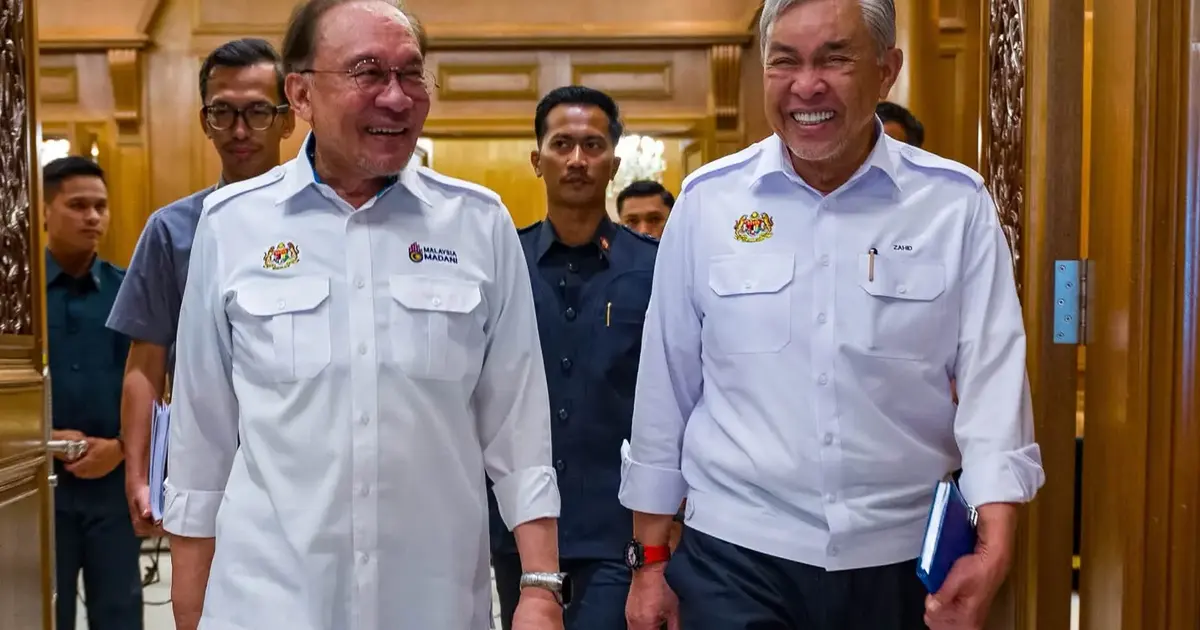
Prime Minister Anwar Ibrahim and Barisan Nasional chairman Ahmad Zahid Hamidi appeared together in public displays of goodwill, moving past a period of apparent friction within the governing coalition. The apparent reconciliation comes just one day after Zahid had made a provocative statement suggesting that Anwar could dismiss the eight BN-affiliated ministers if he took issue with their performance or tenure in government.
The remarks from Zahid, who leads Malaysia's oldest political formation after its return to federal power, represented the kind of direct challenge that periodically surfaces when coalition partners test each other's resolve and negotiating positions. His comment that the prime minister possessed the authority to remove BN ministers reflected the underlying tension between coalition members over ministerial portfolios, influence, and the distribution of government positions. By articulating this explicitly, Zahid appeared to be either issuing a test of the coalition's stability or attempting to reframe the terms of debate around ministerial continuity.
The appearance of both leaders together, smiling and projecting harmony, served multiple political purposes within Malaysia's delicate coalition environment. It conveyed to the public, party members, and international observers that despite occasional sharp exchanges, the fundamental coalition partnership remained intact and functional. Such public displays of unity have become routine diplomatic theatre in Malaysian politics, where coalition governments depend on maintaining the perception of cohesion even when underlying tensions exist over power-sharing arrangements.
Anwar's position as prime minister depends substantially on BN's continued participation in the coalition. While Pakatan Harapan controls significant parliamentary numbers, the inclusion of BN—which holds the largest number of seats among coalition components—strengthens his government's numerical advantage and political legitimacy. Any significant breach with BN would immediately threaten his administration's stability and governing capacity. Conversely, Zahid and BN maintain stakes in government through ministerial appointments, which provide both institutional influence and the patronage resources that benefit party members and constituency politics.
The eight ministers in question represent crucial positions and symbolic weight within the government structure. Their continued presence reflects earlier negotiations between Anwar and Zahid over how power and position would be shared within the coalition framework. Any suggestion that these appointments might be revoked raises questions about the terms of the coalition agreement and whether the distributional bargains struck between partners remain stable or are subject to unilateral revision.
The context of such disputes within Malaysian coalitions typically involves competing priorities around ministerial performance, party representation, inter-factional dynamics within BN, and broader questions about how long different components remain satisfied with their respective allocations. BN itself comprises multiple parties with their own internal negotiations, adding another layer of complexity to coalition management at the national level. Ministers selected from different BN component parties must simultaneously serve their roles in government while maintaining standing within their home parties, creating potential conflicts of interest and loyalty.
Zahid's statement, while framed as a challenge, may have been intended primarily for an internal BN audience, reaffirming his authority and defending BN's corner in government negotiations. Public confrontation with the prime minister, even of a relatively mild sort, demonstrates to BN members and supporters that their chairman is actively defending the party's interests and not passively accepting the government's decisions. This form of political theatre serves important functions in party management, particularly in a coalition where the dominant partner might otherwise exercise excessive control.
Anwar's response through public goodwill and the appearance of calm dialogue represents the preferred approach of a coalition prime minister managing relationships with multiple partners. Rather than escalating tensions or issuing counter-threats, his team moved quickly toward visible reconciliation, suggesting that the exchange had been resolved satisfactorily or at least managed to a point where continued public friction would prove counterproductive. This approach minimizes damage to the government's broader credibility and reduces the likelihood that other coalition partners might perceive weakness or instability.
For Malaysian observers and analysts, such episodes illuminate how coalition governments actually function beyond formal constitutional arrangements. Ministers serve simultaneously as government representatives and party delegates, creating inherent tensions between loyalty to the cabinet collective and loyalty to their parties. Coalition stability depends not on eliminating these tensions but on managing them through implicit understandings, periodic negotiations, and public displays of solidarity that reassure the public that despite friction, governance continues.
The incident also reflects broader patterns in Malaysian politics where ministers from different parties maintain significant independence from the prime minister's office, particularly when their parties control enough seats to make them difficult to replace. This distributes power more widely than in single-party governments but creates coordination challenges and requires constant maintenance of coalition relationships.
Looking forward, the apparent resolution of this particular tension suggests that coalition dynamics remain negotiable and that both Anwar and Zahid view continued collaboration as more beneficial than confrontation. Whether this holds through the remainder of the government's term depends on how successfully the coalition manages inevitable disputes over resources, policy, and representation. The public smiles mask these ongoing negotiations, which will likely continue as the government pursues its agenda and different parties vie for influence and position.

