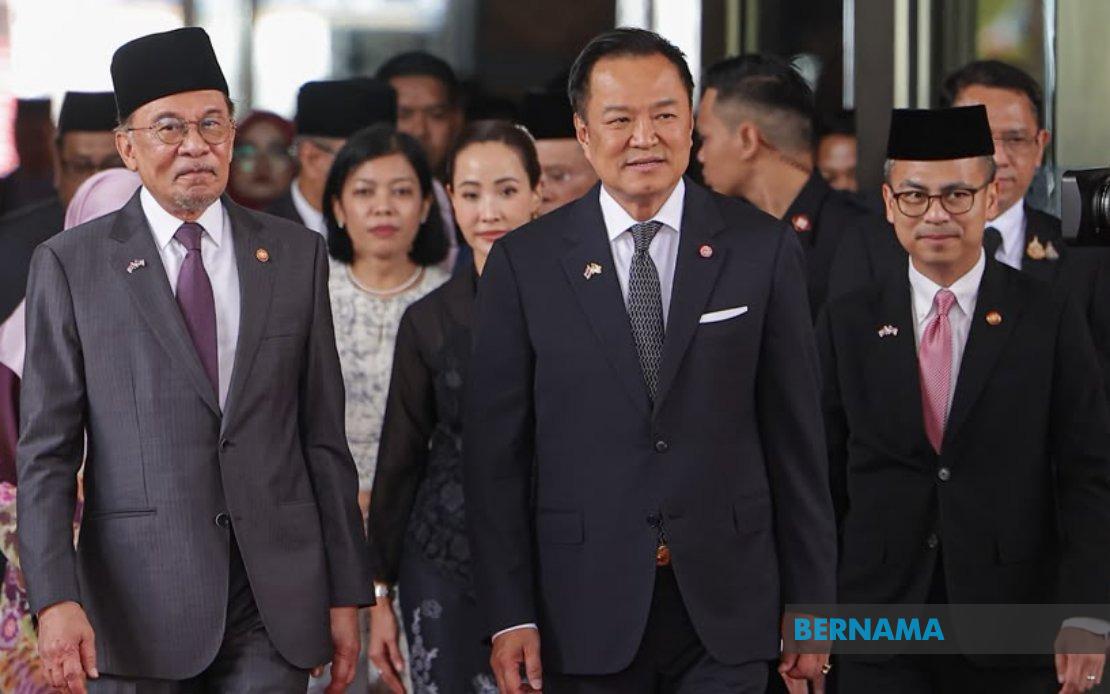
Prime Minister Datuk Seri Anwar Ibrahim hosted his Thai counterpart Anutin Charnvirakul for a high-level bilateral meeting at the Perdana Putra Complex in Putrajaya on July 9, marking a significant diplomatic engagement aimed at broadening the scope of Malaysia-Thailand partnership. The encounter between the two regional leaders provided an occasion to take stock of progress in bilateral relations and chart a course for enhanced collaboration across a spectrum of priority areas. Anutin, who commenced a two-day official visit to Malaysia at Anwar's invitation, touched down at Kuala Lumpur International Airport at 11.11 am, where he was formally received by the Malaysian Prime Minister at the Bunga Raya Complex before both delegations proceeded to the capital's administrative seat.
The substantive agenda encompassed strategic domains that reflect the interconnected nature of contemporary bilateral relations between the neighbouring Southeast Asian nations. Trade and investment featured prominently in the discussions, underscoring the economic interdependencies that bind Malaysia and Thailand. Border connectivity and security matters figured centrally, given the geographical proximity and shared challenges that both capitals confront in their respective neighbourhoods. The agricultural sector emerged as another critical dimension, with both countries recognising the mutual benefits of closer coordination in food production and supply chain resilience—a consideration of heightened importance across the broader region.
Tourism and cultural exchanges constituted a further pillar of the bilateral conversation, reflecting the sizeable flows of visitors and business activity that traverse the Malaysia-Thailand boundary annually. Educational cooperation and people-to-people contact initiatives were also tabled, as both nations view sustained human connection as a foundation for long-term diplomatic and social harmony. Beyond these bilateral concerns, Anwar and Anutin devoted attention to regional and international developments of shared strategic interest, particularly those unfolding within the framework of the Association of Southeast Asian Nations and the broader constellation of regional mechanisms that provide institutional architecture for dialogue.
The composition of both delegations underscored the whole-of-government approach that each side brought to the engagement. Malaysia fielded a substantial ministerial contingent, including Deputy Prime Minister and Minister of Energy Transition and Water Transformation Datuk Seri Fadillah Yusof, Foreign Minister Datuk Seri Mohamad Hasan, Transport Minister Anthony Loke, and Minister of Agriculture and Food Security Datuk Seri Mohamad Sabu. Additional Cabinet representation came from Home Minister Datuk Seri Saifuddin Nasution Ismail, Minister of Investment, Trade and Industry Datuk Seri Johari Abdul Ghani, Human Resources Minister Datuk Seri Ramanan Ramakrishnan, and Economy Minister Akmal Nasrullah Mohd Nasir. This breadth of ministerial involvement illustrated the cross-cutting nature of the bilateral agenda and Malaysia's commitment to advancing cooperation across multiple governmental portfolios.
Thailand's delegation mirrored this comprehensive approach, bringing multiple senior figures to the table. Deputy Prime Minister and Minister of Foreign Affairs Sihasak Phuangketkeow anchored the diplomatic dimension, while Deputy Prime Minister and Minister of Transport Phiphat Ratchakitprakarn brought expertise on infrastructure and connectivity matters. Deputy Prime Minister and Minister of Finance Ekniti Nitithanprapas represented Bangkok's economic and fiscal interests. Sectoral representation came from Minister of Tourism and Sports Surasak Phancharoenworakul, Minister of Defence Lt. General Adul Boonthumjaroen, Minister of Agriculture and Cooperatives Suriya Juangroongruangkit, and Minister of Labour Julapun Amornvivat. The presence of Thailand's deputy premiers alongside its sectoral ministers signalled the weight that Bangkok attached to the bilateral engagement.
The meeting agenda reflected longstanding priorities within the Malaysia-Thailand relationship, yet also responded to contemporary pressures shaping regional dynamics. Border security and the management of cross-boundary flows remain perennial concerns, particularly as both nations grapple with transnational crime, human trafficking, and irregular migration challenges. Trade and investment cooperation carries heightened salience given the economic slowdown that has affected regional growth trajectories and the imperative for both capitals to diversify and strengthen their commercial partnerships. Agricultural collaboration resonates with both countries' recognition that food security cannot be treated as an isolated national concern but requires coordinated regional approaches, especially in the context of climate change pressures and supply chain vulnerabilities.
A tangible outcome of the bilateral discussions materialised in the scheduled signing and exchange of a Memorandum of Understanding on agricultural cooperation. This formal instrument symbolised the concrete commitment that both governments intended to demonstrate regarding enhanced collaboration in the farming and food production sectors. The MOU framework typically establishes foundational principles for engagement, identifies specific areas of technical and commercial cooperation, and provides institutional mechanisms for ongoing coordination between relevant agencies and private sector actors. For Malaysia, such arrangements hold particular significance given the nation's substantial agricultural export interests and its reliance on regional markets for value-added food products.
The timing of Anutin's visit carried broader political resonance within ASEAN's evolving architecture. Thailand, as a long-standing participant in regional diplomacy and a nation with deep historical ties to Malaysia, occupies a distinctive position within the bloc. The bilateral meeting thus served not merely as an occasion for bilateral problem-solving but also as a venue for coordinating perspectives on regional developments and demonstrating the vitality of intra-ASEAN relations at a moment when external pressures and geopolitical competition from major powers increasingly shape the bloc's agenda.
Following the formal bilateral meeting, Anwar extended a reciprocal gesture of respect and hospitality by hosting an official luncheon in honour of Anutin and his accompanying delegation. This ceremonial dimension of diplomatic engagement, while sometimes overlooked in analyses focused on substantive outcomes, serves important functions in reinforcing personal relationships between leaders and demonstrating mutual regard. Such occasions often provide informal opportunities for the principals and their advisers to engage in candid discussion and explore avenues for cooperation that might not emerge within more formal settings.
The engagement between Malaysia and Thailand exemplifies the ongoing necessity for substantive bilateral diplomacy within ASEAN, even as multilateral frameworks and extra-regional partnerships command increasing attention. The range of issues addressed—from trade and investment through border management to agriculture and security—demonstrates the multifaceted character of modern interstate relations. For Malaysian observers and policymakers, the meeting illustrated Anwar's administration's commitment to maintaining robust diplomatic engagement with key regional partners, while positioning Malaysia as an active participant in shaping the regional agenda. Similarly, Thailand's investment in high-level bilateral engagement signals its continued emphasis on strengthening ties with its Malaysian neighbour, notwithstanding the complex history and occasional tensions that have periodically marked the relationship.

