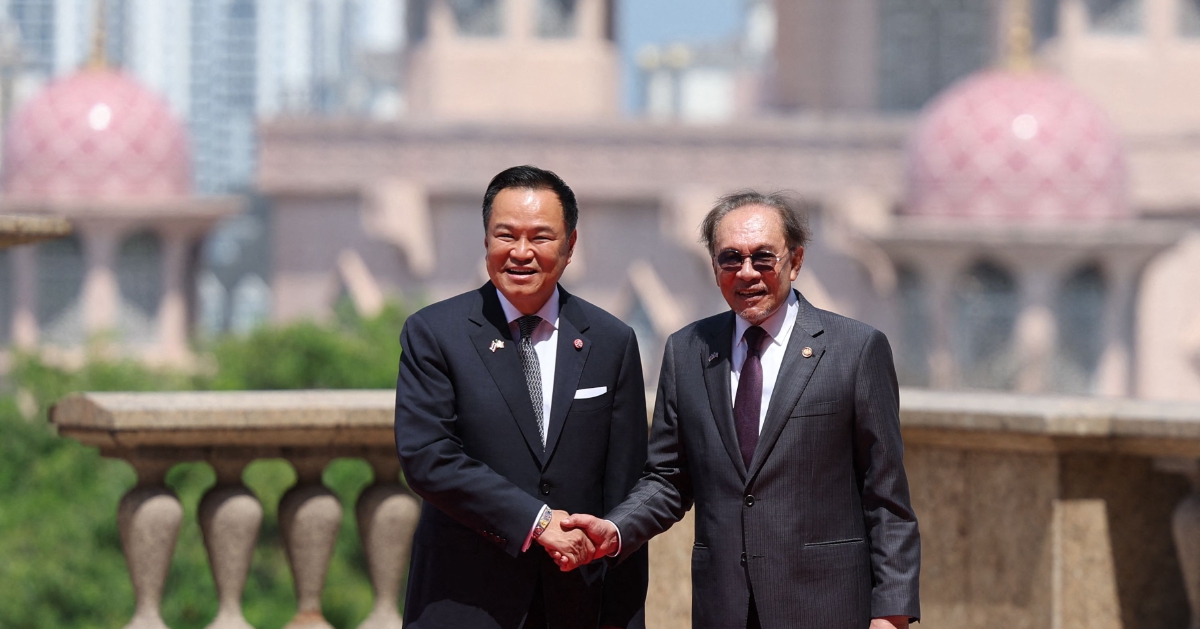
Malaysia and Thailand took a significant step toward deepening their partnership when Prime Minister Datuk Seri Anwar Ibrahim received his Thai counterpart Anutin Charnvirakul at the Perdana Putra Complex in Putrajaya today. The high-level engagement reflects both governments' commitment to revitalizing ties between two of Southeast Asia's major economies, a relationship that carries weight not only for the region's stability but for the wider Association of Southeast Asian Nations framework.
Bilateral meetings of this nature serve as important checkpoints in the diplomatic calendar, allowing leaders to take stock of existing cooperation arrangements and identify new areas for collaboration. The timing of this encounter underscores how Malaysia and Thailand continue to prioritize their relationship despite competing regional interests and domestic political demands. For Malaysian readers, such engagement matters because Thailand remains a crucial trading partner, neighbor, and fellow ASEAN member whose policies directly influence regional economic dynamics and security cooperation.
The agenda for today's talks likely encompassed trade and investment coordination, given that cross-border commerce between the two nations remains substantial. Malaysia and Thailand have long-standing economic linkages spanning manufacturing, agriculture, and tourism sectors. Enhanced cooperation in these fields could unlock mutual growth opportunities, particularly as both nations navigate post-pandemic recovery and seek to maintain competitiveness in an increasingly complex global marketplace.
Beyond commerce, security cooperation between Malaysia and Thailand represents another critical dimension of their bilateral relationship. The nations share maritime boundaries in the Andaman Sea and have common interests in combating transnational crime, including human trafficking, drug smuggling, and illegal fishing. Coordinated law enforcement and intelligence-sharing mechanisms have proven valuable in addressing these challenges, and today's meeting likely provided opportunity to review such arrangements and discuss enhanced regional security measures.
Tourism and people-to-people exchanges form the cultural backbone of Malaysia-Thailand relations. Millions of tourists traverse both nations annually, contributing significantly to local economies while fostering understanding between populations. Given the post-COVID recovery in travel sectors across Southeast Asia, both governments may have discussed strategies to facilitate tourism flows, streamline visa procedures, and develop joint destination marketing campaigns that benefit both economies.
Educational cooperation represents an often-overlooked yet vital channel for bilateral engagement. Malaysian and Thai universities maintain research partnerships and student exchange programmes that build human capital and foster long-term institutional relationships transcending political cycles. Today's talks may have included discussions on expanding academic collaboration, particularly in emerging fields like green technology and digital innovation where both nations have strategic interests.
The meeting also reflects broader ASEAN dynamics. Thailand holds significant influence within the regional bloc, and Malaysia's engagement with Bangkok carries implications for how both nations coordinate within ASEAN forums. Issues ranging from South China Sea maritime management to Myanmar's political situation require ongoing dialogue among member states. By strengthening bilateral foundations, Malaysia and Thailand position themselves to contribute more effectively to ASEAN consensus-building on complex regional matters.
For Malaysian businesses, improved government-to-government coordination can translate into tangible benefits through reduced regulatory barriers, streamlined investment procedures, and enhanced infrastructure connectivity. The Eastern Economic Corridor initiative and other regional development schemes depend partly on bilateral goodwill and aligned policies between neighboring countries. Malaysian exporters and investors operating in Thailand benefit when their government maintains strong diplomatic relations with Bangkok.
The Perdana Putra setting carries symbolic significance as Malaysia's primary diplomatic venue. Hosting the Thai premier there underscores the importance both sides place on this relationship. Such venues facilitate candid discussions away from public glare, enabling leaders to address potential friction points while exploring new collaborative frameworks. The bilateral format, as opposed to larger multilateral settings, allows for more detailed exploration of issues specific to Malaysia-Thailand relations.
Climate change and environmental management increasingly feature in bilateral agendas across Southeast Asia. Both Malaysia and Thailand face pressures from deforestation, transboundary haze, and rising sea levels. Coordinated environmental policies and joint conservation efforts benefit populations on both sides of the border. Today's discussions likely touched on these shared ecological challenges and opportunities for coordinated responses.
Digital economy cooperation represents an emerging frontier for bilateral relations. As both nations advance digital transformation agendas, opportunities exist for technology transfer, telecommunications cooperation, and fintech collaboration. Malaysian and Thai companies operating in digital sectors could benefit from supportive government frameworks developed through today's diplomatic engagement.
The broader context matters too: Malaysia-Thailand relations operate within a regional environment shaped by geopolitical tensions, trade competition, and varying strategic alignments. By maintaining robust bilateral communication channels and continuously refreshing their partnership framework, both nations demonstrate commitment to stability and mutual prosperity in an uncertain global landscape. Such engagement strengthens the entire Southeast Asian region by reinforcing predictability and cooperation among member states.

