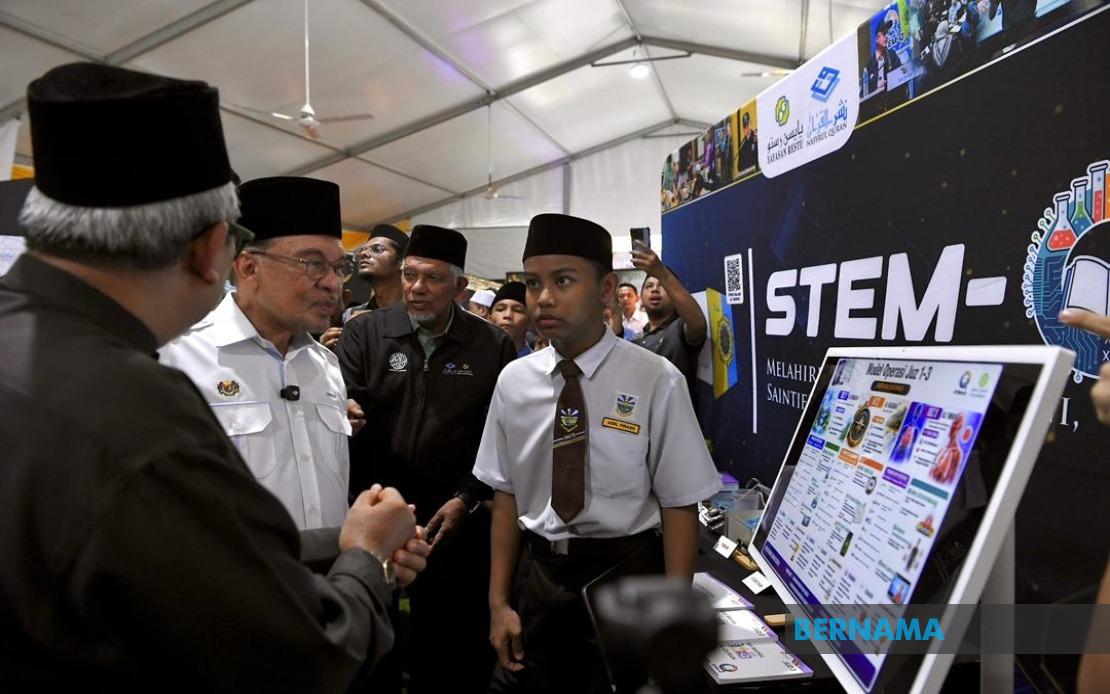
Prime Minister Datuk Seri Anwar Ibrahim has authorised an additional RM4.6 million in government funds this financial year to enhance basic infrastructure across 27 Islamic educational institutions throughout Penang. The announcement underscores the federal administration's renewed commitment to strengthening the physical facilities and operational capacity of religious education providers, reflecting a strategic shift in resource allocation to this sector. Speaking at the National Tadabbur Perdana and Maidah Wanita MADANI Permatang Pauh programmes held at Masjid Muhajirin in Butterworth, Anwar highlighted that this year's funding represents a substantial increase from the RM2.11 million distributed in the previous financial year, which had supported upgrading works at 11 Islamic institutions in the state.
The doubled allocation signals growing government investment in religious education infrastructure, an area that has historically received fragmented funding from multiple sources. The expansion from 11 to 27 beneficiary institutions indicates either improved budgeting capacity, heightened political prioritisation of Islamic education, or both. By extending support to more institutions, the federal government appears intent on achieving more equitable distribution of development funds across Penang's diverse Islamic educational ecosystem. For Malaysian policymakers and administrators overseeing education systems in other states, this approach offers a potential blueprint for scaling support to religious institutions within tighter fiscal constraints.
Anwar, who concurrently holds the Finance Ministry portfolio, outlined the specific categories of infrastructure improvements the allocation would cover. The funds will be directed toward essential renovation and construction projects including structural reinforcements such as walls and fences, upgrades to madrasah facilities, improvements to school buildings, construction of new kindergarten structures, and development of tahfiz academy spaces. These categories reflect recognition of the breadth of Islamic educational provision in Malaysia, from early-childhood religious learning through to specialised Quranic memorisation programmes. The diversity of eligible projects suggests the government recognises that Islamic education in Malaysia encompasses multiple institutional forms and target age groups, each with distinct infrastructure requirements.
Beyond the immediate fiscal commitment, Anwar's remarks positioned religious education as a cornerstone of the broader national development agenda. He articulated that government strategy would persistently prioritise the operational and facility needs of both private and public religious schools, framing strengthened facilities as integral to consolidating Malaysia's religious education capacity. This rhetorical emphasis carries implications for budget cycles beyond the current year, signalling that religious institutions should anticipate continued federal attention and potentially escalating allocations. For Southeast Asian governments similarly grappling with how to support religious education, the Malaysian approach demonstrates one pathway: direct infrastructure funding channelled through ministerial discretion rather than competitive bidding or community-sourced financing models.
A distinctive dimension of Anwar's intervention involves his integration of technological modernisation within religious education frameworks. The Prime Minister specifically advocated for Islamic institutions to embrace artificial intelligence and allied digital tools in pedagogical contexts, particularly within Quranic studies and broader Islamic knowledge domains. This represents a contemporary policy challenge: how to harness computational advancement without compromising spiritual and moral dimensions of religious learning. Anwar's positioning reflects awareness that Islamic education in Malaysia must compete for student engagement and institutional credibility in an increasingly digitised information environment. Malaysian institutions that successfully integrate AI into Quranic studies could establish regional leadership, creating exportable pedagogical models for other Muslim-majority nations.
Crucially, Anwar imposed an ethical boundary around technological adoption. He emphasised that artificial intelligence implementations must be fundamentally grounded in moral and value-based frameworks, rejecting utilitarian approaches that treat technology as morally neutral. His formulation—that AI must possess values and be rooted in morality rather than merely developing capability and understanding—addresses a substantive tension in contemporary educational policy. For Malaysian Islamic institutions, this caveat establishes that technological investment must remain subordinate to doctrinal and ethical principles. The statement implicitly critiques secular approaches to technology integration that prioritise instrumental skills development without corresponding spiritual formation. This moral guardrail may prove challenging to operationalise in practice, particularly as international AI providers embed specific value systems within their platforms.
Anwar's advocacy for community-driven religious programming extends the policy framework beyond physical infrastructure and technological integration. He encouraged the broader public to utilise existing civic freedoms to initiate and sustain religious programmes, specifically Quranic study circles, tadabbur (deep Quranic reflection) sessions, and organised Islamic lectures. This approach distributes responsibility for religious education and engagement across civil society rather than concentrating it entirely within formal institutional channels or government provision. For Malaysian communities, the exhortation creates space for grassroots religious mobilisation while remaining within officially endorsed parameters. The emphasis on continuous, community-based religious learning reflects recognition that formal institutional structures alone cannot sustain population-wide Islamic understanding.
The government's incremental approach to funding expansion warrants scrutiny regarding fiscal sustainability and opportunity costs. Doubling allocations year-on-year may reflect genuine budget expansion or reallocation from other sectors. Malaysian taxpayers and opposition parliamentarians may question whether RM4.6 million allocated to religious infrastructure upgrades represents optimal resource distribution given competing demands in public health, general education, or infrastructure. Regional comparisons are instructive: neighbouring Singapore and Thailand allocate significantly smaller proportions of public budgets to religious education institutions, instead treating such facilities as primarily communal or private sector responsibilities. Malaysia's model of direct government funding for Islamic educational infrastructure reflects particular constitutional arrangements and political calculations but remains subject to fiscal pressures affecting all government expenditure.
The timing and location of Anwar's announcement carry political significance. Penang, governed by the opposition Democratic Action Party with a substantial ethnic Chinese and Indian population, has historically experienced tension over religious versus secular developmental priorities. By announcing substantial Islamic education funding in Butterworth, a constituency within Penang with significant Malay-Muslim demographics, Anwar's federal government signals its capacity to deliver resources irrespective of state-level political alignment. This approach to infrastructure investment across state boundaries reflects centralised fiscal control and can serve as a political tool for federal parties seeking to build support within opposition-governed territories. For analysts tracking Malaysian federal-state relations, such announcements indicate how development allocations remain leveraged for political advantage.
Looking forward, the sustainability and scalability of this funding trajectory remain uncertain. Current economic conditions in Malaysia, including moderating growth and fiscal consolidation pressures, may constrain future year-on-year increases. The government would need to demonstrate tangible outcomes from current allocations—improved educational metrics, enhanced student retention, measurable facility improvements—to justify continued expansion. Regional Islamic education networks, including institutions in Brunei, Indonesia, and Thailand, may seek to benchmark their funding levels against Malaysia's model. Additionally, as these upgraded facilities come online, corresponding investments in teacher training, curriculum development, and quality assurance mechanisms will likely become necessary to maximise returns on infrastructure investment. The RM4.6 million allocation represents an important but potentially insufficient step toward comprehensive strengthening of Islamic education infrastructure in Penang and beyond.

