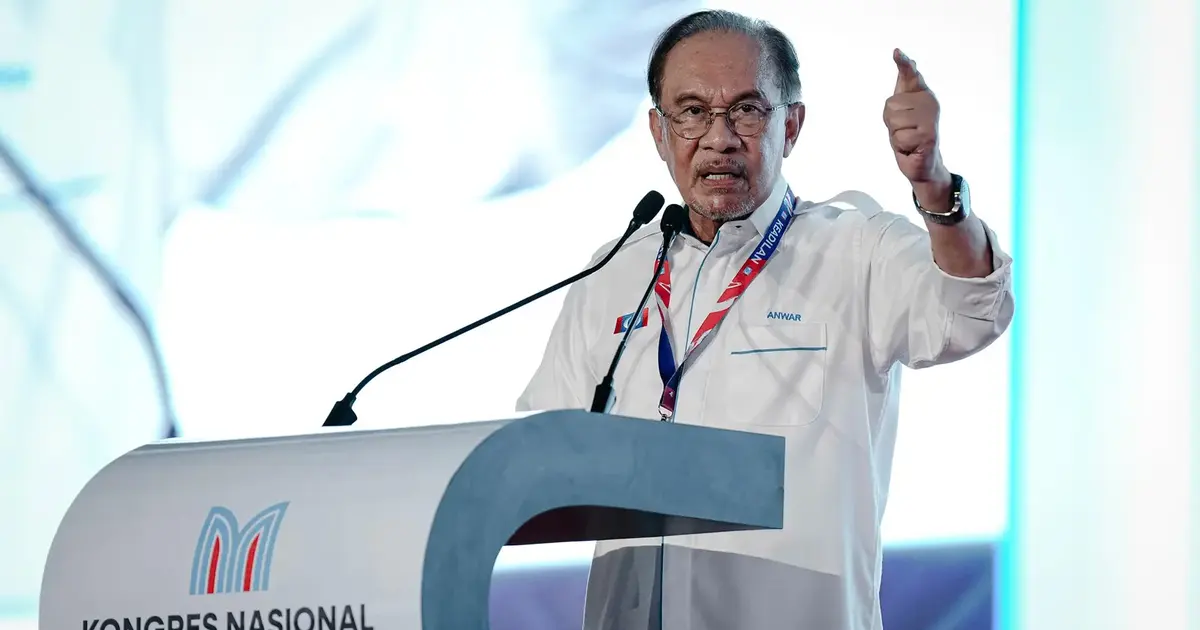
Prime Minister Anwar Ibrahim has unveiled a supplementary allocation of RM1 million directed towards each parliamentary constituency across Malaysia, a move designed to address persistent accusations that his government has been selectively withholding development resources from regions governed by the political opposition.
The announcement carries significant implications for Malaysia's governance structure and federal-state relations, particularly at a time when tensions between the central government and opposition-held administrations remain pronounced. Since assuming office, Anwar's administration has faced repeated criticisms from opposition quarters regarding the distribution of development funds, with several state governments controlled by parties outside the ruling coalition claiming they have received reduced allocations compared to coalition-aligned states. This new initiative appears calibrated to deflect such contentions by ensuring a uniform baseline of federal support reaches every parliamentary constituency, regardless of the political complexion of the surrounding state government.
The RM1 million per constituency translates into substantial additional resources flowing into the system, given Malaysia's 222 parliamentary constituencies. This distributed approach represents a departure from traditional centralised development frameworks where state governments typically served as the primary intermediaries for federal disbursements. By routing funds directly through parliamentary divisions, the federal government essentially establishes parallel channels for development spending that can circumvent state-level administration entirely, a structural arrangement that carries both practical and political dimensions worth examining.
Anwar's explicit refutation of withholding allegations suggests the matter has become a significant political flashpoint affecting the government's credibility and public perception. Opposition parties have leveraged such claims to mobilise voter sentiment in their stronghold states, arguing that supporters are being economically penalised for their political choices. The prime minister's decision to make this announcement publicly underscores his recognition that the narrative surrounding equitable fund distribution carries electoral consequences and shapes public confidence in his administration's commitment to fair governance.
The timing of this allocation warrants consideration within Malaysia's broader political calendar and context. As the government faces ongoing challenges in managing a diverse coalition with divergent interests, demonstrating tangible commitment to universal development support serves multiple objectives simultaneously: it addresses opposition arguments whilst reinforcing the government's message of inclusive development and financial stewardship across all regions regardless of political affiliation.
From a budgetary perspective, this initiative necessitated identification of additional funding sources or reallocation within existing expenditure frameworks. The manner in which the government secured these resources reveals something about fiscal priorities and available fiscal space within the federal budget. Whether these funds represent genuinely new allocations or reordering of existing commitments bears upon assessments of whether this constitutes a genuine expansion of development spending or represents repackaging of previously committed resources.
The constituency-based distribution method also reflects evolving thinking about how federal funds can most effectively reach communities at the grassroots level. Parliamentary constituencies represent the primary electoral division through which Malaysian voters directly connect with the national political system. By allocating resources at this granular level, the government theoretically enables more targeted, community-responsive development initiatives than might emerge from broader state-level allocations managed by administrations potentially pursuing different priorities.
However, this approach simultaneously raises questions about coordination between federal parliamentary representatives and state governments responsible for implementing longer-term development strategies and infrastructure planning. Parallel funding channels could potentially generate inefficiencies or duplicative efforts if federal parliamentary allocations proceed without adequate synchronisation with state-level development blueprints. Effective utilisation of these resources depends heavily upon cooperation and communication between different tiers of governance that do not always align perfectly in opposition-led states.
The announcement also carries implications for the sustainability of such commitments over the medium term. Annual allocations of this magnitude represent ongoing fiscal obligations that must be maintained for the programme to meaningfully affect development trajectories in constituencies. Economic fluctuations, changing revenue collections, or shifting budget priorities could threaten the continuity and credibility of these allocations if maintained inconsistently across electoral cycles.
For Malaysian states, particularly those governed by opposition coalitions, the initiative presents complex considerations. While additional federal resources are universally welcome, the circumventing of state administrative channels for substantial portions of development spending effectively reduces state governments' influence over development priorities and community engagement within their own territories. This structural shift subtly reshapes centre-state dynamics in ways that warrant careful monitoring by constitutional observers and federalism scholars.
Regionally, Malaysia's approach to managing centre-state relations amid significant political polarisation offers instructive lessons for other Southeast Asian democracies navigating similar challenges of maintaining development equity and institutional functionality across divided political landscapes. How effectively this initiative resolves underlying tensions regarding resource distribution and governance fairness will likely influence broader discussions about federalism, political inclusion, and development strategy across the region.
The success of this programme ultimately depends upon implementation fidelity, transparent criteria for fund allocation at the constituency level, and demonstrated tangible improvements in community development and infrastructure. Public perception will be shaped not merely by the announcement itself but by visible outcomes and whether communities across all constituencies experience substantive benefits regardless of their political orientation or the political composition of their surrounding state government.

