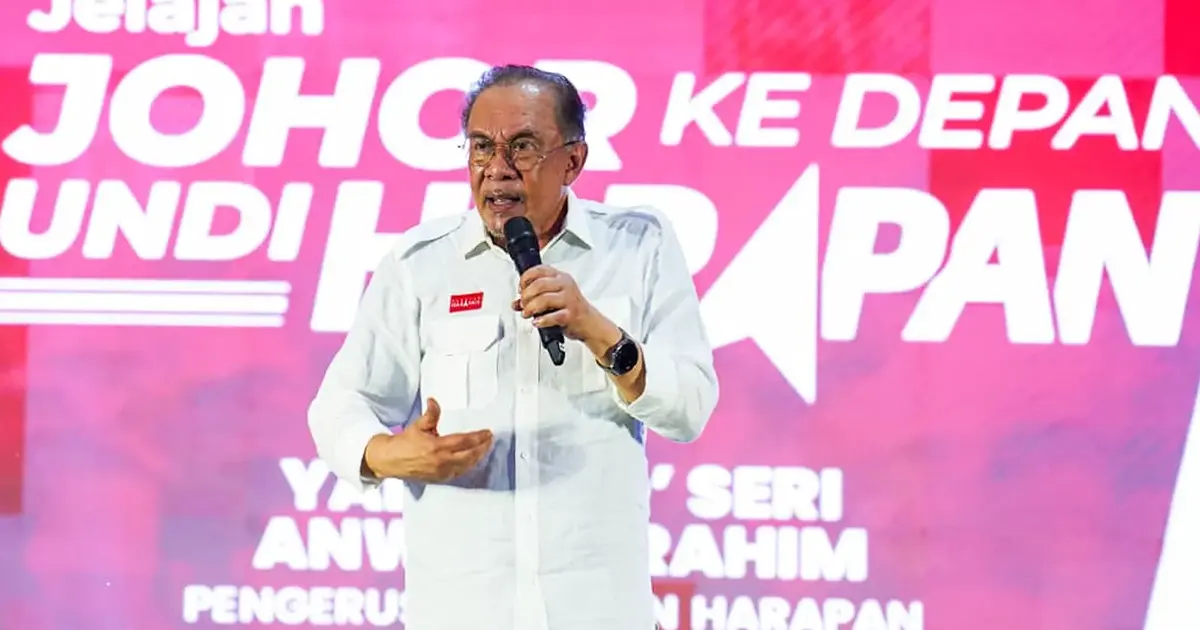
Prime Minister Anwar Ibrahim has pushed back against suggestions that the federal government treats Kedah differently because of its Islamic Party affiliation, asserting that developmental support flows to all states regardless of their political colour. Addressing tensions that have emerged in the relationship between Putrajaya and the northern state, Anwar emphasised that equitable distribution of resources forms a cornerstone of his administration's governance philosophy.
The remarks signal Anwar's intent to demonstrate that Malaysia's federalised system operates without partisan bias in allocating development funds, a position that carries particular weight given the delicate political balance surrounding PAS-led administrations in several states. The federal government's approach to state-level relations has become increasingly scrutinised as the country navigates a complex coalition landscape where multiple parties govern different regions with varying degrees of alignment to the central government.
Kedah, under the leadership of Menteri Besar Sanusi Md Nor, has represented one of the key flashpoints in these discussions. The state's governance under PAS has occasionally collided with federal initiatives, prompting questions about whether resource allocation reflects political considerations. Anwar's assertion that the federal government actively supports Kedah's development challenges any perception of deliberate neglect or discrimination based on the state's political composition.
The Prime Minister's comments underscore a broader commitment to transcend partisan divisions when administering national resources. Malaysian federalism inherently requires coordination between federal and state governments that may operate under different political umbrellas, and successful governance depends on separating development imperatives from electoral calculations. Anwar's statement positions his government as committed to this principle, though the reality of centre-state relations often proves more complicated than public declarations suggest.
From a regional perspective, how federal governments treat opposition-controlled territories carries implications for political stability and democratic health. When resources are perceived as weaponised against states governed by rival parties, it erodes trust in institutional fairness and can deepen political polarisation. Conversely, demonstrating equitable treatment across party lines helps legitimise centralised power structures and encourages cooperation between different levels of government, ultimately benefiting the broader economy and citizenry.
Kedah's position as a significant northern state makes its development trajectory particularly important for the region's overall progress. The state serves as an economic bridge within the northern corridor, encompassing agricultural, manufacturing, and tourism sectors that contribute meaningfully to national economic activity. Any perception of federal neglect could potentially undermine investment confidence and local development momentum, with cascading effects across the broader northern zone.
The underlying tension appears to reflect broader questions about resource distribution in Malaysia's multi-party federalism. While Anwar emphasises non-discrimination, the historical pattern of Malaysian politics has sometimes seen unequal treatment of opposition-controlled states, whether through budgetary allocations, infrastructure projects, or bureaucratic responsiveness. These past patterns create a climate of suspicion that requires consistent demonstration of fair dealing rather than mere assertion.
Sanusi Md Nor's apparent scepticism about federal support, implied in Anwar's defensive posture, hints at ongoing friction within the central-state relationship. Whether this reflects genuine concerns about resource flows or political positioning for domestic consumption within Kedah remains unclear, but the exchange highlights how governance operates amid competing narratives about fairness and support. The Menteri Besar's questioning implicitly challenges Anwar to substantiate claims of equitable treatment through tangible evidence.
The federal system's functionality depends significantly on this ability to transcend partisan loyalty when allocating public resources. States with populations exceeding three million, like Kedah, possess sufficient political weight and economic importance that their grievances, whether legitimate or perceived, can influence broader political dynamics. How Anwar's administration responds to such concerns will likely shape perceptions of federal fairness during the remainder of his tenure.
For Malaysian readers and policymakers, this dispute carries practical implications beyond political theatre. Infrastructure development, educational funding, healthcare provision, and economic support mechanisms all depend on federal-state coordination. When suspicion clouds these relationships, administrative efficiency suffers and communities in disputed territories may find themselves caught between competing political interests rather than receiving uninterrupted services.
Moving forward, merely stating commitment to equitable treatment appears insufficient to address underlying scepticism. Transparent mechanisms for resource allocation, clear criteria for project selection, and documented evidence of support reaching all states regardless of political composition would provide more robust reassurance than rhetorical assertions. The Prime Minister's confidence in his government's approach must be tested against measurable outcomes that demonstrate genuine equity in federal support.
The broader lesson from this exchange extends to Malaysia's ongoing journey toward mature federalism. A truly developed system would see resource allocation debates focused primarily on technical merit, need assessment, and strategic priorities rather than on political affiliation. Whether current tensions between Anwar's federal government and Sanusi's Kedah administration represent temporary friction or symptomatic of systemic imbalances will become clearer as specific development projects advance or stall in the coming months.

