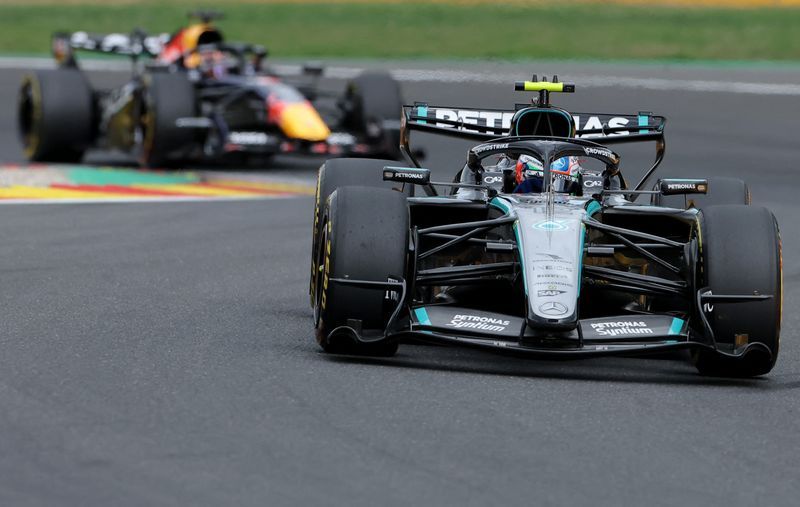
Kimi Antonelli's commanding performance at Spa-Francorchamps on Sunday has reshuffled the dynamics of this season's Formula One championship battle, with the Mercedes driver now holding a formidable 45-point advantage over Ferrari's Lewis Hamilton following his sixth victory in just ten races. The result proved devastating for his closest rival before the race, teammate George Russell, whose championship hopes took a tangible blow after a first-lap collision forced him into the gravel and out of contention in one of the most dramatic opening sequences of the Belgian Grand Prix.
Russell's retirement marked a striking reversal of fortune for the Briton, who had entered the race as the leading challenger to Antonelli's dominance. The incident, which occurred as Russell attempted to recover ground lost during the getaway, unfolded during a chaotic opening lap that saw multiple drivers jostling for position on one of Formula One's most demanding circuits. The collision not only removed a significant points-scoring opportunity for Russell but also highlighted the intensifying pressure within Mercedes as both drivers battle for supremacy in what has become a two-car contest for the championship.
Ferrari's Charles Leclerc secured the runner-up position, crossing the line 1.952 seconds adrift of Antonelli after executing a strategically astute pit stop during the deployment of a virtual safety car. The Monegasque driver's second-place finish demonstrates Ferrari's capacity to capitalize on race-day opportunities, though the gap to the dominant Mercedes outfit remains substantial. Leclerc's performance underscored the importance of tactical acumen in modern Formula One, where split-second decisions regarding pit timing can determine the difference between victory and the podium.
Max Verstappen's third-place finish for Red Bull secured the team's 300th Formula One podium, a milestone that reflects the Austrian team's sustained competitiveness throughout the sport's recent history. However, Verstappen's performance came at a time when Red Bull's championship credentials appear to have weakened relative to the resurgent Mercedes team, which continues to assert technological superiority across much of the grid. The podium, while respectable, underscore the challenge facing Red Bull in closing the gap to a Mercedes operation that has clearly found significant performance gains.
Lewis Hamilton's fourth-place finish carried the lingering cloud of potential further penalties, as stewards investigated an unsafe pit release alongside a five-second penalty already applied for his collision with Russell. The incident, which Hamilton himself triggered through contact with his teammate, placed him under scrutiny that could have relegated him further down the final classification. Hamilton's result came despite these complications, yet the situation illustrated the increasingly tight margins between success and failure at the championship's upper echelons.
Antonelli's achievement this season represents a remarkable trajectory for the 19-year-old Italian, whose six victories from ten rounds establish him as the dominant force in contemporary Formula One racing. The Mercedes driver's consistency has been equally impressive, suggesting that his championship challenge is built on genuine pace advantage rather than fortune. His latest victory, secured from pole position—continuing Mercedes' unblemished record of qualifying dominance this season—demonstrates a level of control that competitors have struggled to match.
The strategic landscape of the championship has become increasingly favorable to Antonelli following Sunday's results. Russell's significant setback at Spa-Francorchamps means the gap between the two Mercedes drivers has expanded to 50 points, effectively placing Russell outside realistic contention for the title barring a dramatic reversal. This development transforms the championship narrative from a Mercedes internal battle into something resembling a coronation, assuming Antonelli maintains his current trajectory through the remaining races.
Beyond the podium finishers, the midfield battle continued to provide competitive entertainment, with Oscar Piastri's fifth-place result for McLaren maintaining his team's push for constructors' championship points. Isack Hadjar's remarkable sixth-place finish for Red Bull, achieved despite starting from the back of the grid, demonstrated the unpredictable nature of racing at Belgium's undulating circuit where fuel consumption and tire management become critical variables. Lando Norris, the defending champion, recovered to seventh position despite the substantial handicap of a ten-place grid penalty resulting from prior penalties, suggesting that McLaren retains competitive pace despite a challenging afternoon.
The distributed point-scoring throughout the race, with Gabriel Bortoleto adding to Audi's tally in eighth, Arvid Lindblad scoring for Racing Bulls in ninth, and Franco Colapinto earning points for Alpine in tenth, illustrated how mid-grid machinery continues to compete effectively within defined parameters. These results carry implications for the constructors' championship, where various teams jostle for supremacy and significant financial benefits.
Antonelli's own reflection on his victory acknowledged both the tactical elements that conspired in his favor and the performance required to capitalize when circumstances aligned. The Mercedes driver's recognition that fortune had played a role—referencing the virtual safety car deployment and resulting pit stop strategy—suggested a measured perspective that acknowledged both skill and circumstance in championship racing. His comment about momentum and the necessity of converting opportunities reflected the psychological dimension of sustained success, where confidence becomes a self-reinforcing asset.
For Malaysian and Southeast Asian followers of Formula One, Antonelli's emergence as the championship's dominant figure represents a significant narrative shift from earlier seasons. His Italian heritage and youth appeal create fresh storylines for broadcasters and audiences across the region, where motorsport continues to command substantial viewership. The championship's trajectory toward a clear outcome may influence fan engagement patterns through the remaining calendar, potentially affecting viewing figures and sponsor interest across Asian markets.
The implications for Mercedes' championship ambitions appear increasingly positive, having established such a commanding points advantage that even moderate performance levels could secure the constructors' title. Hamilton's role as a secondary force within his own team, rather than as a championship contender, marks a significant departure from his previous status and raises questions about the longer-term dynamics within the Mercedes organization. As the season progresses toward its conclusion, Antonelli's path to championship glory appears distinctly clearer following his dominant display at Spa-Francorchamps.

