The moment Suwanna Saeteaw recognised her sister's mobile phone among the salvaged belongings recovered from the Bangkok bar inferno, her worst fears crystallised. What had been a fragile thread of hope—that her 25-year-old sibling Jarawee Sermsiri had somehow escaped the blaze—snapped in an instant. The phone, displayed on a television news broadcast from the scene of the Rong Beer Na Lat Phrao bar and restaurant fire, was being held by a rescue worker. When Suwanna made the call herself on the evening of July 13, the person on the other end confirmed what she already knew in her heart: the phone had been recovered from the wreckage, not from a survivor seeking refuge in a hospital bed. Across the sprawling Thai capital, scenes like this repeated themselves as families embarked on an agonising vigil, moving between hospitals, forensic centres and shelters, searching lists of survivors whilst steeling themselves for the possibility that their relatives might be numbered among the unidentified dead.
The fire that tore through the single-storey concrete structure just before midnight on July 12 claimed 28 lives and injured more than 70 others, marking Thailand's deadliest fire in nearly two decades. The last tragedy of comparable magnitude occurred in 2009, when the Santika club fire in Bangkok erupted during New Year celebrations, killing 67 people and leaving more than 200 injured. That disaster, which shocked the nation and prompted promises of reform, had faded from public memory—and, it appears, from the consciousness of those responsible for enforcing building safety codes. The Rong Beer Na Lat Phrao fire represents not merely a statistical tragedy but a systemic failure, a grim reminder that despite past warnings, the lessons learned in blood and ash have not been adequately translated into structural and regulatory change.
Suwanna's ordeal exemplifies the emotional devastation unfolding across Bangkok. Holding back tears as she spoke with journalists, she described the uncertainty that accompanies the waiting period. Authorities had collected DNA samples from recovered remains, she explained, but the process of identification would require approximately three days to complete—an eternity for families haunted by the question of whether their loved ones are alive or dead. "I'm heartbroken right now, but I'm still hoping that my sister's alive and receiving treatment at one of the hospitals," she told The Straits Times, even as the physical evidence suggested a darker conclusion. The temporal chasm between the fire and the confirmation of identity is a uniquely cruel aspect of such disasters, extending grief and uncertainty in equal measure.
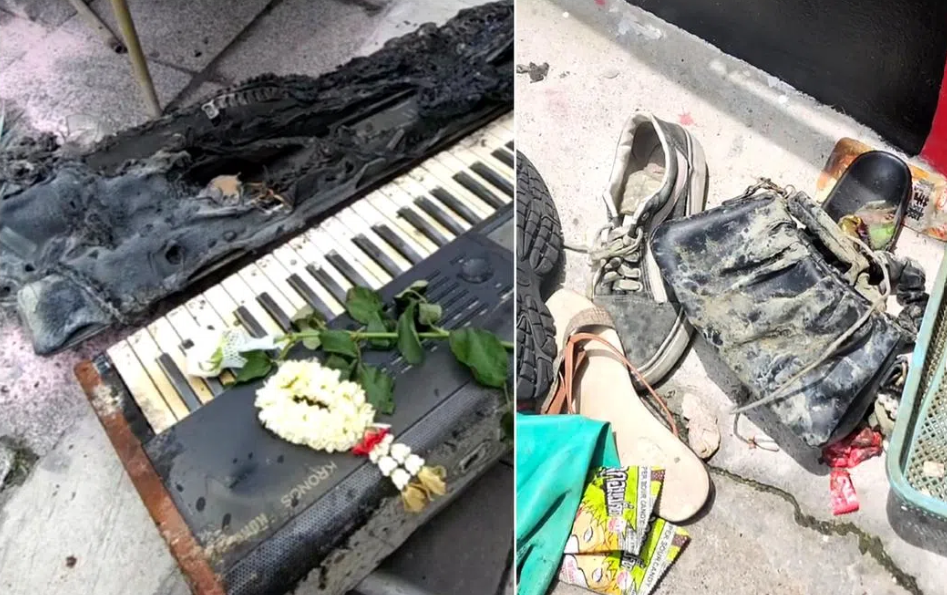
The scene outside the charred venue provided a stark visual documentation of the panic that had seized occupants as flames and dense black smoke engulfed the building. Abandoned shoes, handbags and personal effects lay scattered across the ground where people had fled in terror, leaving behind fragments of their evening in their desperate scramble for safety. On July 13, as investigators sifted through the wreckage, a clearer picture of the catastrophe began to emerge—one that pointed less to accident and more to a convergence of negligence, design deficiency and possible regulatory malfeasance. Bangkok Governor Chadchart Sittipunt outlined the preliminary focus of the investigation: whether emergency exits had been blocked or rendered inaccessible, whether combustible materials in the ceiling had accelerated the fire's spread, and why the building's occupants had been unable to evacuate with sufficient speed.
The structural factors that contributed to the death toll appear increasingly apparent from preliminary investigations. Police Chief Kitrat Panphet revealed a particularly telling detail: the majority of victims were discovered in the toilet areas, indicating that as the fire spread and panic ensued, people had fled to what they believed were secondary exits—only to find themselves trapped in dead ends. "When the fire broke out, they panicked. There were no lights," Kitrat told reporters, suggesting that the chaos was compounded by inadequate emergency lighting systems. More damning still was the discovery that one of the bar's exit doors was obstructed by a shelf, effectively creating a bottleneck that allowed only a single person to pass through at a time. In a situation where hundreds of patrons needed to evacuate simultaneously, such a narrow passage became a death trap rather than a lifeline. Investigators are examining the electrical wiring in the 50-year-old building and whether decorative elements may have contributed to the rapid spread of flames and smoke.
Structural engineer Amorn Pimanmas, president of the Thailand Structural Engineers Association, provided expert analysis of the specific conditions that made the venue particularly lethal. The bar's low ceiling, combined with decorations made of polyurethane foam—a highly combustible material—created the perfect conditions for toxic smoke to accumulate and spread rapidly. In such an enclosed environment with insufficient vertical space, smoke concentrates quickly, reducing visibility to near-zero and filling the lungs of trapped occupants within minutes. "It's not like we don't have the law. It's the problem of how the law can be strictly enforced," Amorn observed pointedly, articulating a critical distinction that troubles safety advocates throughout Southeast Asia. Thailand possesses fire safety regulations on paper, but their implementation and enforcement remain inconsistent and often corrupted by indifference or financial incentive.
The troubling detail that the bar had passed an inspection just three months prior, in April, raises uncomfortable questions about the rigour and independence of safety compliance procedures. Governor Chadchart noted that approximately 300 customers were present when the fire started, though the venue typically accommodated between 600 and 700 patrons on a normal evening. Whether this represented lower-than-usual occupancy remains unclear, but what is certain is that even the lower number exceeded safe evacuation capacity given the building's physical constraints. A restaurant waiter named Chaiyo Piwisol, who had visited the establishment three times before the fire, offered an observer's perspective on the venue's inherent dangers. He described it as consistently cramped and crowded, with narrow doorways that had always made him uneasy. "The place had a lot of decorations, lights and other things hanging from the ceiling. I think there should have been stronger safety measures," he said—a comment that, in retrospect, reads as a prescient warning.
Prime Minister Anutin Charnvirakul visited the scene and acknowledged that preliminary findings suggested the existence of "blind spots" without visible fire escape routes—architectural deficiencies that represent fundamental violations of fire safety protocol. His statement carried a dual message: an appeal for public patience whilst the investigation proceeded, coupled with a stern warning that "there will be no leniency if any laws have been broken." This rhetorical stance, whilst politically necessary, will be tested by the outcomes of the investigation. Thailand's track record suggests that accountability for such disasters is inconsistently pursued, with implementation depending heavily on political pressure and media scrutiny. Without sustained attention and genuine criminal prosecution where warranted, such warnings risk becoming mere theatre.
The personal toll on survivors has been equally devastating. Panathaporn Thongyord, a 19-year-old who managed to escape, lost a close friend in the fire—someone she had known since childhood and with whom she had shared countless intimate moments of growing up together. The last exchange between them crystallises the horror of the event: her friend's selfless insistence that Panathaporn flee and not attempt a rescue. "Everything happened so fast... We grew up together, slept over at each other's houses, ate together. I just want justice for my friend. I want to know why that back door couldn't be opened," she said, her pain channelled into a demand for accountability. Such questions, multiplied across dozens of families, form the human foundation of what must become a genuine reckoning with Thailand's approach to venue safety.
The fire has revived long-standing concerns about Thailand's enforcement of fire safety standards across the hospitality and entertainment sectors. A pattern of deadly nightclub and bar fires over the years suggests that lessons are learned and forgotten in cycles, with reform initiatives gaining traction only in the immediate aftermath of tragedies before gradually eroding. The Santika club fire of 2009 prompted promises of stricter inspections and penalties, yet the Rong Beer Na Lat Phrao fire indicates that such commitments have not been institutionalised into sustained practice. Without comprehensive reforms addressing both the structural inadequacies of older buildings and the systematic corruption or negligence that allows unsafe venues to operate, Thailand will remain vulnerable to further tragedies of this magnitude. The families searching for their loved ones, the survivors grappling with survivor's guilt, and the friends of the deceased all represent the human cost of a failure not of law itself but of the political will to enforce it consistently and fairly.
The investigation now proceeding will determine specific causes and assign responsibility, yet the broader question facing Thailand is whether this moment will catalyse genuine systemic change or fade into the background as the news cycle moves forward. Other Southeast Asian nations, including Malaysia, would be wise to examine Thailand's experience not as a distant tragedy but as a cautionary tale about the dangers of allowing commercial interests to override public safety standards. The gap between regulations on paper and their implementation in practice remains one of the region's most persistent vulnerabilities, particularly in sectors where enforcement requires sustained effort and political backbone. Until such gaps are addressed comprehensively, the risk of future tragedies—whether in Bangkok, Kuala Lumpur or elsewhere in the region—remains all too real.

