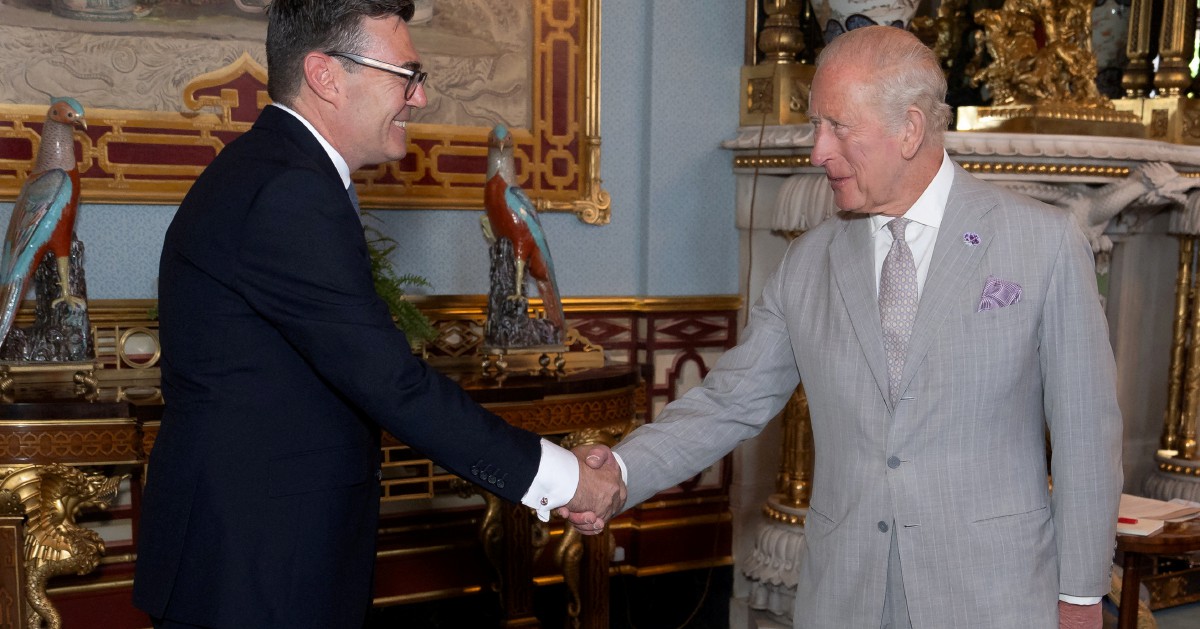
Andy Burnham officially took office as United Kingdom Prime Minister on Monday after conducting the customary audience with King Charles III at Buckingham Palace. The appointment marks a significant transition in British leadership, with Burnham now responsible for leading the government and charting its course through the coming months and years. His accession to the country's highest executive office came through the formal constitutional process that sees the monarch invite the leader of the party or coalition commanding parliamentary confidence to form a government.
The change in leadership represents a notable shift in political direction at Westminster. Burnham's predecessor, Keir Starmer, handed over the reins of government following what observers viewed as a critical juncture in his administration. The transition was executed through established constitutional protocols, ensuring continuity in governance even as leadership and policy priorities may shift. This orderly transfer of power underscores the stability embedded within British parliamentary democracy, where changes in administration occur within a structured legal framework.
Burnham brings considerable experience in public office to his new role. Before his elevation to Prime Minister, he held senior positions within the Labour government and served as Mayor of Greater Manchester, where he built a reputation for championing regional devolution and local economic development. His background in regional leadership suggests he may bring particular attention to levelling-up initiatives and addressing disparities between different parts of the United Kingdom. His tenure as mayor exposed him to the complexities of coordinating policy across multiple authority levels, experience that could prove valuable in navigating the intricate terrain of national governance.
The timing of this transition occurs within a broader context of British political evolution. Labour returned to power in recent elections after a prolonged period of Conservative governance, and the party now faces the practical challenge of implementing its manifesto commitments while managing economic pressures and public service demands. Burnham's appointment signals Labour's decision to adjust its leadership approach, potentially indicating a desire to emphasise different priorities or communication strategies than those pursued under Starmer's stewardship.
For Malaysian observers, the British political transition offers instructive parallels and contrasts with Westminster-influenced systems closer to home. Like Malaysia, the United Kingdom operates under a constitutional monarchy where the sovereign plays a ceremonial role in appointing the Prime Minister, though in practice choosing the individual who commands parliamentary confidence. Understanding how established democracies manage leadership transitions can provide useful perspective on governance stability and democratic processes in the region. The smooth execution of this changeover, despite its potential for disruption, demonstrates how constitutional conventions can facilitate peaceful transfers of power even during periods of political change.
Burnham's incoming government faces a substantial legislative and policy agenda. The new Prime Minister is expected to articulate his vision for the nation's economic direction, approach to public services including the National Health Service, and Britain's role in international affairs during the coming weeks. His first speeches and policy announcements will set the tone for his administration and signal which challenges he considers most pressing. Regional development, likely drawing on his Manchester experience, may feature prominently in his early agenda, alongside traditional Prime Ministerial concerns such as economic growth and public sector efficiency.
The change of Prime Minister also carries implications for Britain's international relationships and diplomatic positioning. Prime Ministers typically conduct state visits and bilateral meetings with international counterparts, and Burnham will need to establish working relationships with key global partners. For Southeast Asia, including Malaysia, any shifts in British foreign policy priorities or engagement strategies will merit close attention, particularly regarding trade relationships, security cooperation, and the United Kingdom's role in regional forums.
Domestic policy areas where Burnham may diverge from his predecessor's approach remain to be seen. His background suggests potential emphasis on addressing regional inequality and devolution matters that might differ in weight or emphasis from Starmer's priorities. The fiscal pressures facing the British state, including managing inflation, protecting public services amid budgetary constraints, and addressing social challenges, will demand his immediate attention regardless of his personal policy inclinations.
The constitutional process by which Burnham assumed office reflects principles of parliamentary democracy that have evolved over centuries. The requirement that he command confidence in the House of Commons means his government exists at the pleasure of the legislature, fundamentally different from presidential systems where the head of government enjoys a fixed term independent of legislative confidence. This architectural difference shapes how Prime Ministers govern and interact with parliament, typically requiring more frequent defence of policy before hostile questioning from opposition benches.
Burnham's transition to Number 10 concludes one chapter of Labour's governance while opening another. How his administration manages the balance between maintaining Labour's core commitments and responding to emerging circumstances will substantially influence British politics through the remainder of this parliamentary term. His appointment represents not merely a change of personnel but potentially a recalibration of emphasis within the governing party's approach to the challenges facing contemporary Britain.

