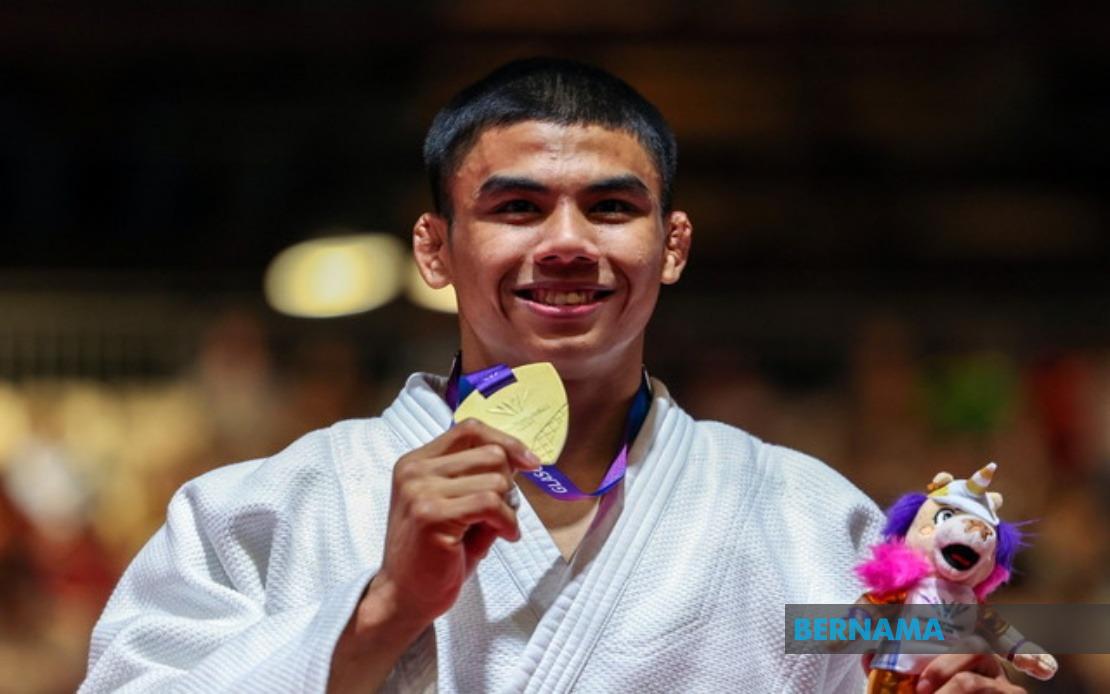
The transition from elite athlete to coach has proven far more psychologically demanding than competing in the judogi, according to Commonwealth Games gold medallist Amir Daniel Abdul Majeed. Now 21 years old, the accomplished judoka has recently assumed the role of assistant coach for the Penang judo contingent at SUKMA Selangor 2026, where he is discovering that managing a team from the sidelines carries considerably more nervous tension than facing opponents on the mat. The shift from individual accountability to collective responsibility has reshaped how he approaches pressure, though he describes the experience as ultimately gratifying.
When competing as an athlete, Amir's focus remained laser-sharp on his own technical execution and tactical decisions during bouts. The burden was personal and immediate—success or failure depended primarily on his own performance. Transitioning to mentorship has fundamentally altered this calculus. As an assistant coach overseeing 13 judo athletes, particularly young competitors he has watched develop over several years, the emotional investment extends far beyond his own results. He now bears responsibility for their technical progression, strategic preparation, mental conditioning, and competitive outcomes. This expanded scope of accountability generates a qualitatively different form of pressure than anything he experienced as a competitor.
The coaching assignment at SUKMA Selangor 2026 has already yielded tangible results for the Penang delegation. Over the three-day event at the IDCC Ideal Convention Centre in Shah Alam, Amir's coaching contributions helped the team accumulate three gold medals, one silver, and five bronze medals across various weight categories. This performance elevated Penang to a joint-first position in the judo medal standings alongside Johor, a substantial achievement that underscores the effectiveness of his mentorship despite his recent career transition. The success reflects both his technical knowledge and his ability to motivate young athletes who have previously trained alongside him as a peer competitor.
Despite his fresh coaching responsibilities at SUKMA, Amir remains very much an active competitor in his own right. The judoka is currently awaiting official confirmation regarding his participation in the Aichi-Nagoya 2026 Asian Games scheduled to take place in Japan. A selection meeting convened this week is expected to determine whether he will represent Malaysia at the continental sporting showcase. This dual role—simultaneously coaching emerging talent while pursuing his own elite athletic objectives—creates a unique pressure dynamic that few young sportspeople experience.
Amir's perspective on the Asian Games opportunity reveals a sophisticated understanding of athlete development and career trajectory. He does not view the Aichi-Nagoya competition merely as an end in itself, but rather as a critical stepping stone within a longer strategic arc. The calibre of international competition at an Asian Games significantly exceeds what he encounters in most domestic and regional events. Securing as many high-level bouts as possible in Japan would provide invaluable experience and empirical data about his competitive standing relative to Asia's elite judoka. This information proves essential for realistic assessment and targeted improvement in areas requiring development.
Beyond immediate Asian Games preparation, Amir is explicitly charting a course toward the Olympic Games, which represents the pinnacle ambition for any international athlete. The path to Olympic qualification requires sustained excellence across a multi-year cycle, with consistent performances at progressively demanding competitions. Experience against world-class opponents at the Asian Games directly translates into improved technique, tactical awareness, and mental resilience. Furthermore, competitive exposure at this level allows national federations and international selectors to evaluate his trajectory and potential.
Malaysia is also slated to host the Southeast Asian Games in 2027, an event that will command national attention and resources. The SEA Games Malaysia 2027 represents another crucial milestone in Amir's competitive calendar. A successful showing at Aichi-Nagoya 2026 would position him optimally for defending or elevating Malaysia's judo medal haul on home soil. Success at the Asian Games immediately preceding a home SEA Games creates momentum and psychological advantage that can prove decisive.
The intersection of Amir's coaching role and competitive aspirations reflects broader patterns within Malaysian sports. Many elite athletes are increasingly called upon to contribute to athlete development and institutional knowledge while maintaining their own competitive standards. This expectation stems from the relatively small population of world-class Malaysian judoka and the limited pool of individuals with both recent elite experience and proven understanding of modern training methodologies. Amir's willingness to embrace this dual responsibility demonstrates commitment to Malaysian judo's systemic development, not merely his personal advancement.
However, balancing intensive coaching demands with personal competition preparation requires exceptional time management and mental compartmentalization. The emotional investment in his athletes' outcomes could potentially distract from preparations for his own international competitions. Conversely, athletes often find that coaching responsibilities provide beneficial perspective and reduce pressure-induced anxiety by shifting focus outward. For Amir, working with younger judoka may actually enhance his own competitive mindset by reinforcing fundamentals and strategic principles he now teaches others.
The broader significance of Amir's transition extends to Malaysian judo's competitive future. By bringing recent elite experience and contemporary technical knowledge into the coaching structure at SUKMA level, he accelerates the development of junior athletes who may eventually represent Malaysia internationally. This creates a virtuous cycle where today's elite competitors become tomorrow's elite coaches, maintaining continuity of expertise and elevating competitive standards across successive generations.
Looking ahead, the next several months will prove pivotal for Amir across multiple dimensions. The Asian Games selection announcement will clarify his competitive schedule and training priorities through 2026. His continuing involvement with the Penang judo team at SUKMA demonstrates that regardless of international selection outcomes, he intends to remain engaged with grassroots athlete development. This balanced approach—pursuing Olympic ambitions while investing in institutional capacity building—positions him as a potentially transformative figure in Malaysian judo during the remainder of this Olympic cycle.

