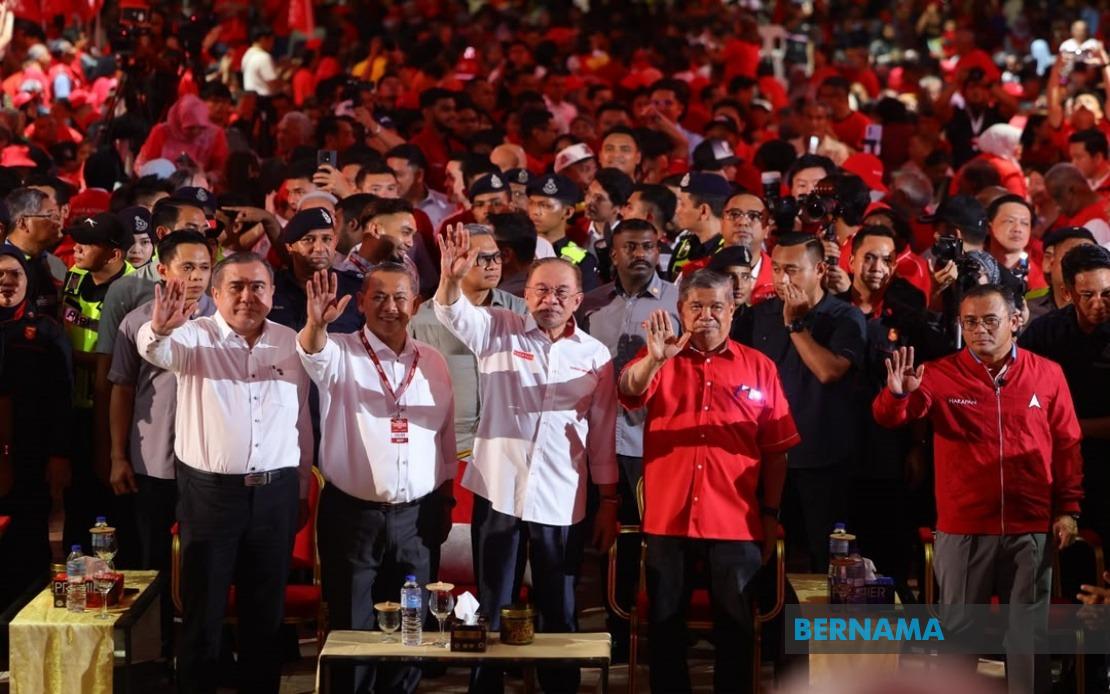
Datuk Seri Aminuddin Harun, the Negeri Sembilan Pakatan Harapan chairman, has made a direct appeal to voters across the state to extend the coalition's political mandate in the forthcoming 16th state election. Speaking at a candidate announcement ceremony in Kuala Pilah, Aminuddin framed the electoral contest as fundamentally about securing the conditions necessary for sustained governance, investor confidence, and uninterrupted delivery of public services. His argument rests on a premise that has become central to PH's electoral strategy across multiple state contests: that political continuity translates directly into economic and social gains for ordinary Malaysians.
The stability argument carries particular weight in Negeri Sembilan's context. Since 2018, when PH first came to power federally and regionally, the state has built what Aminuddin characterises as a track record of manifest commitment. The administration points to progress in fulfilling campaign promises, ongoing welfare initiatives spanning education assistance and the free tablet scheme for students, and measurable improvements in state economic indicators. This narrative—that coalition governance has demonstrably improved public life—forms the backbone of PH's case for renewal, moving beyond abstract appeals to competence toward concrete examples of service delivery.
Economic performance has become PH's primary exhibit in this argument. The state has attracted RM19.1 billion in investments under coalition administration, a figure Aminuddin presented as evidence of investor confidence in the government's stewardship. This investment inflow matters not merely as an abstract success metric but as a signal to markets that the state offers a reliable political environment for business expansion. For a resource-constrained state competing against others in the region, such investor appetite translates into job creation, tax revenue, and developmental capacity. Aminuddin's invocation of this figure reflects a sophisticated understanding that voters increasingly evaluate political performance through economic outcomes.
The expansion of zakat collection provides another measurable indicator of state resource mobilisation. Under Aminuddin's leadership, zakat revenues have more than doubled from approximately RM80 million to nearly RM200 million. This dramatic increase enables substantially greater assistance channelled to vulnerable populations. The figure carries additional significance because it demonstrates the coalition's capacity to deepen Islamic social welfare mechanisms—a politically sensitive arena where competent governance can strengthen PH's standing among Muslim-majority constituencies. The ability to grow religious taxation streams whilst expanding their distribution addresses both economic management and religious legitimacy concerns.
A critical theme emerging from Aminuddin's remarks concerns federal-state coordination. He stressed that effective implementation of development projects requires close cooperation between Negeri Sembilan's state administration and the Federal Government, a point of particular salience given that PH controls both levels of government. This alignment theoretically permits integrated policy execution across jurisdictional boundaries, something lacking when state and federal governments operate under competing political directions. For Malaysian voters accustomed to centre-periphery tensions in governance, the prospect of harmonised state and federal action under a single coalition represents a tangible administrative advantage.
DAP secretary-general Anthony Loke's contribution to the campaign launch reveals broader strategic calculations within the PH coalition. Loke explicitly characterised the Negeri Sembilan election as PH's "second round" following the coalition's unsuccessful Johor campaign, acknowledging that the federal coalition absorbed significant damage from that state election defeat. His language—emphasising the need to "rebuild momentum" and prevent further losses—indicates that Negeri Sembilan has assumed heightened importance beyond its intrinsic value. A successful retention would interrupt a narrative of coalition decline and provide evidence that PH's political base remains capable of mobilisation despite recent setbacks.
Loke's frank assessment of the Johor defeat reveals an important strategic maturity within PH's internal discourse. Rather than minimising or obscuring the loss, coalition leadership has opted for direct acknowledgment coupled with forward orientation. This approach potentially inoculates PH against charges of denial or disconnection from electoral reality whilst signalling to supporters that the coalition possesses resilience and adaptive capacity. Loke's statement that PH has "neither the space nor the time to grieve" articulates a disciplined refusal to dwell on previous disappointment, redirecting energy toward the immediate contest.
The campaign strategy Loke outlined emphasises unified deployment of PH's electoral machinery across component parties. By insisting that Aminuddin remains the coalition's Menteri Besar candidate and principal "commander" for the state election, PH leadership consolidates decision-making authority and prevents the fragmentation that sometimes plagues multi-party coalitions during campaigns. This centralised approach aims to ensure that different PH components operate from consistent messaging and aligned strategic objectives rather than pursuing separate agendas that might confuse voters or dilute the coalition's overall impact.
A notable dimension of Loke's remarks concerns the political boundaries PH leadership has established for the campaign itself. His emphasis on respectful conduct, proper decorum, and honour toward Negeri Sembilan's customs and royal institution reflects calculated political positioning. By pre-emptively establishing standards for campaign behaviour and explicitly pledging loyalty to the Yang Dipertuan Besar and constitutional monarchy, PH attempts to prevent opposition parties from exploiting any perceived disrespect toward state institutions. This is particularly significant for DAP, which has historically faced accusations from Umno-led coalitions of being irreverent toward Islam, the monarchy, and traditional institutions. Proactive institutional deference thus serves both defensive and offensive political purposes.
The reference to the Rukun Negara—the national social contract articulated in 1970—further situates PH's campaign within a framework of constitutional legitimacy and national unity. By invoking these foundational principles, PH leadership positions itself as custodian of Malaysia's established political-constitutional order rather than as a disruptive force. This positioning becomes particularly important for DAP, whose presence in a governing coalition sometimes provokes concerns among conservative voters regarding secular governance or Chinese political power. Anchoring the campaign in constitutional and national principles aims to neutralise such anxieties.
For Malaysian observers, the Negeri Sembilan election serves as a significant test of PH's electoral viability following the Johor setback. The state represents genuinely competitive ground where the coalition retains substantial advantages through incumbency and delivery record, yet faces opposition parties energised by recent momentum. The election will provide early indication of whether PH's difficulties in Johor reflect durable shifts in voter sentiment or represent state-specific dynamics from which the coalition can recover. A successful retention would suggest PH possesses sufficient organisational capacity and voter support to resist the momentum that appeared to be building against it, whilst a loss would signal more fundamental problems with the coalition's electoral positioning across multiple states.
The economic narrative that PH has constructed in Negeri Sembilan—centred on investment attraction, welfare expansion, and institutional capacity—will face direct electoral testing. Voters must evaluate whether tangible improvements in their material circumstances justify continued coalition governance, or whether opposition parties' alternative visions and messaging resonate more powerfully. This contest between incumbent performance claims and opposition aspirational messaging will shape not only Negeri Sembilan's political future but also broader patterns of Malaysian electoral competition in the period ahead.

