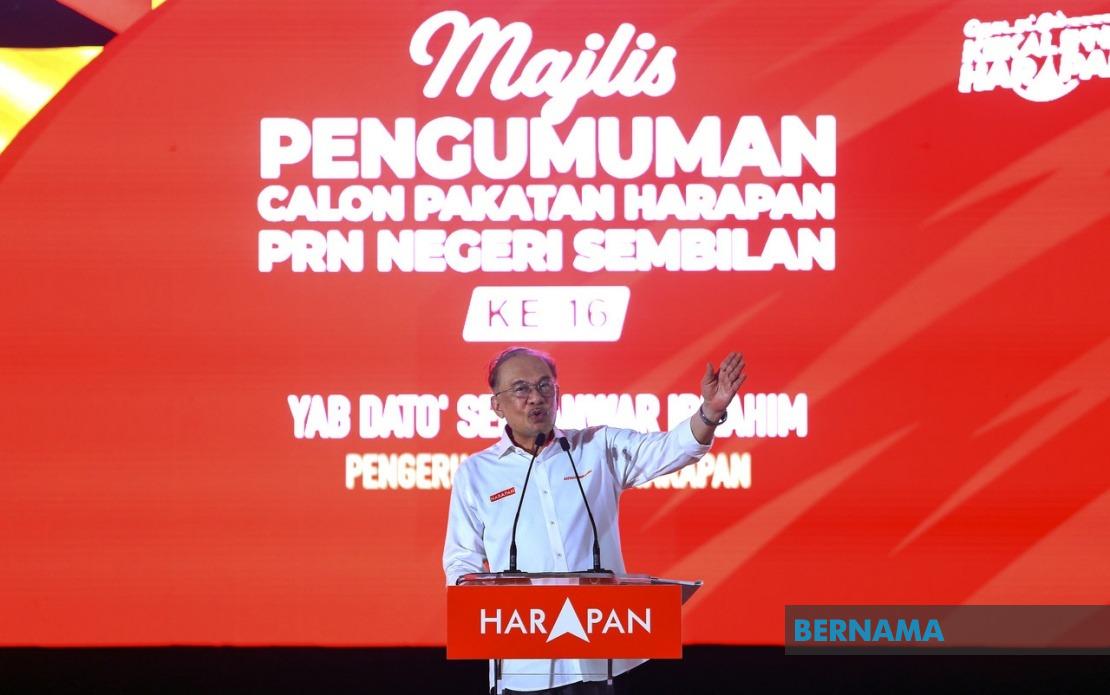
Prime Minister Datuk Seri Anwar Ibrahim unveiled the initial slate of Pakatan Harapan candidates for the 16th Negeri Sembilan State Election at a gathering in Kuala Pilah on July 14, revealing that Negeri Sembilan Menteri Besar Datuk Seri Aminuddin Harun will shift constituencies to contest the Linggi seat. The announcement came during a packed coalition rally featuring party leadership and thousands of supporters, signalling the coalition's strategic repositioning in the crucial central state ahead of polling day.
Aminuddin, who currently serves as both the Menteri Besar and chairman of Pakatan Harapan's Negeri Sembilan branch, brings substantial electoral experience to his new constituency. Having represented the Sikamat state seat across four consecutive election cycles since 2008, Aminuddin has established himself as a durable political operator capable of holding challenging seats through multiple political cycles and leadership transitions. His decision to move constituencies underscores deliberate party strategy, with Linggi representing either a consolidation of coalition gains or a calculated expansion into new territory ahead of what promises to be a competitive statewide contest.
Accompanying Aminuddin's candidacy announcement was confirmation that DAP secretary-general Anthony Loke will mount a defence of the Chennah seat, which he has successfully retained since his initial election in 2013. Loke's political trajectory within DAP has been marked by steady advancement to senior party positions, and his nomination reflects the coalition's confidence in his electoral appeal within his constituency. His incumbency provides Pakatan Harapan with experience and entrenched grassroots networks in Chennah, a strategic advantage as voters weigh their choices in the election campaign.
The timing and staging of the candidate announcement bore the hallmarks of a coordinated coalition operation, with Prime Minister Anwar personally delivering the news rather than delegating to subordinates. His visible presence underscored the national leadership's investment in Negeri Sembilan's electoral outcome and signalled that these races carry implications beyond state-level politics. The scale of the event, drawing thousands of party activists and supporters, reflected the coalition's determination to project momentum and unity during the candidate selection phase.
The coalition's senior hierarchy turned out in force to demonstrate solidarity and party coherence. Amanah president Datuk Seri Mohamad Sabu, PH communications director Datuk Seri Fahmi Fadzil, and coalition election director Datuk Seri Amirudin Shari all graced the ceremony, each bringing their own constituencies and political networks to bolster the occasion. This display of unified leadership from parties representing different religious and ethnic constituencies within Pakatan Harapan conveyed a message of coalition stability at a moment when pre-election tensions sometimes strain multiparty alliances.
For Malaysian observers, the Negeri Sembilan contest carries broader significance within the ongoing evolution of the country's political landscape. The state, traditionally considered a competitive battleground between major coalitions, has witnessed shifting alignments and voter preferences over recent election cycles. Aminuddin's repositioning and Loke's incumbency defence together suggest that Pakatan Harapan believes it can maintain or expand its footprint in the state, despite challenges that have tested coalition unity elsewhere in the country.
The announcement also reflects the particular strengths of the two candidates within their respective political ecosystems. Aminuddin's executive experience as Menteri Besar provides him with tangible developmental achievements and administrative visibility that typically resonate with voters evaluating state-level leadership. Meanwhile, Loke's portfolio as DAP secretary-general positions him as a bridge between party-specific concerns and broader coalition interests, a role that matters in constituencies where party identity and coalition loyalty both carry weight.
For regional observers tracking Malaysian politics, these nominations illustrate how the country's coalitional politics continue evolving post-2022. While the Federal Territory fell under different political arrangements, state elections in places like Negeri Sembilan demonstrate that Pakatan Harapan remains a functioning electoral coalition capable of coordinating candidate selection and projecting party unity, even as federal politics occasionally witness friction. The successful orchestration of these announcements suggests that the coalition's machinery, while tested, retains capacity for coherence when facing elections where outcomes matter for state governance and resource allocation.
The choice to feature Aminuddin and Loke as opening salvos in the coalition's candidate announcement strategy also carries implicit messaging about coalition priorities and leadership confidence. By elevating the Menteri Besar himself as a candidate rather than reserving him for behind-the-scenes coordination, the coalition signals that it believes he possesses sufficient electoral appeal and public standing to survive direct voter scrutiny in a different constituency. This willingness to put senior figures directly on the ballot differs from strategies sometimes employed when leadership appears vulnerable.
As campaigns in Negeri Sembilan gather momentum, these opening moves will likely set the tone for how opposition coalitions respond and which constituencies become focal points for competitive contests. The state's 36 seats represent an attractive prize for any coalition seeking to demonstrate electoral viability and governance capability, and early candidate announcements provide voters and political analysts their first glimpses into how parties plan to contest different areas. Aminuddin's move to Linggi and Loke's defence of Chennah therefore merit close observation as indicators of coalition strategy and confidence levels heading into what may prove a significant test of political support.

