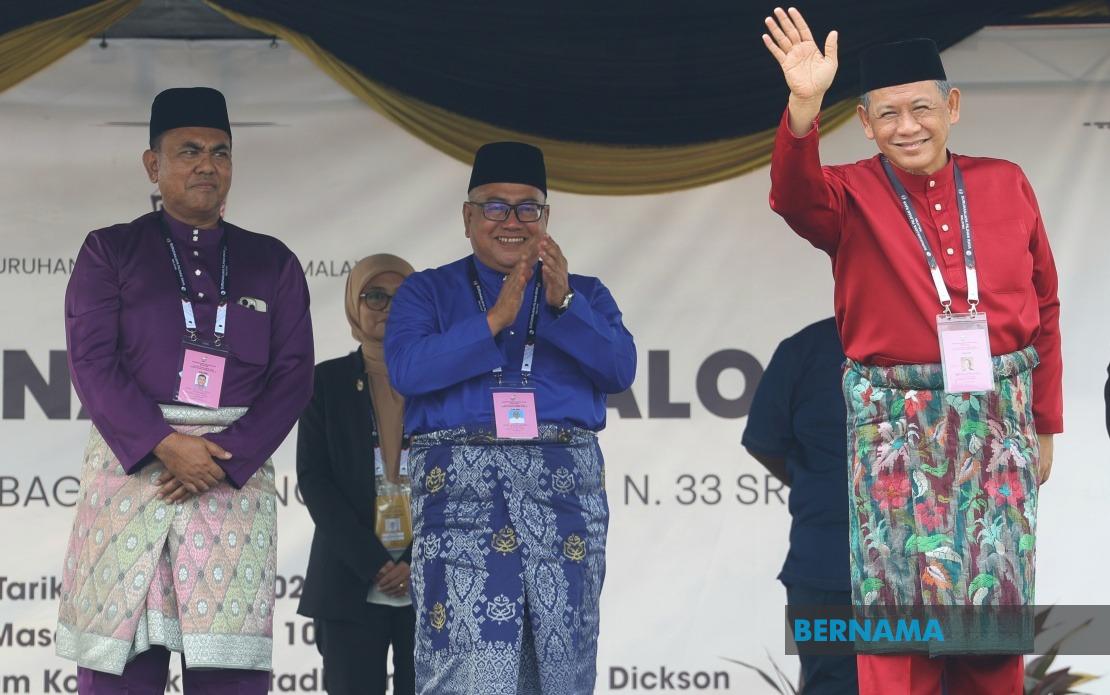
The Negeri Sembilan state election is shaping up as a complex political battlefield, with the Menteri Besar himself forced to defend his seat in a three-way contest that underscores shifting coalition dynamics in the state. Datuk Seri Aminuddin Harun, leading the Pakatan Harapan government, will contend with two formidable challengers for the Linggi seat: the incumbent Datuk Mohd Faizal Ramli of Barisan Nasional, who has held the position and possesses ground advantage, and Datuk Zamri Md Said representing Bersatu, the party whose defection from PH has fractured the ruling coalition nationally and now threatens it at the state level.
The candidate nominations were officially closed on July 18 at the Port Dickson District Administration Complex, with returning officer Nurhazelin Makli confirming all participants in the race. This pattern of three-cornered contests is not isolated to Linggi. The Negeri Sembilan contest reveals a state increasingly fragmented among competing political forces, with Bersatu acting as a disruptive third force in multiple constituencies, fundamentally altering the electoral calculus that previously favoured straight fights between PH and BN.
In other constituencies, the competition reflects similar complexity. The Sri Tanjung seat will pit PH incumbent Dr G. Rajassekaran against BN's A. Achutan and Bersatu newcomer Leevineshwaraan Murugan. Meanwhile, Lukut has become another three-way battle, with PH incumbent Choo Ken Hwa facing both Perikatan Nasional candidate Sathes Kumar Nilameham and independent contender Teo Seng Lee. These arrangements suggest Bersatu is positioning itself as a significant player capable of splitting the anti-establishment vote or presenting itself as an alternative to the two traditional blocs.
The Bagan Pinang constituency presents a particularly intriguing scenario with PAS incumbent Abd Fatah Zakaria defending against PH's Nasir Raman and Bersatu's Sheikh Junaidy Jamaludin. This contest highlights how the Islamist party has managed to retain ground in certain areas despite broader political shifts, whilst also illustrating the proliferation of candidates vying for voter attention. Among the contested seats, only Chuah appears set for a two-way race, pitting PH incumbent Yew Boon Lye directly against BN's Pau Jeou Ching.
The fragmentation of the political landscape has immediate implications for governance. For Aminuddin and his administration, the Linggi contest represents a personal political test. Losing his own seat whilst leading the state government would constitute a catastrophic setback, potentially forcing his resignation and destabilising the PH state administration. The challenge from Bersatu is particularly acute given that the party was once part of the federal and state governing coalition before abandoning PH to realign with UMNO nationally, a move that created deep political wounds and voter confusion about political affiliations and principles.
Election Commission data reveals the scale of the electorate across Negeri Sembilan, with 889,490 voters eligible to cast their ballots in the August 1 polling. This comprises 867,151 ordinary voters alongside 16,884 military personnel and their spouses, and 5,455 police personnel and their spouses. Early voting has been scheduled for July 28, allowing security force personnel and their families to vote ahead of the general poll. The substantial military and police voter component in certain constituencies may influence campaign strategies, particularly around security-related issues and worker welfare.
For Malaysian politics, the Negeri Sembilan election serves as an important indicator of shifting voter sentiment in the crucial central region of Peninsular Malaysia. The state has traditionally been a barometer for national political trends, and the emergence of Bersatu as a competitive force at the state level suggests that the fractious politics of recent years—characterised by coalition-hopping and the blurring of ideological boundaries—have permeated down to regional contests. Voters now face more complex choices with multiple candidates competing in most seats rather than the clearer binary contests of previous election cycles.
The presence of independent candidates in certain constituencies, notably Teo Seng Lee in Lukut, also signals growing voter disaffection with organised political structures. Whether this reflects a genuine grassroots movement or merely localised protest voting will become clearer once results are tallied. However, the proliferation of candidates undoubtedly dilutes voter choice and can produce outcomes where victors are elected with plurality rather than majority support, potentially affecting the legitimacy of representatives elected with fractured support bases.
For Negeri Sembilan's government formation, the arithmetic becomes crucial if results produce a hung assembly or highly fragmented representation. Coalition mathematics involving PH, BN, Bersatu, PAS, and potentially independent candidates could determine whether the state administration remains stable or enters a period of political uncertainty. The current PH government's majority may be vulnerable depending on how many seats its candidates win and whether defections or cross-overs become possible after polling day. This vulnerability could embolden rival factions to pursue post-election alliances that reshape the state government composition.
The timing of this state election also carries national implications. Occurring whilst federal politics remains turbulent and Malaysian voters grapple with cost-of-living pressures and economic uncertainty, the Negeri Sembilan result will provide insights into whether incumbent governments face voter punishment or whether localised performance and leadership factors allow regional administrations to buck broader national trends. For Aminuddin specifically, strong personal performance despite national headwinds would enhance his standing as a regional political leader capable of delivering for constituents regardless of coalition membership.

