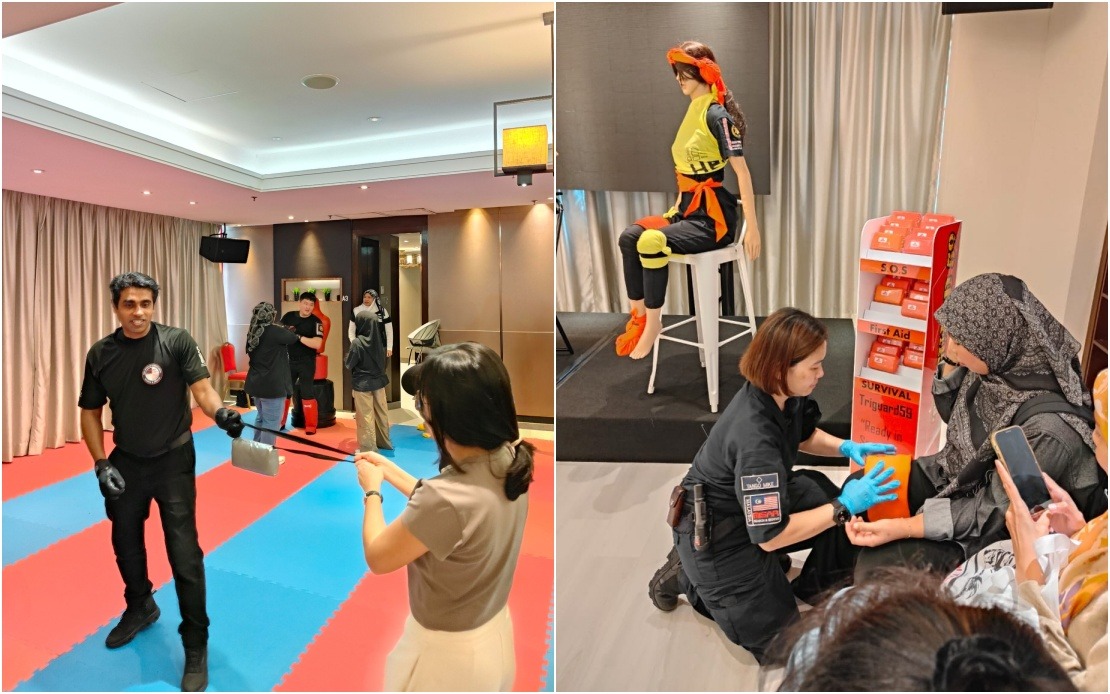
Allianz Malaysia Berhad has deepened its community safety mandate by conducting the ninth iteration of its Women's Street Crime Awareness Campaign in partnership with Kelab Marshal Keselamatan Jalan Raya Kuala Lumpur (RSMC), underscoring how corporate entities and specialist safety organisations can collaborate to build urban resilience. The initiative, conducted at Wisma Huazong YTL Hall in Seri Kembangan, Selangor, assembled 200 women for an intensive half-day training addressing vulnerabilities that affect daily life for millions across Malaysia's urban centres.
The programme targeted women aged 16 and above with a comprehensive curriculum spanning practical and theoretical dimensions of personal safety. Participants engaged with educational sessions and hands-on demonstrations covering high-risk scenarios that women frequently encounter: unauthorised home entries, bag snatching, elaborate road-based fraud schemes, unwanted surveillance, vehicle theft, crash response protocols, basic self-defence techniques, and crisis management. This breadth reflects the multi-layered nature of contemporary urban crime, which rarely confines itself to a single category.
What distinguishes this year's iteration from previous campaigns is the introduction of a structured dialogue component alongside practical skills training. Rather than treating the event as a one-way knowledge transfer, organisers created space for participants to share real experiences and articulate safety concerns directly to RSMC specialists. This peer-learning dimension proves crucial in a cultural context where personal anecdotes and contextualised advice often resonate more powerfully than abstract safety principles. Participants received customised guidance tailored to neighbourhood-specific risks and demographic circumstances.
Allianz Malaysia's corporate social responsibility positioning reflects a strategic recognition that insurance companies maintain a vested interest in accident prevention and crime reduction. By investing in awareness campaigns, Allianz simultaneously builds brand goodwill, establishes itself as a socially conscious entity, and contributes to reducing the frequency of claims. Sean Wang, the company's chief executive officer, emphasised that the campaign's success extends beyond the immediate participant count. He highlighted that community leaders approached the organisation about replicating similar programmes in their respective neighbourhoods, indicating genuine grassroots interest in scaling safety initiatives.
This multiplier effect—where knowledge disseminates through informal networks and community champions—remains integral to sustainable public health and safety outcomes. Malaysian urban communities often respond more effectively to peer-driven education campaigns than top-down government directives, particularly on issues touching personal security and bodily autonomy. The enthusiasm shown by neighbourhood leaders suggests that localised, women-centric safety training addresses a genuine gap in existing frameworks.
RSMC founder and president Captain K. Balasupramaniam articulated the deeper philosophy underlying the campaign: empowerment through knowledge and skill-building. He positioned street crime awareness not as fear-mongering but as confidence-building, enabling participants to make informed choices amid uncertainty. This framing matters considerably, as poorly executed safety campaigns sometimes inadvertently heighten anxiety without providing corresponding agency or practical solutions. By coupling awareness with actionable self-defence and emergency response techniques, the programme avoids the pitfall of leaving women more frightened but no more capable.
The choice of location—Seri Kembangan in Selangor—reflects targeting of suburban areas where rapid urbanisation has sometimes outpaced the development of formal community safety infrastructure. Selangor's explosive growth over two decades has created neighbourhoods with transient populations, varied income levels, and sometimes fragmented community cohesion. Women in such areas face particular vulnerabilities, from harassment on public transport to home security risks in newly developed residential zones. Situating the campaign in this demographic context demonstrates strategic prioritisation.
The nine-iteration history of this campaign indicates institutional commitment from both Allianz Malaysia and RSMC to persistence in safety advocacy. Annual repetition allows for curriculum refinement, accumulation of lessons learned, and establishment of trusted brand identity around the initiative. Participants in year nine likely benefited from systematic improvements implemented following eight previous iterations. This contrasts with one-off awareness events that often dissipate without institutional follow-up.
For Malaysian readers and policymakers, this initiative offers a template for corporate-civil society partnerships addressing urban safety deficits. Government agencies and municipal authorities in Kuala Lumpur, Selangor, and other major metros struggle with resource constraints limiting their capacity for expansive public awareness campaigns. Private sector engagement—whether through insurance companies, banks, technology firms, or telecommunications providers—can supplement governmental efforts while building brand equity. The success metrics here go beyond attendance figures to encompass community leader interest and reported behaviour changes, indicators that measure genuine impact rather than merely recording participation.
The evolution from purely practical training to integrated dialogue sessions reflects maturation in understanding adult learning principles. Women bring existing knowledge about their neighbourhoods and threat environments; effective safety training acknowledges and builds upon these existing schemas rather than imposing external frameworks. By creating space for experience-sharing, the Allianz-RSMC partnership validated participant expertise while providing supplementary skills and information.
Looking forward, questions remain about sustaining momentum and measuring long-term impact. Do participants implement safety practices learnt during the campaign? Do they indeed become advocates within families and communities, as both organisers hope? Longitudinal tracking of behavioural outcomes would strengthen the evidence base for this model. Additionally, as urban crime evolves—with online harassment, digital fraud, and cyberstalking emerging alongside traditional street crimes—safety programmes require continuous curriculum updates to remain relevant to women's actual threat environments.
The campaign ultimately reflects a growing recognition that street safety represents a legitimate community concern and that women merit systematic, skills-based training in personal protection. Rather than accepting crime as an inevitable feature of urban life, the Allianz-RSMC partnership demonstrates that private and civic organisations can collaborate to build safer, more resilient communities. The interest from community leaders in replicating this model suggests potential for expanding the initiative's reach, particularly if existing materials and expertise can be adapted for different geographic and demographic contexts across Malaysia.

