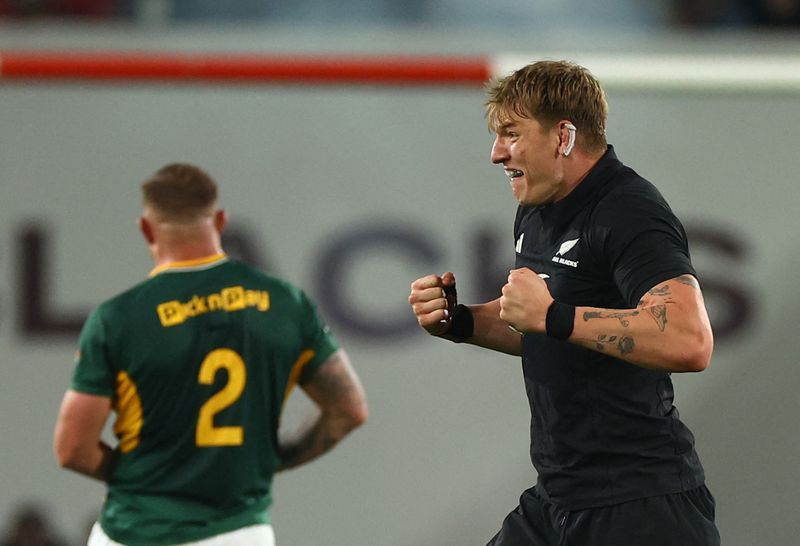
New Zealand's All Blacks produced a statement performance to dismantle South Africa's Springboks 33-16 at Ellis Park in Johannesburg on Saturday, claiming the opening test of their four-match series and halting the world champions' formidable 12-match winning streak. The victory represents a significant upset given that the touring side had entered the contest as underdogs, yet they proved sufficiently disciplined and clinical to overcome the Springboks' relentless physical assault and emerge with a deserved success that will reshape expectations around this compelling rivalry.
The All Blacks' attacking prowess proved decisive throughout an encounter that embodied the brutal intensity characteristic of matches between these two rugby powerhouses. Will Jordan, New Zealand's record try-scorer, showcased his predatory instincts by crossing twice, bookending tries from Josh Moorby, Fabian Holland, and Luke Jacobson. Ruben Love's reliable boot added four conversions to complete a five-try haul that demonstrated the visiting team's capacity to maintain attacking intent despite sustained defensive pressure. By contrast, South Africa managed only one try through Andre Esterhuizen, with Cheslin Kolbe adding three penalties and one conversion in a performance that highlighted the Springboks' struggle to translate territorial and scrum dominance into scoring opportunities.
Coach Dave Rennie's assessment of the contest captured its true character—despite the convincing scoreline, the match represented a gruelling tactical battle where execution ultimately determined the outcome. The All Blacks' defensive resilience proved exceptional, particularly during phases when South Africa's forward pack exerted considerable pressure. Rather than wavering under sustained assault, New Zealand's defenders remained resolute and punished the home side whenever they attempted to expand play, exemplifying the kind of structured defensive architecture that characterizes successful touring performances. This combination of defensive solidity and opportunistic attacking created a formula that proved almost impossible for the Springboks to counteract despite their considerable physical advantages.
The contest began with competing strategic philosophies that would prove consequential. South Africa spurned an early penalty opportunity in the second minute, electing instead to pursue a lineout maul that failed to materialise. Three minutes later, another penalty was successfully converted for opening points. New Zealand responded similarly in the ninth minute, also rejecting easier points to build a lineout platform from which Jordan scored the match's opening try. This early period established the pattern whereby both teams prioritised territorial accumulation and potential dominance over conservative point accumulation, a philosophy that ultimately benefited New Zealand's superior opportunism and execution.
The first half witnessed oscillating momentum as both teams inflicted their respective strengths. Esterhuizen's powerful finish restored South Africa's advantage following Jordan's opener, but Moorby's clever finishing on the left wing restored New Zealand's lead. The Springboks, showing more patience, secured a 13-12 halftime advantage through Kolbe's two penalty conversions. However, this apparent dominance proved illusory—South Africa's handling errors and ill discipline prevented conversion of their forward superiority into substantial point accumulation, a recurring theme that would intensify as the match progressed.
The second half confirmed New Zealand's tactical supremacy and mental toughness. Holland's charging-down of a clearance kick in the 48th minute exemplified the All Blacks' intense pressure and their capacity to exploit opposition mistakes. South Africa continued generating scrummaging advantages and kickable penalties, yet persistent handling errors and growing indiscipline prevented them from translating these opportunities into consistent scoring. The Springboks' vulnerability to counter-attack became increasingly apparent, with McKenzie's line-break subsequently enabling Jacobson's crucial try that effectively settled the contest's outcome.
The final quarter deteriorated markedly for South Africa as frustration mounted and discipline collapsed entirely. Marco van Staden and Cobus Reinach received sin-bin cards in the contest's final ten minutes as multiple turnovers and handling mistakes accumulated. Jordan's second try, scored near the conclusion, extended New Zealand's margin to insurmountable proportions and represented both his 53rd international try and a fitting punctuation to the All Blacks' dominant display. This late dominance reflected broader patterns evident throughout—New Zealand's intensity forced South Africa into error, while the home side's attempts to impose physicality were systematically negated by superior tactical awareness and defensive organisation.
Coach Rassie Erasmus acknowledged that his team's downfall stemmed from strategic moments where New Zealand's intensity forced critical errors that momentum-shifting consequences. South Africa's customary strengths—forward domination, physical intimidation, and set-piece precision—proved insufficient against an opponent who refused to be intimidated and instead maintained the composure necessary to capitalise on opposition mistakes. This represents a particularly troubling development for the Springboks, whose winning formula typically relies on forward-based suffocation and controlled expansion, yet neither element materialised effectively despite apparent territorial and physical advantages.
The victory delivers substantial psychological benefits for New Zealand heading into successive test encounters. Holding a 1-0 series advantage against the world's top-ranked team establishes crucial momentum and confidence, particularly given the underdogs' status they carried into this campaign. The All Blacks demonstrated that South Africa's recent dominance remains vulnerable to teams capable of maintaining disciplined defensive structures while exploiting handling and decision-making errors. For regional supporters and analysts, this result fundamentally recalibrates the power dynamic in international rugby and suggests that the championship landscape remains more fluid than recent outcomes suggested.
The contest's implications extend beyond bilateral competition. It demonstrates that elite rugby success requires not merely physical dominance but tactical sophistication, disciplined execution, and mental resilience under sustained pressure. New Zealand's willingness to match South Africa's physicality while simultaneously maintaining superior technical proficiency and decision-making provides a template for teams seeking to compete against traditionally dominant rivals. The Springboks' challenge moving forward involves rediscovering the precision and patience that built their recent success while avoiding the frustration-induced indiscipline that intensified their Ellis Park disappointment.

