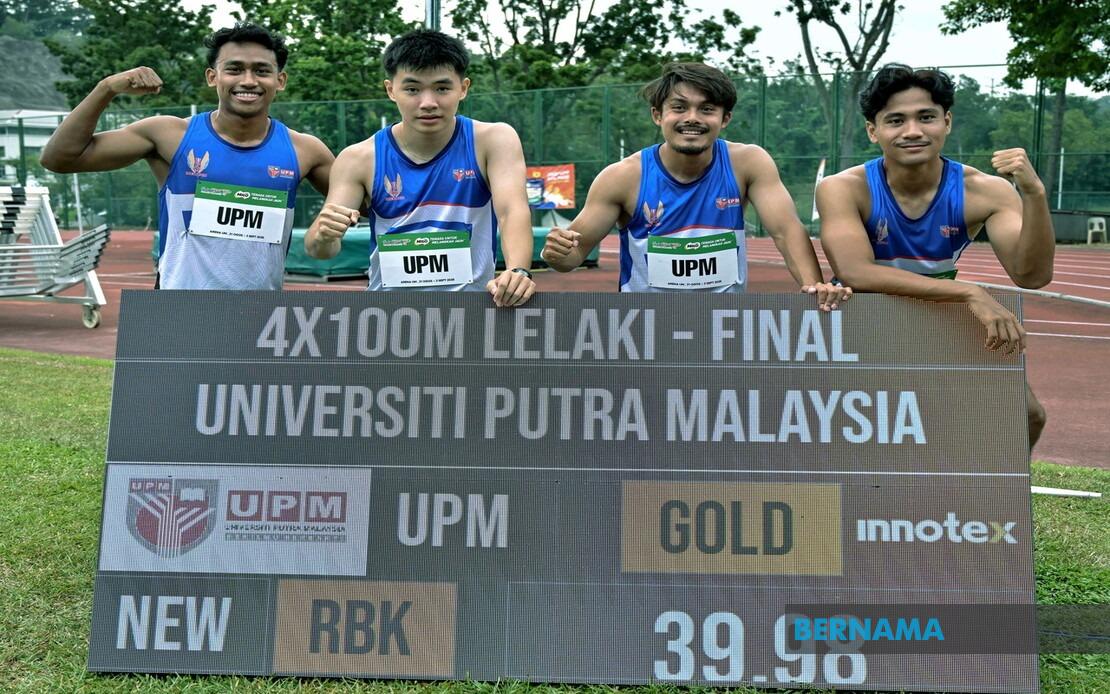
Universiti Putra Malaysia's men's 4x100-meter relay team delivered a breakthrough performance at the 2026 Higher Education Institutions Sports Games in Kuala Lumpur, winning gold with a commanding time of 39.98 seconds that erased the previous games record of 40.98 seconds. The achievement, delivered on August 31 at the UM Arena in Universiti Malaya, represents a watershed moment for the institution's athletics legacy, proving that a carefully planned succession strategy is bearing fruit at the national championships.
The triumph holds particular significance because it marks the capstone to senior runner Aliff Iman Mohd Fahimi's competitive career at SUKIPT, coinciding with the emergence of a cohort of junior athletes competing at the games for the first time. This alignment of veteran leadership and youthful energy appears to have created an ideal formula for both immediate victory and long-term programme sustainability. The UPM sprint relay has traditionally been a powerhouse event, and the new generation is poised to maintain that standard while potentially pushing it further.
Aliff Iman approached his final SUKIPT appearance with deliberate intent, positioning himself as a bridge between UPM's storied athletics past and its anticipated future. He spoke candidly about carrying forward the legacy established by celebrated predecessors Jonathan Nyepa and Zulfiqar Ismail, athletes whose performances had set a high bar for subsequent cohorts. By anchoring a team composed entirely of first-time SUKIPT competitors, he demonstrated that knowledge transfer and confidence-building can accelerate the development of emerging talent in high-pressure competitive environments.
The runner acknowledged the weight of responsibility that accompanied his selection for this particular team composition. Rather than viewing the youth of his teammates as a limitation, Aliff Iman reframed it as an opportunity to establish new benchmarks for UPM athletics. His statement that the victory represented "a renewal for the relay quartet or sprint event at UPM" captured the philosophical approach underpinning the university's athlete development strategy. This generational transition, often challenging in competitive sports environments, appears to have been executed with foresight and careful planning.
Central to the UPM success was Aliff Iman's analytical confidence in his teammates' individual capabilities. He noted that each member of the quartet averaged sprint times between 10.4 and 10.5 seconds in individual competitions, a data-driven assessment that informed their ambitious target of breaking the 40-second barrier. This mathematical approach to relay racing—recognising that consistent individual performance translates into collective achievement—reveals a maturing approach to athletics programme management among Malaysian universities.
The fact that Aliff Iman competed while wearing wristbands inscribed with "Papa" and "Mama" added an emotional dimension to his return to competition. He had been sidelined for six months due to injury, making his resurrection as an active competitor both personal and symbolic. His willingness to return specifically for this relay assignment underscored the mutual commitment between the senior athlete and the university programme to ensure successful knowledge transfer to the next generation.
Teammate Reeve Kua provided insight into the challenges facing athletes preparing for major championships in the Malaysian climate. He revealed that he had competed while recovering from a severe fever, managing his condition through basic measures like paracetamol and rest the previous evening. Despite physiological stress, he executed his leg of the relay effectively, exemplifying the resilience expected of competitive university athletes. His ability to overcome acute illness and still contribute to a record-breaking performance demonstrates the psychological and physical preparation invested in this team.
The UPM quartet faced formidable competition from Universiti Pendidikan Sultan Idris, which secured second place with a time of 40.16 seconds. The UPSI team's inclusion of national-level runner Danish Iftikhar Muhammad Roslee elevated the competitive standard of the event and added prestige to UPM's victory. Final anchor runner Ahmad Amir Aiman Mohd Kamaruddin confronted this elite opposition directly in the closing stages, yet maintained the baton transmission sequence that ultimately delivered gold. Malaysian Polytechnics finished third with 41.75 seconds, reflecting the depth of relay talent across Malaysia's tertiary education system.
The sub-40-second achievement at SUKIPT carries implications beyond institutional pride. It signals that Malaysian university athletics continues to develop sprinters capable of competing at international standards, particularly in relay formats where consistency across four athletes proves demanding. The record's establishment by a predominantly junior team suggests that successor cohorts may push these boundaries even further in subsequent games cycles.
Aliff Iman's departure from SUKIPT competition, marked by this golden farewell, leaves UPM with both immediate success and a documented model for generational transition. His willingness to mentor younger athletes publicly, his analytical framework for assessing collective performance, and his symbolic leadership through the wearing of family-inscribed wristbands all demonstrate that athletics legacy-building involves more than individual accomplishment—it requires deliberate cultural transmission and emotional investment in institutional continuity.
The victory at the 2026 SUKIPT games exemplifies how strategic succession planning, grounded in individual athlete development and senior mentor engagement, can yield both contemporary success and long-term programme strengthening. As Malaysian universities increasingly recognise that sustainable athletic excellence requires structured generational handovers rather than reliance on individual stars, Aliff Iman's final relay serves as both conclusion and catalyst. The new UPM quartet has demonstrated that the university's athletics future remains secure, carrying forward tradition while establishing new competitive benchmarks.

