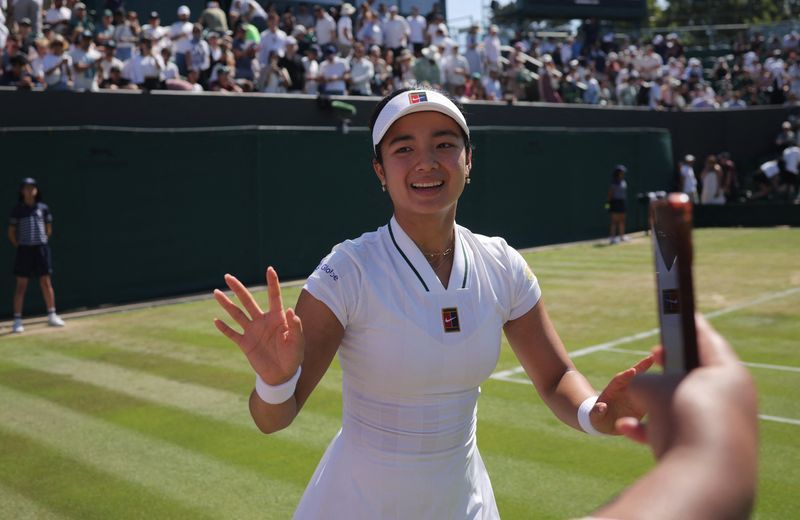
Alexandra Eala wrote another chapter in Philippine tennis history on Thursday at the All England Club when she stormed past Australia's Maya Joint to become the first player from the Philippines ever to reach the third round of a Grand Slam tournament. The 21-year-old from Quezon City, seeded 29th, dispatched her opponent 3-6 6-2 6-0 in a commanding display that showcased her rapidly improving form on grass courts. Her victory proved the words emblazoned across her sun visor—a Tagalog phrase meaning "once it grows, it cannot be stopped"—were far more than motivational decoration.
Eala's path to this milestone took an unexpected turn when she dropped the opening set against Joint, the same opponent who knocked out Serena Williams in the opening round. Rather than wilt under the pressure of pursuing history, the young Filipino player regrouped with remarkable composure. She won the next two sets without surrendering a game, a dominant reversal that demonstrated the mental resilience increasingly evident in her play. This performance underscored why coaches and observers have begun to view her trajectory with genuine optimism, not merely as a feel-good story but as a genuine competitive threat on the professional circuit.
The significance of Eala's achievement extends beyond the immediate tournament results. For Philippine tennis, which has long struggled for consistent representation on the grandest stages of the sport, her breakthrough serves as a watershed moment. The nation has produced talented players over the years, but none had previously navigated the demanding gauntlet of a Grand Slam to reach the round-of-16. In a region where tennis infrastructure and funding remain concentrated in a handful of wealthy nations, Eala's success represents validation of the investment being made in Philippine sports development and proof that world-class talent can emerge from less prominent tennis nations.
At just 21 years old and competing in only her sixth Grand Slam tournament, Eala has shown a learning curve that distinguishes her from many of her peers. She broke into the top 50 rankings last year and has maintained upward momentum throughout the current season, suggesting this Wimbledon run may represent a beginning rather than a peak. Her particular comfort on grass surfaces has been especially noteworthy. She captured the Birmingham title last month and reached the semi-finals in Berlin, indicating that her performance at Wimbledon reflects genuine grass-court prowess rather than a one-off breakthrough.
Next, Eala faces an assignment that would intimidate most players at her career stage: defending champion Iga Swiatek on Saturday. The Polish player, a six-time Grand Slam champion, brings formidable credentials and the psychological advantage of having just won the title. Yet Eala approached the prospect with measured confidence during her post-match interview, acknowledging the challenge while expressing belief in her capacity to compete. Her demeanor suggested not arrogance but rather the quiet self-assurance of an athlete discovering that she belongs at this level of competition. The manner in which she dispatched Joint indicated that Swiatek will face no ceremonial opponent.
Beyond tennis performance, Eala has become a cultural ambassador for the Philippines, a role she embraces with evident pride. Her sponsor Nike has worked closely with her to incorporate Filipino elements into her on-court attire, including the Tagalog motto on her sun visor. For her Wimbledon debut last year, the company supplied her with a custom hair tie adorned with a sampaguita bloom, the national flower of the Philippines. These details matter because they represent genuine integration of cultural identity into her athletic identity rather than tokenistic gestures. Eala has spoken openly about how carrying parts of her heritage onto tennis's biggest stages feels profoundly sentimental.
The young athlete trained at the Rafa Nadal Academy in Mallorca, where she has developed the technical and tactical foundation for her recent success. Yet she has remained firmly rooted in her identity and purpose. In interviews, she articulates a clear sense that representing the Philippines constitutes a fundamental motivation alongside personal ambition. She has emphasized that she is not attempting to become someone else or abandon her values to achieve success. This authenticity, unusual among young professional athletes in the modern era of curated social media personas, contributes to the emotional resonance of her achievements. Filipinos watching from home connect with her not merely because she is winning but because she is winning while remaining visibly connected to who she is.
For Malaysian and Southeast Asian followers of tennis, Eala's breakthrough carries particular relevance. The region has invested heavily in developing tennis infrastructure and identifying young talent, yet consistent Grand Slam success remains elusive for most Southeast Asian nations. Eala's triumph suggests that the talent pipeline in the region may be deeper than previously recognized and that sustained support combined with access to world-class coaching can yield results at the highest level. Her success may well inspire similar investment and confidence in emerging players from neighboring countries who possess the necessary attributes but lack comparable exposure or opportunity.
The symbolic weight of Eala becoming the sole Philippine representative in the main Wimbledon draw takes on additional poignancy given the rarity of such visibility for Southeast Asian players at Grand Slams. She carries not only personal ambitions but collective hopes, yet she carries this burden without visible strain. Her performances suggest a maturity beyond her years—the ability to process the emotional and psychological dimensions of representing an entire nation while maintaining focus on the technical and tactical requirements of elite tennis. This balance represents perhaps the most impressive aspect of her breakthrough, transcending the mere accomplishment of reaching the third round.

