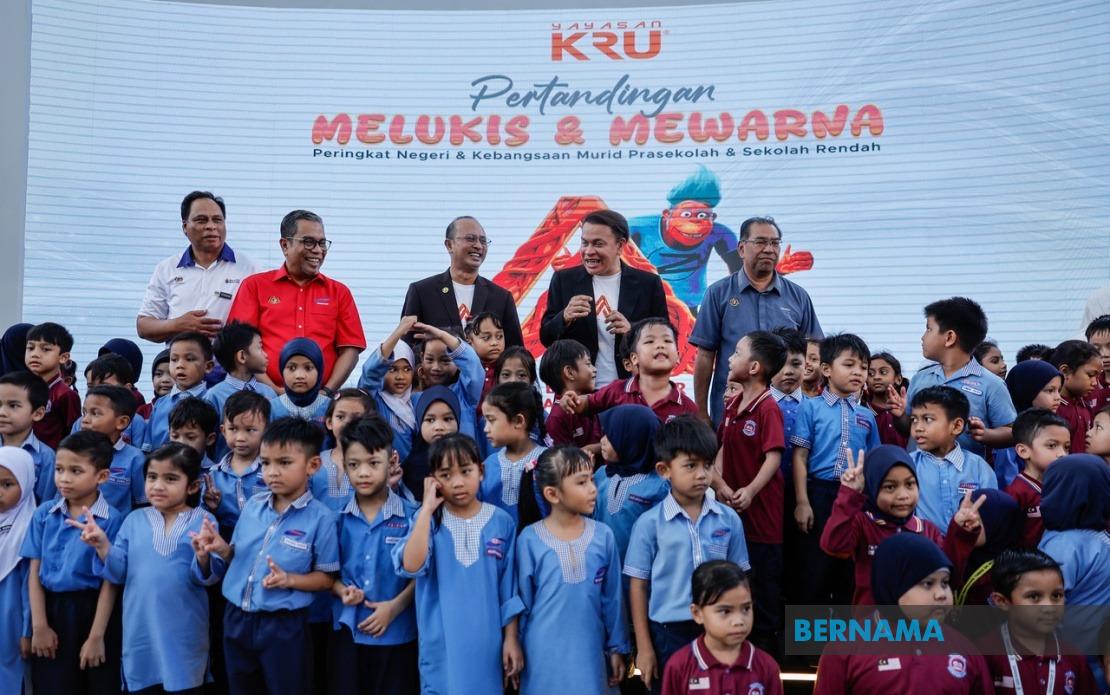
Yayasan KRU has secured a place in the Malaysia Book of Records following the unprecedented success of its AKAR 2026 colouring competition, which mobilised more than 153,000 preschool children across the country in a single coordinated event. The competition, which unfolded simultaneously in kindergartens nationwide, represents the largest participation ever recorded in such an initiative involving young learners, reflecting both the reach of Malaysia's early childhood education network and growing parental interest in structured creative activities for their children.
The breadth of participation underscores how early childhood development has become a priority within Malaysia's educational ecosystem. KEMAS and Unity kindergartens, which together serve tens of thousands of families, provided the infrastructure through which the competition reached this scale. This coordination across diverse institutional settings demonstrates the capacity of government-linked agencies to execute nationwide programmes efficiently, a capability that has implications beyond this single event for how other large-scale childhood initiatives might be organised in the future.
The programme draws support from a constellation of government bodies, signalling a whole-of-government approach to early education. The Education Ministry, the Community Development Department, the Department of National Unity and National Integration, and the National Higher Education Fund Corporation all lent institutional backing to AKAR 2026. This multi-agency collaboration reflects recognition that early childhood experiences shape not only individual development but also national social cohesion and environmental consciousness from an impressionable age.
Beyond the competitive element, the organisers embedded a substantive educational message through the "I Love Orangutans" campaign, which channelled the children's artistic efforts toward environmental conservation awareness. Rather than treating colouring merely as entertainment, the competition integrated messaging about biodiversity and habitat protection—critical concerns for Malaysia given the country's role as custodian of some of Southeast Asia's most biodiverse forests. Exposing five and six-year-olds to these themes establishes early foundations for environmental stewardship.
Yayasan KRU Board of Trustees president Datuk Norman Abdul Halim characterised the achievement as historic and emphasised that the event served dual purposes: unleashing children's creative potential while instilling environmental values. His framing positioned AKAR 2026 not as a mere competition but as an intervention in childhood development aligned with national priorities around both human capital and ecological sustainability. This philosophical underpinning distinguishes the initiative from purely commercial colouring contests.
The financial incentive structure reflects a commitment to recognising achievement while building long-term savings for participating families. Approximately RM100,000 in prize money will be distributed at state and national levels, with winnings deposited directly into beneficiaries' National Education Savings Scheme accounts. This mechanism serves multiple objectives simultaneously: it rewards excellence, provides financial support to families, and channels resources toward education through a dedicated savings vehicle. State-level winners advance to national finals scheduled for Putrajaya on August 29, where the top prize reaches RM3,000—a substantial sum that acknowledges the most accomplished young artists.
The tiered prize structure, from state to national levels, creates a pathway through which talented children receive recognition proportionate to their achievement. The opportunity to compete at Putrajaya's national finals also introduces participants to the capital and formal competitive environments, potentially broadening their horizons beyond their immediate communities. For many preschool participants, this represents their first experience with structured nationwide competition.
KEMAS director-general Datuk Mohd Hanafiah Man positioned creativity as essential to developing a competitive generation, a perspective that aligns with contemporary educational thinking emphasising soft skills alongside academic content. As Malaysia navigates economic transition and seeks to move up global value chains, the ability to think imaginatively and solve problems creatively becomes increasingly valuable in the labour market. Initiatives introducing these competencies at preschool age establish foundations that compound over years of schooling.
The participation of senior officials from multiple agencies at the official launch—including JPNIN director-general Datuk Zulkifli Hashim and PTPTN chief executive Ahmad Dasuki Abdul Majid—signals high-level institutional endorsement. Such visible backing from government leadership lends credibility to the programme and demonstrates commitment to early childhood development across the bureaucracy. It also suggests that AKAR 2026 may serve as a model for future nationwide childhood initiatives.
From a Malaysian perspective, the MBOR recognition carries symbolic weight beyond the participation numbers themselves. It positions Malaysia as capable of organising large-scale, coordinated childhood programmes that attract unprecedented engagement. This capacity matters for a nation conscious of its standing regionally and internationally, and it demonstrates that Malaysian institutions can mobilise resources effectively around developmental priorities. The record-breaking participation also provides reassurance to parents and educators that the infrastructure supporting early childhood education is robust and evolving.
The broader implications extend to how Southeast Asian nations might approach early childhood development coordination. Malaysia's demonstration that 153,000 young children could participate in a nationwide simultaneous event suggests possibilities for regional initiatives that transcend borders. Early childhood education, unlike many other sectors, remains relatively localised and fragmented across the region despite shared developmental challenges and opportunities.
Looking forward, AKAR 2026 establishes a foundation upon which future iterations might build. The combination of competitive incentives, environmental messaging, and accessible participation mechanics proved effective at mobilising engagement. Whether this success can be sustained and scaled—or replicated across other creative domains—will depend on continued institutional support and the willingness of government to invest in early childhood development as a strategic priority rather than ancillary provision.

