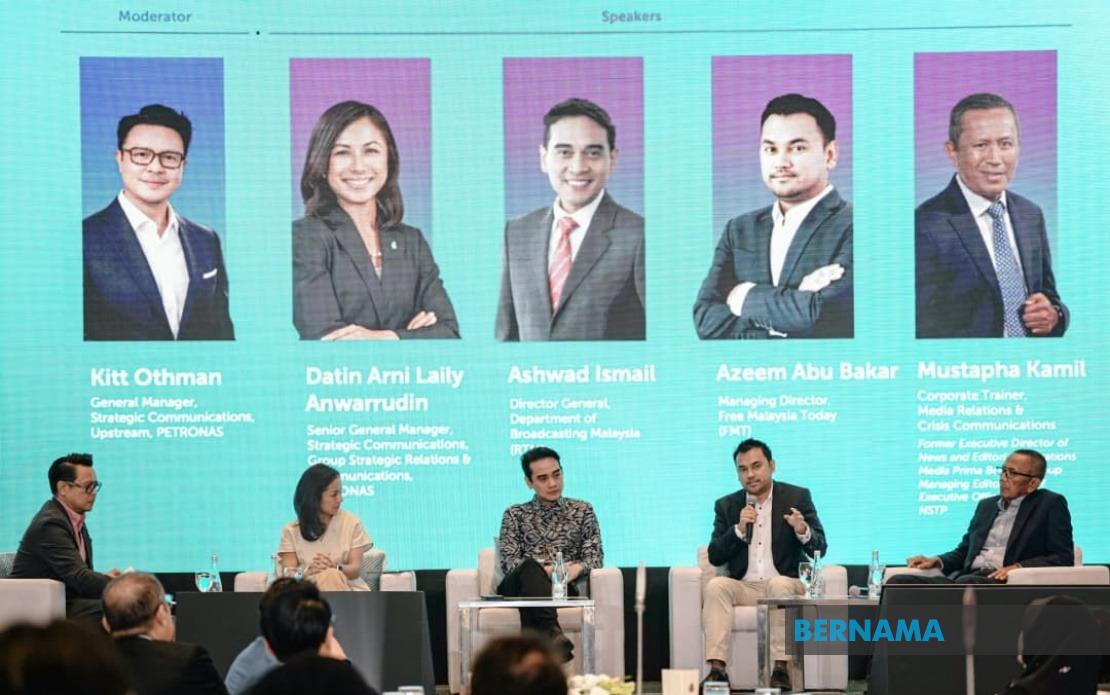
In a gathering that underscores the existential pressures facing communications professionals across the region, senior executives and media leaders converged in Kuala Lumpur to grapple with a central challenge of our time: how organisations maintain credibility when artificial intelligence can spread unverified claims faster than truth-checkers can respond. The discussion at the PETRONAS Lunch Escape 2026 programme, held under the banner of exploring media credibility and artificial intelligence, revealed a sector in transition, forced to abandon decades-old playbooks for untested strategies in an environment where the speed of information propagation has fundamentally altered the risk calculus for every major corporation.
Datin Arni Laily Anwarrudin, who leads strategic communications for PETRONAS, articulated the core predicament confronting large organisations: the velocity with which AI distributes false or misleading information now poses an existential threat to brand reputation, making the luxury of careful deliberation a commodity organisations can no longer afford. Her observation strikes at the heart of why this moment matters not just for Malaysia's energy sector but for multinational and domestic enterprises across Southeast Asia that increasingly must operate in spaces where misinformation travels at algorithmic speed. The challenge, as she framed it, extends beyond mere damage control—it speaks to a fundamental loss of narrative authority that characterises the digital age.
Central to her argument was an uncomfortable truth: organisations that fail to proactively shape their own stories invite others—whether competitors, activists, or bad-faith actors—to define them instead. This represents a philosophical shift from the defensive posture that characterised corporate communications for generations. Rather than responding to crises as they emerged, modern organisations must maintain an almost constant state of narrative readiness, ensuring that when incidents occur, they already command sufficient credibility and public goodwill to frame events on their own terms. For Malaysian companies seeking to maintain investor confidence and consumer trust, this reorientation carries profound implications, particularly as regional markets become more sophisticated in their consumption of information and more cynical about corporate communications.
The obsolescence of what Anwarrudin termed the "16-hour window"—a concept that once governed media cycles and allowed communications teams breathing room—underscores how radically the information landscape has shifted. That window, once the interval between a crisis breaking and newspapers hitting print, has collapsed entirely. News now propagates in minutes, not hours, through channels that bypass traditional gatekeepers. Mustapha Kamil Mohd Janor, drawing on his experience across multiple Malaysian media powerhouses, reinforced this reality, arguing that organisations lacking structured crisis communication teams operate in a state of dangerous vulnerability. His call to arms represented more than procedural advice; it reflected recognition that the communications function has moved from a support service to a frontline operation requiring the same strategic attention as any core business function.
Yet beneath this apparent crisis of speed and information overload lies a more subtle concern about authenticity and purpose. Ashwad Ismail and other panellists acknowledged that while technological disruption reshapes the mechanics of communication, the underlying mission of the media—to guide public understanding and support informed decision-making—remains constant. This observation carries particular weight in a Malaysian context where trust in institutions and media has become increasingly contested. The suggestion that journalism retains its searchlight function, illuminating society's options and consequences, implies that amidst the noise of AI-generated content and algorithmic amplification, human judgment and editorial integrity remain irreplaceable.
Free Malaysia Today's Azeem Abu Bakar offered a framework for understanding how media organisations specifically can navigate this transition: by developing what he termed "SUPER" journalists—professionals whose capabilities encompass sources, understanding, pattern recognition, efficiency, and reputation. This characterisation moves beyond job descriptions into a portrait of what journalism becomes when stripped of its accidental protective advantages. Journalists can no longer rely on being the only entities with means to disseminate information widely; their value now accrues from their ability to synthesise, contextualise, and verify information in ways that AI-driven systems, at least presently, cannot replicate. For Malaysian journalism, still developing its digital-first capabilities, this insight suggests that investment in reporter quality and editorial sophistication represents a competitive advantage that mere technological adoption cannot replicate.
The gathering revealed a shared conviction among corporate and media leaders that transparency has shifted from an ethical aspiration to a practical necessity. Anwarrudin's observation that opacity invites outside parties to fill informational vacuums reflects how the information ecology has changed. Organisations can no longer successfully maintain strategic silence; the vacuum created by withholding information will be populated by speculation, competitor narratives, or algorithmically-amplified conspiracy. For Malaysian corporations operating in sectors like energy, finance, or telecommunications—where stakeholder scrutiny runs high—this reality demands a fundamental recalibration of what information gets shared, when, and through which channels. The risk calculus has inverted: silence now carries greater reputational hazard than measured transparency.
Perhaps most significantly, the discussion illuminated how the AI era has collapsed the distinction between internal and external communications. What was once a carefully managed hierarchy of messages—investor communications differing from employee messaging, which differed from public statements—now flows through shared digital channels accessible to all audiences simultaneously. This collapse demands communications strategies that achieve coherence not through compartmentalisation but through genuine consistency. For Malaysian companies with complex stakeholder relationships across government, markets, communities, and international partners, this represents a fundamental challenge requiring both cultural and structural change.
The convening of these voices—from PETRONAS, RTM, Media Prima, FMT, and Bernama—suggested growing recognition across Malaysia's institutional landscape that the communications challenge before them demands collective intellectual effort. Individual organisations cannot solve these problems in isolation; the information ecosystem itself has become the competitive arena. Companies and media outlets that develop superior capabilities in verifying information, building credibility through consistent transparency, and engaging audiences with genuine understanding will thrive in the years ahead. Those that attempt to navigate this terrain using twentieth-century playbooks will find themselves increasingly irrelevant and vulnerable to the reputational consequences of AI-enabled information manipulation.

