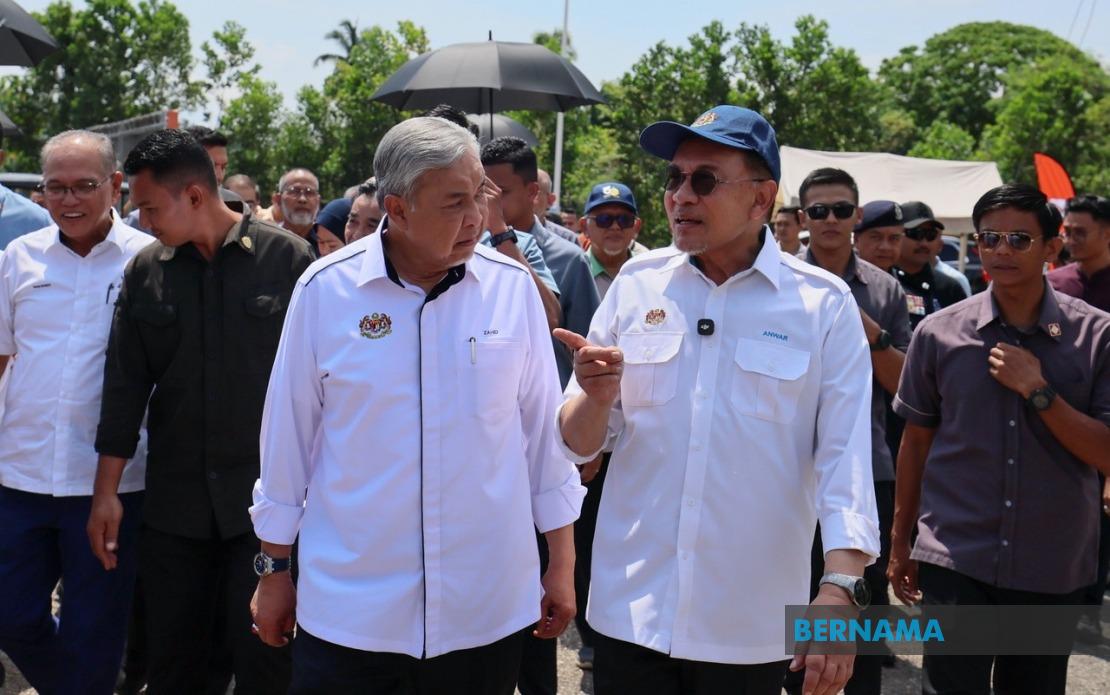
Deputy Prime Minister Datuk Seri Dr. Ahmad Zahid Hamidi has put forward a significant structural proposal to address FELDA's persistent financial difficulties: transferring portions of land currently under FGV Holdings Berhad's management back to the Federal Land Development Authority. The proposal was unveiled at the FELDA Settlers' Day and 70th Anniversary Celebration in Bandar Pusat Jengka, where Prime Minister Datuk Seri Anwar Ibrahim was also present, signalling high-level government focus on resolving one of the country's most pressing rural development issues.
The core logic behind Ahmad Zahid's proposal centres on operational efficiency and accountability. By having FELDA manage its own plantation operations rather than delegating to FGV, the authority would retain greater control over revenue generation and cost management. The Deputy Prime Minister, who simultaneously holds the portfolio of Minister of Rural and Regional Development, argued that this restructuring could meaningfully accelerate the process of settling accumulated debts while simultaneously channelling better financial returns to the farming communities who depend on FELDA's operations. This represents a departure from the earlier model where FGV served as a holding company managing FELDA's assets.
The financial scale of FELDA's challenges cannot be understated. According to information shared by Ahmad Zahid, the Federal Government currently expends nearly RM1 billion annually in direct assistance to FELDA. This substantial allocation covers various aspects including settler welfare and operational support, yet despite these injections, government projections suggest the organisation would require a minimum of nine years to restore itself to financial stability. The sheer magnitude of annual government support underscores why policymakers are considering more radical restructuring options rather than incremental reforms.
Prime Minister Anwar Ibrahim has previously characterised FELDA's debt situation as resulting from administrative weaknesses in earlier management periods. The government's position reflects acknowledgement that systemic problems, rather than temporary market fluctuations, created the current predicament. This framing is crucial for understanding why proposals like Ahmad Zahid's land transfer are gaining traction: they represent attempts to fundamentally alter operational structures rather than patch symptoms through continued subsidies.
The proposal carries particular significance for the multiple generations of FELDA settlers whose livelihoods depend on the organisation's viability. Ahmad Zahid explicitly emphasised that government priority must extend across first-generation settlers, their children, and grandchildren. For these communities, which often occupy relatively isolated agricultural areas, FELDA's financial health directly correlates with income stability, infrastructure development, and access to essential services. A more resilient FELDA operating under its own management could potentially translate into higher dividend distributions and better estate maintenance.
Beyond the land management question, the government is simultaneously addressing distress among members of Koperasi Permodalan FELDA (KPF), a cooperative investment mechanism through which settlers participated in shareholding. Ahmad Zahid disclosed that some KPF members urgently wish to redeem their shares due to disappointing dividend yields, a consequence of deteriorating stock market and property values. Approximately RM350 million is needed to facilitate these redemptions for members who face personal hardship, some having secured loans or liquidated property to purchase their shares.
The restructuring of KPF assets to enable share redemptions represents a parallel intervention addressing immediate member distress while FELDA undergoes longer-term restructuring. Ahmad Zahid indicated that this asset restructuring programme is advancing and must be concluded by year-end. For affected members, clearing this backlog would provide some financial relief, though it does not address the underlying question of why dividend yields fell so sharply. This suggests the government is balancing immediate humanitarian concerns against structural reform efforts.
The timing of these proposals reflects shifting political priorities since Anwar Ibrahim's government took office. Rural constituencies remain electorally significant, and FELDA communities represent a concentrated population whose economic security has visibly deteriorated over recent years. By presenting solutions that combine direct financial support with structural reform, the government signals responsiveness to rural grievances while attempting to project an image of serious problem-solving rather than indefinite subsidy dependence.
However, questions remain about the practicality and timeline for Ahmad Zahid's land transfer proposal. FGV Holdings exists partly because previous administrations believed consolidated management could achieve economies of scale and operational efficiency. Simply reversing this decision requires clarity on how FELDA would finance operations, recruit specialised management expertise, and compete in commodity markets where FGV's scale provides advantages. The proposal sketches a direction without detailing implementation challenges.
For Malaysian investors and observers monitoring rural development policy, these proposals signal potential significant changes to FELDA's structure. The organisation manages substantial land holdings across the country and operates with historical significance in post-independence rural development. Restructuring of this magnitude could create both opportunities and disruptions in the agricultural sector. Regional peers monitoring Malaysia's approach to state enterprise reform and rural fiscal sustainability may also draw lessons from how the government balances welfare obligations against financial viability.
The proposal also reflects broader conversations about asset ownership and management within Malaysian governance. Whether FELDA should function as an autonomous economic entity or primarily as a welfare instrument has long divided policymakers. Ahmad Zahid's proposal leans toward treating FELDA as a potentially self-sufficient agricultural operation rather than a permanent subsidy recipient, though the RM1 billion annual government support suggests the independence argument remains aspirational rather than immediately achievable.
Moving forward, the government faces the challenge of executing these interconnected reforms while maintaining settler confidence. The nine-year financial recovery timeline is lengthy enough to test political commitment across multiple election cycles. Success would require not merely transferring assets from FGV but fundamentally improving FELDA's operational performance, commodity market competitiveness, and cost efficiency. The coming months will reveal whether Ahmad Zahid's proposals transition from announcements into concrete implementation.

