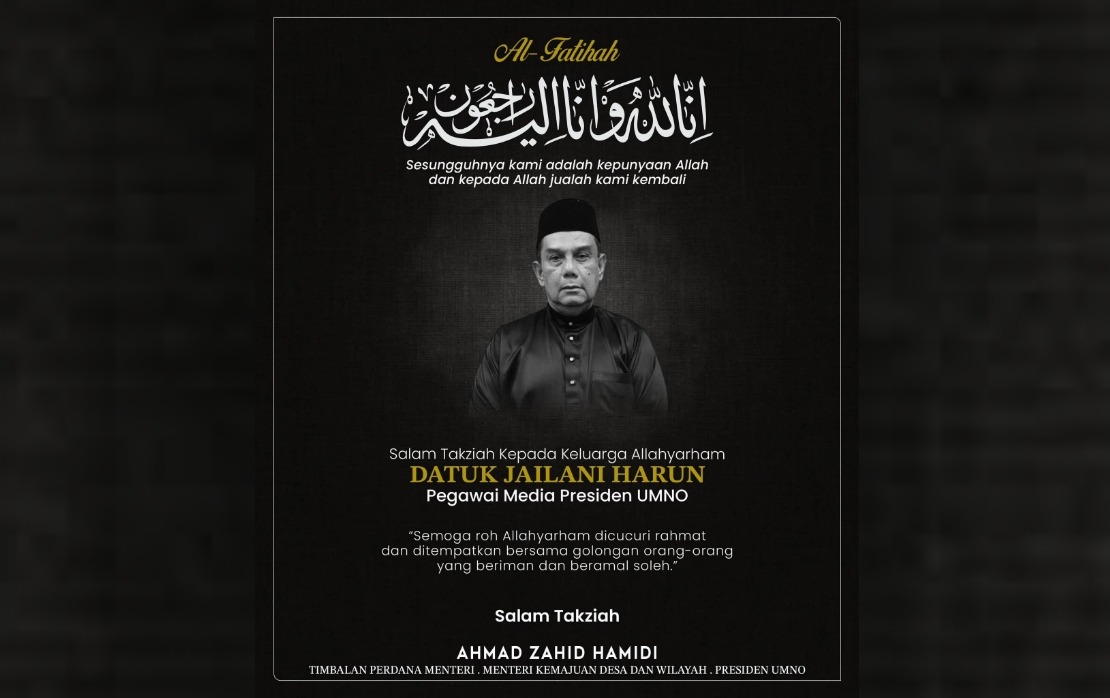
Deputy Prime Minister Datuk Seri Dr Ahmad Zahid Hamidi has expressed profound sadness following the passing of Datuk Jailani Harun, a veteran journalist and long-serving media officer at the UMNO President's Office. Jailani, who was 66, died on July 7 at Serdang Hospital in Kuala Lumpur, leaving behind a legacy of dedicated service to Malaysia's oldest political party during a significant period in its institutional development.
Ahmad Zahid, who also serves as UMNO president, made a personal visit to Serdang Hospital earlier that morning to see Jailani during his final hours. The encounter proved emotionally difficult for the senior politician, who spoke of his initial hope for recovery even as the gravity of Jailani's condition became apparent. In his public statement shared on Facebook, Ahmad Zahid recalled the visit with evident emotion, acknowledging that despite his prayers for a miraculous recovery, he ultimately accepted that divine will had determined otherwise.
The Deputy Prime Minister's tribute underscored Jailani's personal qualities and professional standing within UMNO circles. Ahmad Zahid characterised him as an individual distinguished by kindness, humility, and considerable respect among colleagues and peers. These attributes suggest that Jailani had cultivated meaningful relationships throughout his career in media and communications, earning esteem beyond mere professional obligation. In Malaysian corporate and political culture, such personal recognition often reflects deep integration within institutional networks and genuine appreciation from leadership.
Ahmad Zahid's condolences extended not merely to Jailani's immediate family but explicitly to his entire household, acknowledging the ripple effects of such loss across multiple generations and relationships. His prayer that the family be granted strength and fortitude in their grief followed conventional Islamic expressions of sympathy, reflecting both his personal faith and the cultural norms within Malaysia's Muslim-majority society. The sentiment carries particular weight coming from a national figure in a position of significant authority, offering not only personal sympathy but implicitly signalling UMNO's institutional acknowledgment of the loss.
The final arrangements for Jailani reflected Islamic burial practices within Malaysia's Muslim community. Following Jailani's death at 11:34 am, preparations proceeded for his internment at the Alam Damai Muslim cemetery in Cheras, with the ceremony scheduled after asar prayers. This timeline allowed family members and colleagues adequate notice to participate in funeral rites, and the choice of cemetery location within Kuala Lumpur suggested either family residence or long-standing community connections in the capital.
Jailani's career trajectory bridged journalism and political communications at a particularly dynamic juncture in Malaysian politics. His transition from independent journalism to serving as a media officer for UMNO's president reflected the common pattern among communications professionals who move between media institutions and political party positions. Such career movements, while raising questions about editorial independence in some contexts, remain standard practice in Malaysian political and corporate spheres, where professional networks often facilitate lateral movement between sectors.
The timing of Jailani's death occurred during a period of considerable activity within UMNO following the party's 2022 general election performance. As UMNO works to consolidate its position within Malaysia's political coalition and manage internal dynamics, the loss of an experienced media officer represents not merely personal loss but institutional consequence. Veterans of political communications carry institutional memory, established media contacts, and nuanced understanding of party messaging strategies that cannot be easily replicated through standard recruitment.
Jailani's role specifically positioned him at the intersection of UMNO's presidential office and public communications, suggesting direct involvement in high-level messaging strategy and media relations. The UMNO president's office represents the party's authoritative voice on major policy positions and strategic direction, making media officers in such positions integral to how the party communicates with both the broader Malaysian public and its own membership. Jailani's experience would have encompassed various political transitions, electoral campaigns, and institutional challenges across multiple administrations.
The recognition of Jailani's contributions through Ahmad Zahid's public tribute reflects broader Malaysian practice of acknowledging long-serving officials who contribute to institutional continuity. In Malaysian organisations, both governmental and political, recognition of retiring or deceased personnel often serves to reinforce institutional values and demonstrate appreciation for behind-the-scenes contributors whose work receives limited public attention. Such acknowledgments also serve to strengthen morale among remaining staff by demonstrating that dedicated service receives recognition at the highest levels.

