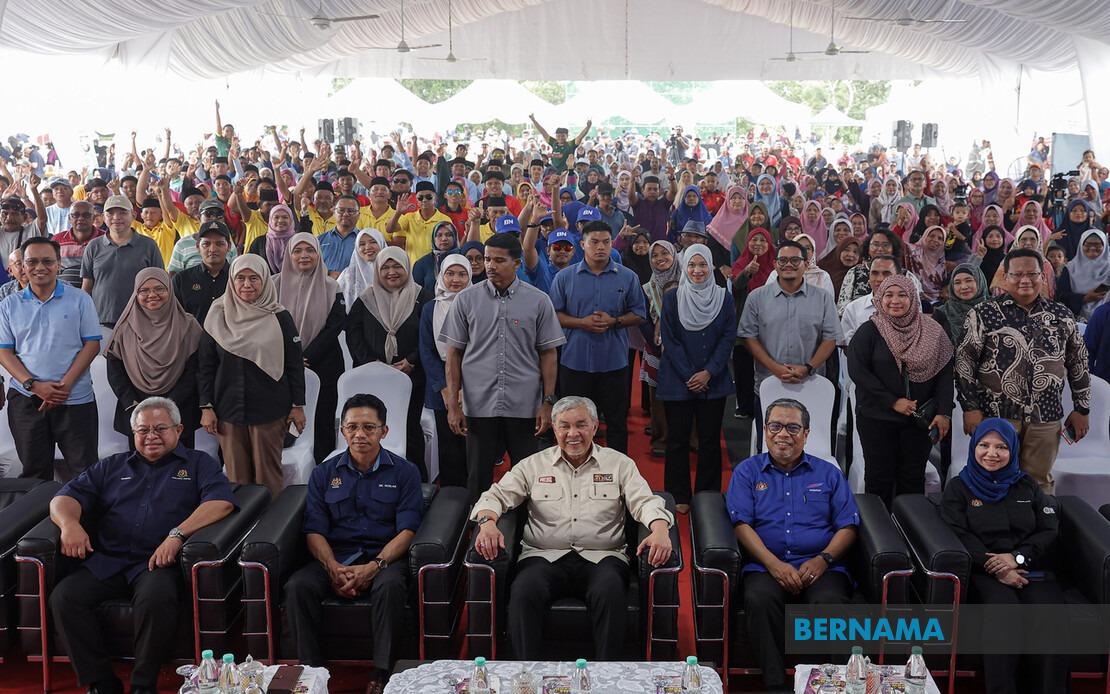
Barisan Nasional chairman Datuk Seri Dr Ahmad Zahid Hamidi has signalled that Malaysia's unpredictable political terrain necessitates a fundamental rethinking of how established coalitions operate and cooperate. Speaking at an event near Jempol in Negeri Sembilan, Ahmad Zahid underscored that the traditional playbook governing party alliances no longer suffices in an era marked by rapid realignments and shifting voter sentiment. His remarks reflect growing acknowledgment within BN leadership that the 2023 general election's fragmented outcome and subsequent state-level volatility demand fresh strategic frameworks to maintain coherence across the federation.
Central to Ahmad Zahid's vision is the working arrangement between Barisan Nasional and Perikatan Nasional in the forthcoming Negeri Sembilan state election, which he characterises as a pilot programme for broader cooperation. This arrangement, he emphasised, will determine whether similar understandings should be extended to other contests, notably the Melaka state election and the anticipated sixteenth general election. The strategic logic underlying this incremental approach is straightforward: by testing coalition mechanics in a lower-stakes state election, both BN and PN can identify potential synergies and friction points before committing to nationwide coordination that might reshape Malaysian politics for years to come.
The distinction Ahmad Zahid drew between formal coalition architecture and practical vote-coordination mechanisms reveals the evolving nature of Malaysian political agreements. He stressed that the BN-PN understanding does not constitute a binding formal alliance with entrenched institutional structures or shared policy platforms. Instead, it represents a tacit accommodation focused on a narrower, instrumental objective: preventing the wasteful fragmentation of anti-opposition votes through overlapping candidacies in the same constituencies. This calibrated approach allows both coalitions to maintain organisational independence whilst achieving tactical synchronisation where their interests align, a pragmatism born from the realisation that rigid, all-encompassing alliances increasingly prove unstable in contemporary Malaysian politics.
The mechanics of this arrangement centre on seat-sharing discipline and candidate coordination. By ensuring that neither BN nor PN fields candidates in constituencies where the other is already contesting, both coalitions theoretically maximise their combined electoral efficiency. The alternative—competing directly in the same seats—risks splitting votes amongst allied parties, potentially allowing opposition candidates to claim victories with mere pluralities. This danger became starkly apparent in recent elections where fractionalised anti-government voting patterns inadvertently benefited opposition candidates, a lesson Ahmad Zahid and other BN strategists have clearly internalised.
The Negeri Sembilan state election, scheduled for early voting on July 28 with polling day on August 1, assumes outsized significance within this broader strategic framework. As the experimental ground for BN-PN cooperation, the results will provide empirical evidence about whether such arrangements can deliver mutual benefits. A successful outcome would likely embolden both coalitions to extend similar arrangements to Melaka and beyond, gradually reshaping the competitive landscape heading into the general election. Conversely, a disappointing performance might necessitate a return to more adversarial relationships or encourage exploration of entirely different coalition configurations.
The timing of Ahmad Zahid's statements reflects the fluid nature of Malaysian coalition politics in the post-2023 environment. The absence of a dominant governing coalition with clear parliamentary supermajorities has created space for more fluid, seat-specific arrangements that would have seemed unthinkable in earlier decades. Both BN and PN, whilst maintaining organisational separation and distinct political identities, have incentives to prevent outcomes where opposition parties—whether Pakatan Harapan or other groupings—consolidate power in state legislatures or Parliament. This shared defensive interest, rather than positive ideological alignment, increasingly drives cooperation amongst non-opposition coalitions.
For Malaysian voters and political observers, Ahmad Zahid's comments signal that the coming years will likely witness continued experimentation with coalition structures and electoral arrangements. The traditional model of binary competition between monolithic blocs appears increasingly obsolete, replaced by more flexible architectures adapted to the fragmented, multi-polar political landscape that has emerged. This creates both opportunities and risks: opportunities for more nuanced political competition and representation, but risks of continued instability as coalitions repeatedly recalibrate in response to electoral results and leadership changes.
The implications extend beyond domestic politics. Regional powers monitoring Malaysia's governance stability will note that political leadership is attempting to devise mechanisms to reduce volatility through procedural innovations rather than addressing underlying substantive divisions. Whether coordination on candidate placement genuinely enhances stability or merely postpones deeper reckoning with fractionalised public opinion remains to be seen. The coming general election, whenever it is called, will represent a critical test of whether Ahmad Zahid's strategy of calibrated coalition building can deliver the political stability that Malaysia's economic and security challenges increasingly demand.

