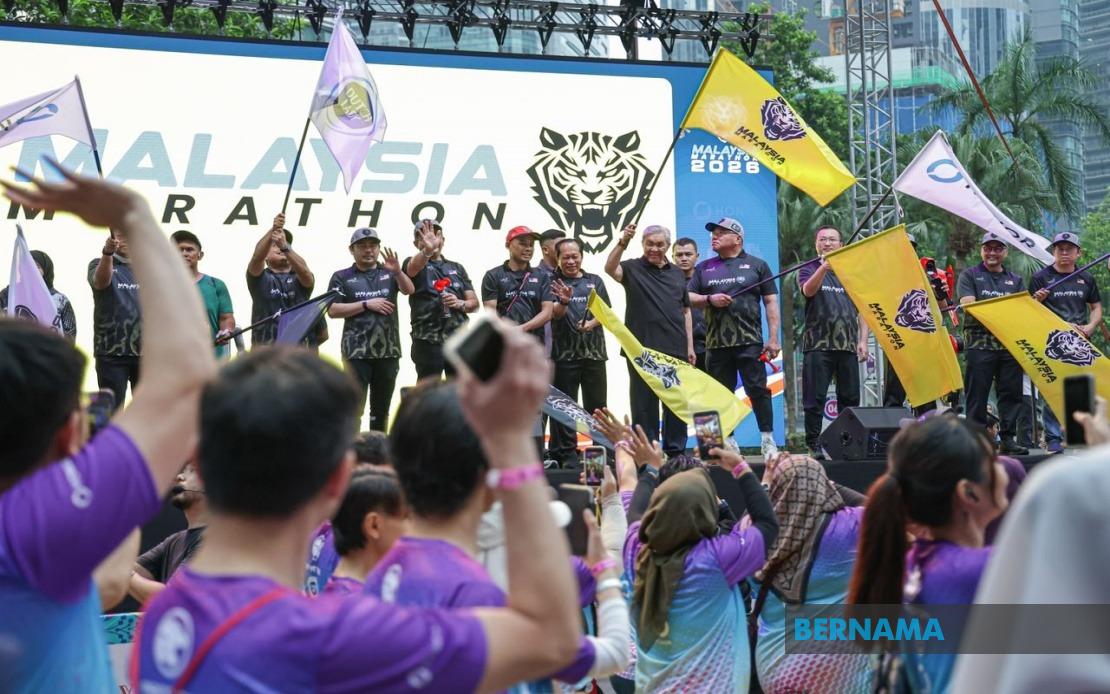
Deputy Prime Minister Datuk Seri Dr Ahmad Zahid Hamidi officially inaugurated the Malaysia Marathon 2026 on Saturday, dispatching 10,000 runners into a five-kilometre fun run at the Kuala Lumpur City Centre grounds. The launch ceremony, held as part of the nation's 2026 National Day commemorations, featured a full programme of patriotic performances and ceremonial elements before participants set off on their course. Tourism, Arts and Culture Minister Datuk Seri Tiong King Sing and Deputy Works Minister Datuk Seri Ahmad Maslan attended the event, underscoring the government's commitment to promoting national sporting initiatives and community engagement.
The morning's programme opened with the national anthem, 'Negaraku', performed by assembled participants and officials. Following this ceremonial opening, musicians from the Malaysian Armed Forces band took to the stage, providing live entertainment that energised the crowd gathered at the sprawling KLCC grounds. The patriotic atmosphere was further enhanced by a one-kilometre-long parade featuring the Malaysian flag, in which approximately 1,000 students from Kolej Poly-tech MARA (KPTM) Bangi participated. This integration of youth participation alongside the main racing event reflected efforts to instil national pride and sporting values among younger Malaysians.
The Malaysia Marathon 2026 represents a significant milestone as an inaugural event, having already achieved recognition from World Athletics, the international governing body for track and field sports. This accreditation lends credibility to the event on the global stage and positions Malaysia as a serious host for international athletics competitions. The first edition successfully attracted a substantial crowd, drawing together 25,000 competitors comprising both domestic runners and international participants across four distinct race categories. Such participation levels indicate strong appetite for large-scale sporting events in Malaysia and reflect the growing fitness consciousness among the regional population.
The marathon's structure accommodated runners of varying abilities and fitness levels through its tiered category system. The full marathon distance of 42 kilometres was flagged off by Minister Tiong from Pavilion Kuala Lumpur, with 2,000 participants commencing from that starting point. The intermediate half-marathon course of 21 kilometres drew 8,000 competitors, while the 10-kilometre category attracted 5,000 runners. This graduated approach ensured inclusivity, allowing recreational joggers and serious athletes alike to participate according to their capability and preference. The staggered starts throughout the morning meant that different groups of participants could begin their races at optimised times.
A notable operational change for this edition was the relocation of the finish line from its traditional venue at Dataran Merdeka to the KLCC grounds, which served as the common finishing point for all four race categories. This consolidation simplified logistics for organisers and created a unified celebration area where all participants could converge regardless of their starting distance. The KLCC location, being a prominent urban landmark readily accessible to the city centre, enhanced visibility for the event and facilitated spectator attendance. This adjustment demonstrates organisers' flexibility in adapting venue arrangements to accommodate the expanded scale of the 2026 edition.
The timing of the marathon launch as part of National Day celebrations carries symbolic significance, linking sporting achievement with patriotic fervour. By incorporating the event into the nation's annual commemorative calendar, Malaysian authorities have positioned athletic excellence as an expression of national identity and collective pride. This approach aligns with regional trends where Southeast Asian nations increasingly utilise sporting events as platforms for nation-building and international soft power projection. The integration resonates particularly in Malaysia's multicultural context, where large-scale, inclusive sporting events serve as unifying experiences transcending ethnic and religious boundaries.
The event's success in attracting world-class recognition and substantial international participation positions the Malaysia Marathon 2026 as a potential flagship sporting property for the nation. As global running communities continue expanding post-pandemic, major marathons have become increasingly valuable as tourism generators, economic stimulators, and lifestyle promotion vehicles. Malaysia's capacity to host such events demonstrates its infrastructure maturity and organisational capability, potentially opening doors for hosting larger international sporting competitions. The participation of government ministers in the launch ceremony underscores the political priority placed on developing the nation's sporting profile.
The involvement of KPTM students in the flag parade segment illustrates the government's strategy of connecting younger Malaysians with national sporting initiatives. Educational institutions have become crucial partners in scaling such events, simultaneously providing students with experiential learning opportunities and strengthening community bonds around shared national objectives. This youth engagement model has proven effective in other Southeast Asian contexts and may serve as a template for future large-scale events. The visible participation of students in ceremonial roles helps normalise sporting culture among younger demographics, potentially cultivating long-term interest in athletics and fitness pursuits.
The Malaysia Marathon 2026 reflects broader regional trends towards health-conscious living and active recreation, particularly in urban Southeast Asian populations. As prosperity increases across the region, participation in recreational running has surged dramatically over the past decade. Malaysia, as one of Southeast Asia's more affluent economies with established urban infrastructure, finds itself well-positioned to capitalise on this trend. The event's success provides momentum for organisers to develop it into an annual fixture on Malaysia's sporting calendar, potentially rivalling established marathons in other regional cities like Singapore and Bangkok.
Looking forward, the inaugural Malaysia Marathon 2026 has established important benchmarks for future editions. The World Athletics recognition grants organisers credibility for pursuing continuous improvement and seeking higher standards of international participation. Organisational learnings from this inaugural event, particularly regarding the finish line relocation and multiple race categories, will inform strategies for scaling the event further. As Malaysia continues developing its positioning as a regional sporting hub, the marathon represents an accessible, mass-participation platform that complements more elite-focused international competitions. The convergence of government support, corporate involvement, and community enthusiasm suggests this event has strong foundations for sustained growth and increasing prominence within Malaysia's sporting landscape.

