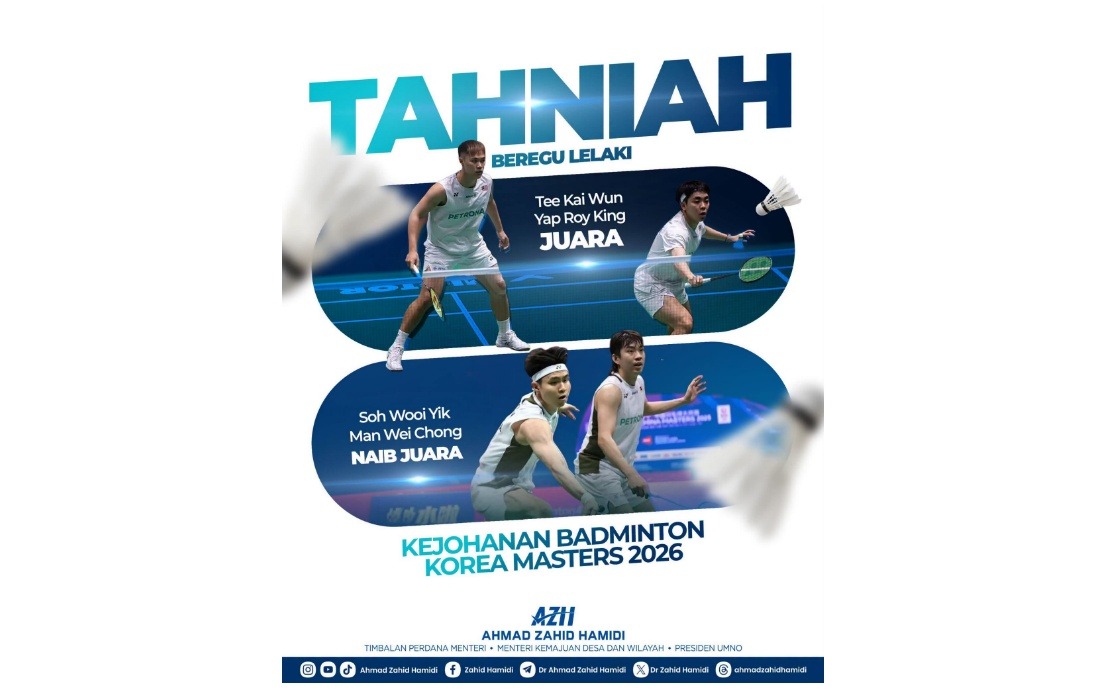
Malaysia's badminton prowess on the international circuit received a boost of recognition from the highest levels of government when Deputy Prime Minister Datuk Seri Dr Ahmad Zahid Hamidi publicly acknowledged the stellar performance of two local men's doubles teams at the 2026 Korea Masters Badminton Championships. The tournament, held at the Yi Sun-sin Gymnasium in Asan, South Korea, delivered a particularly encouraging result for the national badminton programme, with Malaysian pairs occupying both the championship and runners-up positions in the men's doubles category.
The championship title went to Tee Kai Wun and Yap Roy King, who secured a convincing victory in what marked their debut appearance at the prestigious Korea Masters event. Their opponents in the final were fellow Malaysians Soh Wooi Yik and Man Wei Chong, creating a distinctly Malaysian final that highlighted the depth of talent currently available in the men's doubles discipline. The champions triumphed with a decisive scoreline of 21-13, 21-18, completing the match in just 31 minutes and demonstrating both technical superiority and match fitness against their compatriots.
Ahmad Zahid's public acknowledgment, conveyed through a social media statement, framed the achievement as a significant morale boost for the national badminton programme and the broader sporting aspirations of the country. He emphasised that such international success served as vital motivation for athletes to continue pursuing excellence on the world stage, particularly in a sport where Malaysia has historically maintained a competitive edge. The deputy premier's intervention underscores how badminton achievements carry weight at the highest echelons of Malaysian politics, reflecting the sport's cultural significance within the nation.
The competitive nature of the final between the two Malaysian pairs was particularly noteworthy, as it demonstrated that success in international badminton is not concentrated among a single dominant partnership but distributed across multiple competitive units. This diversification of medal-winning potential is strategically valuable for Malaysia's long-term badminton development, as it suggests a broader pipeline of talent capable of delivering results against international opposition. The closely-contested match between Kai Wun-Roy King and Wooi Yik-Wei Chong, according to Ahmad Zahid's characterisation, reflected the quality of play that Malaysian audiences and administrators have come to expect.
Historically, the Korea Masters represents one of the more challenging tournaments on the international badminton calendar, and Malaysia's achievement takes on additional significance given this context. The tournament's prestige within the sport means that victories here carry particular weight in terms of world rankings and international recognition. For Tee Kai Wun and Yap Roy King, their maiden Korea Masters triumph establishes them as serious contenders on the international circuit and validates their partnership as capable of competing at the highest level.
The success of Soh Wooi Yik in particular represents continuity in Malaysian badminton excellence, as he previously partnered with Aaron Chia to claim the men's doubles crown at the 2024 Korea Masters. This earlier achievement made Malaysia only the second nation to win the Korea Masters title in recent iterations of the tournament, a distinction that reflects the high calibre of badminton being produced domestically. The fact that Wooi Yik has now reached the final of this tournament on consecutive occasions underscores his status as one of Asia's premier male doubles players.
The partnership of Soh Wooi Yik with Man Wei Chong represents an interesting development in Malaysian doubles badminton, as it shows the programme's flexibility in forming competitive pairings and the willingness to experiment with different player combinations to maximise success. This approach has clearly borne fruit at the Korea Masters, where the pairing demonstrated sufficient quality to advance through the tournament and secure a finals berth. Such tactical adaptability in team selection suggests a maturing approach to badminton management within the national programme.
From a Southeast Asian perspective, Malaysia's performance at the Korea Masters carries broader implications for the region's badminton standing. While South Korea and Indonesia have historically been dominant forces in badminton, Malaysia's consistent ability to produce champions and competitive finalists across multiple tournaments demonstrates that regional competitiveness remains robust. The performance also suggests that Malaysian coaching structures, training facilities, and player development pathways continue to produce world-class athletes capable of winning against the best international opposition.
The recognition extended by Ahmad Zahid reflects a broader understanding within Malaysia's political establishment that sporting success contributes meaningfully to national pride and international standing. Badminton, in particular, holds a special place in Malaysian national consciousness given the country's historical achievements in the sport and the enduring popularity of badminton among Malaysian communities. When political leaders actively congratulate athletes and teams, they reinforce the message that sporting excellence aligns with national priorities.
Looking forward, the performances at the Korea Masters should serve as a foundation for Malaysian badminton's preparation for upcoming major tournaments, including world championships and Olympic qualification events. The emergence of Tee Kai Wun and Yap Roy King as Korea Masters champions provides the national programme with additional depth in the men's doubles category and creates competitive pressure that should elevate overall standards. The success also underscores the importance of sustained investment in badminton development, from grassroots facilities through to elite training programmes and international competition participation.
The congratulations extended by the Deputy Prime Minister should be understood not merely as ceremonial acknowledgment but as part of a broader government commitment to sports development within Malaysia. High-level political recognition of sporting achievements can translate into sustained funding, improved facilities, and policy support that directly benefits athlete welfare and performance. In this context, Ahmad Zahid's Facebook post represents a tangible link between Malaysia's sporting community and the nation's political leadership, affirming that badminton success contributes to Malaysia's standing both regionally and globally.

