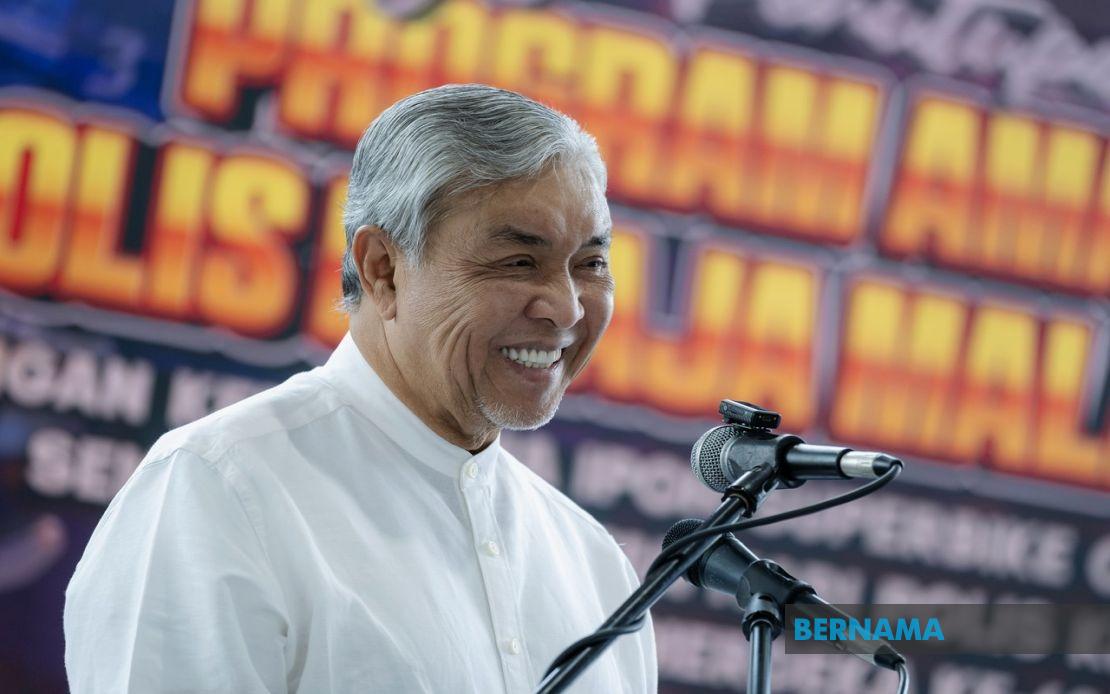
Deputy Prime Minister Datuk Seri Dr Ahmad Zahid Hamidi has stressed the importance of Malaysian motorcyclists adhering to the traffic laws and regulations of countries they visit, framing compliance as essential to maintaining harmonious relations across Southeast Asia. Speaking at the Kuala Lumpur Police Contingent Headquarters following the closing ceremony of the Negeri Sembilan Contingent Charity Ride programme, Ahmad Zahid presented a vision of regional cooperation rooted in mutual respect and legal compliance rather than confrontation or selective rule-following.
The Deputy Prime Minister's remarks came in response to a high-profile incident in Hat Yai, Thailand, where a group of Malaysian high-powered motorcycle riders were issued traffic summonses by Thai police. The incident gained significant traction on Malaysian social media, with some online commentators alleging that Thai authorities had overstepped their authority or treated the riders unfairly. Thai police, however, rejected these characterisations and clarified that the fines were issued for legitimate traffic violations, specifically the unauthorised use of flashing lights and modified exhaust systems that produced noise levels exceeding legal limits.
Ahmad Zahid's intervention into the matter reflects a broader diplomatic concern about how isolated incidents involving Malaysian citizens abroad can escalate into bilateral irritants if not carefully managed. The Deputy Prime Minister's framing pivots away from questions of whether Thai enforcement was proportionate, instead emphasising that Malaysian nationals must proactively ensure they are complying with local regulations before crossing borders. This approach suggests a deliberate effort to depoliticise what could become a point of friction between Kuala Lumpur and Bangkok, particularly given the informal networks of motorcycle enthusiasts that span both countries.
The Deputy Prime Minister articulated a principle of self-responsibility that extends beyond individual riders to reflect broader ASEAN values. He stated that tolerance and understanding of neighbouring countries' regulations were crucial pillars for maintaining functional interstate relations, and that Malaysian travellers should recognise they are guests in foreign jurisdictions. This messaging carries implications for how Malaysia positions itself within the regional bloc, particularly as border mobility and cross-national tourism expand among ASEAN members.
Ahmad Zahid also flagged a reciprocal concern regarding foreign-registered vehicles operating within Malaysian territory in breach of local traffic laws. This symmetry in his remarks indicates that the issue extends beyond Thai-Malaysian tensions and reflects a broader challenge across the region: how to harmonise enforcement standards and expectations when citizens and vehicles frequently cross porous borders. The Deputy Prime Minister indicated that Malaysia is actively investigating instances of foreign vehicle violations, suggesting a need for clearer protocols or bilateral agreements on traffic enforcement and dispute resolution.
The mechanism for addressing such cross-border regulatory conflicts, Ahmad Zahid suggested, lies within existing institutional frameworks. He proposed that issues stemming from differing traffic enforcement standards or specific incidents could be discussed and resolved through the Annual Consultation Meeting platform convened between Prime Minister Datuk Seri Anwar Ibrahim and other ASEAN leaders. This diplomatic pathway reflects a preference for high-level political engagement over contentious public disputes, allowing both governments to address the issue without loss of face or escalation through social media commentary.
Beyond the regulatory framing, Ahmad Zahid took the opportunity to celebrate the Charity Ride programme, which successfully mobilised 53 companies to contribute funds totalling RM102,000. The charitable initiative, organised in conjunction with Police Day and Merdeka celebrations, distributed the collected funds to support 120 Royal Malaysia Police families and 12 welfare homes along the convoy route. This charitable dimension underscores how organised motorcycle communities can serve as platforms for social contribution and civic engagement, potentially positioning responsible riding culture as compatible with legal compliance and community values.
Ahmad Zahid further signalled his personal commitment to expanding such initiatives, expressing his intention to participate in a large-scale motorcycle convoy programme scheduled for the 70th National Day and 220th Police Day celebrations in 2025. He suggested the event should aim to attract at least 220 riders, indicating an ambition to harness the enthusiasm and organisational capacity of the motorcycle community for purposes that align with national celebrations and social welfare. This forward-looking stance suggests that rather than viewing motorcycle culture as primarily a source of regulatory friction, Malaysian authorities are exploring how to channel it constructively.
The broader context of Ahmad Zahid's remarks reflects evolving attitudes within ASEAN toward managing informal cross-border mobility and community-driven activities. As motorcycle culture expands throughout Southeast Asia, with informal networks of enthusiasts frequently organising rides and gatherings across national borders, governments face the challenge of balancing openness to such activities with enforcement of legitimate safety and environmental standards. The Thai authorities' action against the Malaysian riders, though presented as straightforward traffic enforcement, touched on questions about noise pollution and modifications that are increasingly regulated across the region as urbanisation intensifies.
Malaysia's positioning on this issue is particularly significant given the country's role as a regional hub and its significant motorcycle-riding population. The Deputy Prime Minister's emphasis on voluntary compliance and mutual respect, rather than defensive nationalism, may set a tone for how Malaysia handles future cross-border incidents involving its citizens. By framing the issue as one of citizenship responsibility and regional comity rather than bilateral grievance, Ahmad Zahid has attempted to establish a principle that Malaysian travellers, regardless of their social status or community affiliation, are bound by the same legal standards as any foreign visitor.
The incident in Thailand also underscores the power of social media in amplifying isolated events into perceived diplomatic issues. The viral video alleging mistreatment of Malaysian riders demonstrates how quickly narratives can take hold in the digital sphere, sometimes outpacing official fact-checking or contextual explanation. Ahmad Zahid's intervention serves partly to counter such narratives by reframing the issue through the lens of legal responsibility, effectively asking the Malaysian motorcycle community to internalise standards of compliance before embarking on international rides.
Looking forward, the annual bilateral consultations between Malaysian and Thai leadership provide a framework for harmonising traffic enforcement standards and perhaps establishing clearer guidelines for what constitutes excessive modification or dangerous riding practices. As ASEAN deepens economic integration and cross-border movement accelerates, such collaborative efforts at regulation harmonisation may become increasingly important. The charitable ride programmes championed by Ahmad Zahid represent an alternative model where motorcycle communities contribute to social welfare rather than merely generating regulatory concerns.

