Agrobank has successfully mobilised over RM8 million in financing applications through a series of grassroots engagement sessions targeting hawkers and micro-entrepreneurs, signalling strong appetite among small traders for accessible credit facilities tailored to their operational needs. The initiative represents a deliberate shift towards breaking down barriers to formal financing, moving banking services beyond conventional branch locations into the heart of trading communities where small business operators actually conduct their daily commerce.
The bank's expansion into Sabah marks a strategic escalation of its community-based approach, bringing the outreach programme to night markets and farmers' markets in Kota Kinabalu and Papar following successful engagements across multiple locations in the Klang Valley region. This geographic expansion underscores recognition within Malaysia's financial sector that East Malaysian traders face distinct operational constraints and information gaps when accessing formal banking services, requiring customised engagement strategies rather than one-size-fits-all metropolitan-focused policies.
During the Api-Api Night Market session, Agrobank engaged directly with 153 individual hawkers and small entrepreneurs, while the subsequent Tamu Papar Farmers' Market interaction reached an additional 95 traders. These concentrated engagement efforts went beyond simple loan marketing, instead focusing on diagnostic conversations to identify specific financing requirements, with particular emphasis on working capital needs and structured expansion planning for established micro-enterprises. The selection of these specific venues reflected deliberate targeting of economic hubs where traders cluster, understanding that night markets and farmers' markets function as essential circulatory systems within local economic ecosystems across Sabah.
The engagement sessions operated on a premise that conventional banking outreach mechanisms often fail to address the contextual realities of informal-economy participants. By deploying banking personnel directly to trading locations during operational hours, Agrobank sought to reduce the friction and intimidation factors that frequently prevent hawkers from pursuing formal financing, replacing impersonal loan application processes with face-to-face conversations grounded in the traders' commercial realities. This methodology acknowledges that many small operators possess viable businesses and repayment capacity but lack familiarity with banking protocols, collateral documentation standards, or standardised business planning frameworks that formal lenders typically require.
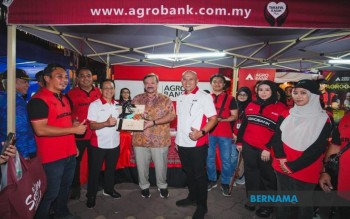
Finance Minister II Datuk Seri Amir Hamzah Azizan's presence at the Api-Api session underscored government alignment with Agrobank's community banking model, signalling ministerial support for financial institutions willing to undertake higher-touch engagement with underserved trader populations. This political backing carries significance beyond symbolic gestures, as it reinforces policy direction at the highest fiscal governance levels and potentially influences how competing financial institutions calibrate their own small business lending strategies and resource allocation decisions.
Agrobank Group president and chief executive officer Datuk Tengku Ahmad Badli Shah Raja Hussin articulated the fundamental principle underlying the initiative: acknowledging that business ecosystems vary dramatically between metropolitan centres and smaller East Malaysian communities. The banker emphasised that standardised approaches frequently overlook location-specific challenges, whether related to commodity price volatility, seasonal revenue fluctuations, supply chain vulnerabilities, or infrastructure constraints that characterise Sabah's trading environment. By implanting banking expertise within local trading communities rather than expecting traders to navigate unfamiliar urban financial districts, Agrobank positioned itself as responsive to grassroots economic realities rather than perpetuating conventional banking distance.
The bank's commitment extended beyond simple capital provision to encompassing financial advisory services and non-financial support mechanisms aimed at professionalising how micro-entrepreneurs manage working capital, maintain accounting records, and structure expansion investments. This holistic approach recognises that capital constraints often reflect underlying business management deficiencies rather than trading acumen alone, and that sustainable lending requires simultaneously building borrower financial literacy and operational discipline alongside providing funds.
The financing mobilisation also aligned directly with Prime Minister Datuk Seri Anwar Ibrahim's directive requiring financial agencies to intensify small-trader outreach and accelerate disbursement from an allocated RM5 billion financing pool targeting informal-economy participants. This RM8 million accumulation through Agrobank sessions represents early validation that when banking services physically locate within trading communities and employ simplified application processes, demonstrated demand for small business financing significantly exceeds what conventional branch-based metrics typically suggest.
For Malaysian policymakers, the Sabah results illuminate a wider challenge: Malaysia's formal financial system has historically underserved the distributed network of hawkers, market vendors, and micro-entrepreneurs who collectively represent substantial employment and economic activity yet remain underbanked relative to their contribution to local economies. Agrobank's ground-level approach offers a replicable model for other financial institutions to consider, particularly as pressure mounts on government to reduce inequality and expand economic opportunity beyond metropolitan-concentrated business networks.
The implications for Southeast Asia extend beyond Malaysia's borders. Across the region, similar trader populations operate within comparable informal-economy structures with analogous financing constraints. Thailand, Indonesia, and the Philippines each confront equivalent challenges of extending formal financial access to distributed hawker and market-trader communities. Agrobank's methodology potentially provides a transferable template for regional financial institutions seeking to deepen market penetration while simultaneously advancing financial inclusion agendas that governments across Southeast Asia increasingly prioritise as development imperatives.
Looking forward, the volume of applications generated through these engagement sessions suggests substantial untapped demand for structured financing among East Malaysian traders. If Agrobank sustains engagement frequency and progressively refines its underwriting processes based on Sabah portfolio performance, the model could catalyse broader financial sector repositioning toward ground-level community engagement as a competitive differentiator. Simultaneously, successful completion of these initial financings will prove crucial for validating the commercial viability of high-touch small-trader lending, directly influencing whether competing banks subsequently commit resources to similar community-based outreach or maintain traditional metropolitan-focused strategies.

