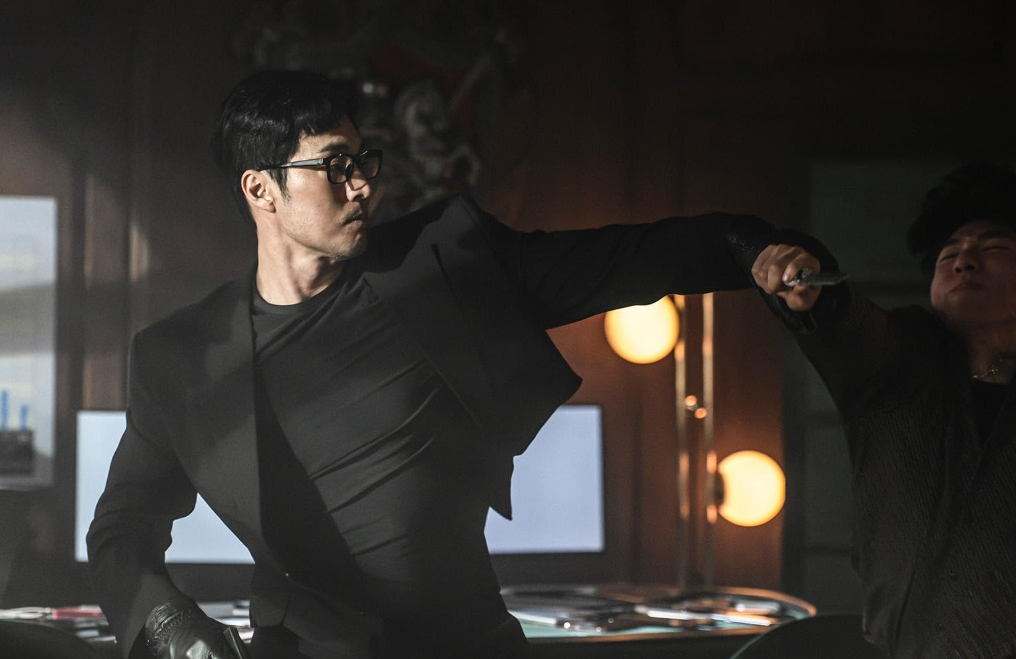
South Korean action cinema has long drawn inspiration from Hollywood's finest, and the new series Agent Kim Reactivated makes that lineage explicit. So Ji-sub, one of Korea's most consistently commanding action performers, takes on a role that inevitably invites parallels to Liam Neeson's iconic 2008 thriller Taken—though director Lee Seung-young insists the comparison flatters his own ambitions rather than defining them. The series follows Manager Kim, an unassuming bank employee and single father struggling to balance his ordinary professional life with the profound responsibilities of raising his daughter Min-ji alone. When his daughter suddenly vanishes, the veil of ordinariness lifts to expose a formidable arsenal of combat skills and a shadowy past that the character has carefully concealed from those around him.
The fundamental premise certainly echoes the Neeson framework: an aging operative discovers that his particular set of skills remain sharp despite years away from active deployment, and fatherhood becomes the catalyst that reignites his lethal capabilities. Yet Lee resists the suggestion that his work merely transposes the Hollywood template into a Korean context. During a recent press conference in Seoul, the director acknowledged the inevitable comparison while charting a distinct creative path. "I think it surpasses Taken," he said with evident humour, immediately undercutting his own hyperbole. "Taken is essentially a real-time pursuit story about a father searching for his daughter, while our story unfolds across 10 episodes. It retains the elements that made Taken compelling, but it's also entertaining even when the main character Kim isn't on screen."
This structural distinction matters considerably for understanding how Agent Kim Reactivated functions as television drama rather than cinema. Where Neeson's film maintains relentless forward momentum across its runtime, the episodic format allows Lee to develop character nuance and interpersonal complexity that a feature film necessarily abandons in pursuit of plot momentum. The series can afford to explore Kim's internal conflict about balancing his lethal expertise with his paternal identity—a tension that emerges only tangentially in traditional action blockbusters. The episodes provide space to examine how a man trained to compartmentalise violence might struggle when his two worlds collide, a psychological dimension that justifies the television format rather than merely extending a cinematic idea.
For the broadcasting network, Agent Kim Reactivated represents a significant strategic departure. The channel has historically specialized in different programming demographics and narrative modes, making this venture into prestige action drama a calculated gamble on both casting and genre. The decision to green-light a high-production action series reflects broader industry recognition that Korean streaming and cable audiences now expect sophisticated action storytelling comparable to premium international offerings. By investing in So Ji-sub's star power and Lee's directorial vision, the network positions itself alongside competitors who have successfully elevated action drama beyond typical melodrama conventions.
So Ji-sub's casting crystallises a particular career moment for the actor. He has anchored several defining Korean action projects throughout his filmography, establishing credibility in combat choreography and the physical demands that such roles require. Yet his statement about accepting the role reveals a deliberate artistic calculation beyond mere action spectacle. "I had been wanting to do another action drama," So explained during promotional interviews. "At first, the action drew me to the script, but what ultimately convinced me was Kim's story as a father raising his daughter alone and desperately searching for her. I felt that emotional journey would be a challenge as an actor, and that's what made me choose the project." This candid assessment suggests that So approaches the material with maturity befitting an actor seeking roles that challenge his range rather than merely showcase his martial capabilities.
The action vocabulary itself diverges from So's previous work in revealing ways. Traditional Korean action dramas often present combat scenarios where both participants understand the lethal stakes, where fighters engage knowing survival remains uncertain. Agent Kim Reactivated reconstructs this dynamic through the lens of a man who fights not with the abstract acceptance of operational risk, but with the concrete, personalised desperation of a parent whose child's life hangs in balance. This emotional specificity transforms the physical choreography from impressive athleticism into narrative expression. Every strike carries psychological weight beyond mere technical execution; So's character fights not because violence constitutes his profession but because nothing else can restore what he has lost.
This thematic reorientation reflects broader evolution within Korean television drama. The industry has gradually moved away from treating action and emotion as competing priorities, instead learning to synthesize them into unified narrative structures. Audiences increasingly reject false dichotomies between spectacle and substance, expecting sophisticated storytelling that acknowledges human vulnerability even within sequences of intense combat. Agent Kim Reactivated positions itself within this maturing landscape, offering what appears to be serious drama that happens to contain extraordinary action rather than action sequences interrupted by character development.
The series arrives during a period of significant creative confidence in Korean screen industries. Following the global success of films like Parasite and Squid Game, Korean production companies no longer feel compelled to replicate American templates verbatim. Instead, they examine international frameworks while asserting distinct cultural perspectives and production values. Agent Kim Reactivated participates in this reimagining by taking the Taken premise—which itself constituted a particular vision of American action heroism—and filtering it through Korean sensibilities regarding family obligation, masculinity, and the personal costs of violence.
For regional audiences across Southeast Asia, the series carries particular resonance. Malaysian, Singaporean, and Indonesian viewers have long demonstrated enthusiasm for Korean action content, and Agent Kim Reactivated arrives with production values that justify that devotion. The 10-episode structure provides sustained engagement that feature films cannot match, creating the kind of appointment television experience that streaming platforms have successfully monetised across the region. Moreover, the central premise of a parent's willingness to transgress moral boundaries for a child's welfare resonates across cultures, making the story fundamentally legible regardless of specific Korean cultural context.
The comparison to Taken, while inevitable, ultimately obscures what may prove distinctive about Agent Kim Reactivated. Yes, both narratives involve fathers leveraging dangerous skills to locate kidnapped daughters. Yet Lee's commitment to episodic storytelling and So's emotional investment in exploring paternal desperation suggest something that transcends simple homage. Korean television has matured considerably since its earlier ventures into action drama, and this series appears positioned to demonstrate that maturation convincingly.

