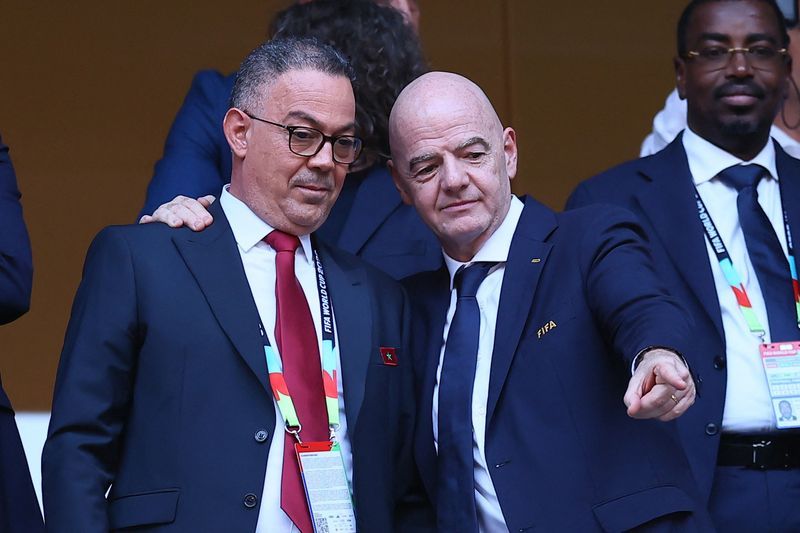
FIFA President Gianni Infantino faces a pivotal moment in his quest to secure a second term, and his survival may hinge on support from Africa's 54 member nations. While football's governing bodies across Asia, Europe, and the Americas have publicly withdrawn confidence in his leadership, the Confederation of African Football has remained noticeably circumspect—a silence that Infantino appears to be leveraging strategically. With a presidential election scheduled for March 2026, the African vote represents a substantial bloc that could determine his political fate on the world stage.
The FIFA President's standing among African administrators has been bolstered by explicit endorsements from five influential continental figures. CAF Vice President Fouzi Lekjaa of Morocco, Egypt's Hany Abo Rida, Niger's Hamidou Djibrilla, and Mauritania's Ahmed Yhaya—all serving on FIFA's Council—have released statements affirming their support for Infantino. Additionally, Veron Mosengo-Omba, the recently installed president of the Democratic Republic of Congo's football federation and former CAF general secretary, issued a backing statement. These endorsements came ahead of the CAF executive committee's meeting in late July, where members discussed the shelved plan to establish a commercial entity that would have generated $4.2 billion from future World Cup broadcasting revenues.
The timing of these African declarations becomes significant when measured against the rejection Infantino received from other continental blocs. Asia, Europe, and CONCACAF—representing the sport's powerhouses—had collectively signalled lost confidence in his leadership over the weekend prior to the African statements. Yet the CAF's measured response suggests a fundamentally different calculus at play. Rather than the swift condemnation witnessed elsewhere, African football's governing body released only a holding statement indicating it would study Infantino's FIFA Forward Enterprise initiative before he abandoned the project under mounting international pressure on Friday.
The divergence in African responses relative to other continents cannot be separated from the financial dimension of Infantino's decade-long tenure. Since his election in 2016, Infantino positioned himself as a champion of development funding for smaller and poorer federations, a promise that resonated powerfully across Africa where many nations lack robust domestic resources for football development. The FIFA baseline funding mechanism guarantees each of the organisation's 211 member associations $8 million across four-year cycles, with CAF adding supplementary annual grants. This institutional largesse represents a substantial injection of capital for struggling federations that might otherwise operate with minimal government support.
The financial dependency that binds many African nations to FIFA's funding apparatus cannot be overstated. Saïd Ali Athouman, president of the Comoros Football Federation, articulated the reality plainly: without commercial sponsorships and government backing, African federations struggle to compete internationally. The disparity between resource-rich and resource-poor nations creates structural inequalities where wealthy European countries can provide comprehensive training infrastructure, medical services, and equipment as matters of routine, while African nations must prioritise such investments against competing governmental demands. This asymmetry makes FIFA development money not merely convenient but essential to the competitive viability of African football.
Fleetwood Haiya, president of the Football Association of Malawi, presented an even starker picture of the constraints facing African football administrators. His federation operates in an environment where governments cannot guarantee basic medical supplies in hospitals, let alone fund stadium construction or player development programmes. For nations confronting such fundamental infrastructure deficits, FIFA's financial mechanisms represent not an ancillary benefit but a foundational requirement for participation in international competition. The withdrawal of such funding—or the election of a president less committed to development disbursement—poses genuine existential challenges for smaller African federations.
Infantino's predecessor, Sepp Blatter, pioneered the strategy of leveraging development funding to secure African political support. When Blatter competed against UEFA President Lennart Johansson in the 1998 FIFA presidential election, he succeeded largely through backing from African nations who had historically received no financial assistance from world football's governing body despite CAF's formal endorsement of Johansson. Blatter's original initiative, the Goal Project, became the template that Infantino subsequently inherited and substantially expanded under the rebranded FIFA Forward programme. This historical continuity demonstrates how effectively financial distribution has functioned as a tool for presidential coalition-building within FIFA's electoral architecture.
The recent World Cup revenue initiative that precipitated the current crisis represented Infantino's attempt to further expand available funds by establishing a new commercial entity that would monetise future World Cup broadcasting rights. Under intense pressure from other confederations, Infantino withdrew this proposal, yet the episode revealed tensions within FIFA's institutional structure. African leaders' measured response to the controversy—neither condemning the plan nor immediately abandoning the FIFA President—suggests a calculation that pragmatic engagement with Infantino remains preferable to backing an unknown alternative.
Southern African Football Confederation President Kaizer Motsepe's effusive endorsement encapsulates the depth of personal political capital Infantino has accumulated within African football circles. Motsepe's characterisation of Infantino as not merely a colleague but a personal friend who has demonstrated loyalty to African interests reflects the relational dimension of FIFA politics that transcends institutional mechanics. In Motsepe's formulation, Infantino's financial commitments to African development constitute loyalty that obligates reciprocal support—a framing that resonates within political contexts where personal relationships and demonstrated commitment carry substantial weight.
The implications for Malaysian and Southeast Asian football observers extend beyond mere institutional intrigue. FIFA's internal power dynamics determine the allocation of development resources, tournament opportunities, and broadcasting revenues that affect all member confederations. Should Infantino retain the presidency through African support, it would reinforce the continent's significance within global football governance while potentially cementing the development funding model that has earned him African loyalty. Conversely, if other confederations successfully challenge his leadership, Southeast Asian federations aligned with Asian confederation interests would need to recalibrate their own engagement with FIFA's institutional framework.
The CAF executive committee's formal meeting would determine whether African football's governing body issues an explicit endorsement or maintains studied neutrality. Either approach serves Infantino's immediate interests—explicit support demonstrates sufficient bloc strength to contest the March election, while continued ambiguity allows African members to calibrate individual positions without institutional constraint. The continent's 54 votes represent approximately 26 percent of FIFA's membership, a proportion that could prove decisive in a contested election where no candidate commands overwhelming support from Europe or Asia.
As Infantino navigates the treacherous politics of international football governance, his African connections offer a lifeline that other continental leaders cannot provide. The combination of historical financial commitment, ongoing institutional dependency, and personal political relationships has constructed a coalition that—despite global criticism—maintains sufficient cohesion to sustain his presidential ambitions. Whether this African foundation proves sufficient to overcome opposition from football's traditional power centres will ultimately determine FIFA's leadership trajectory and the governance framework shaping global football for the next electoral cycle.

