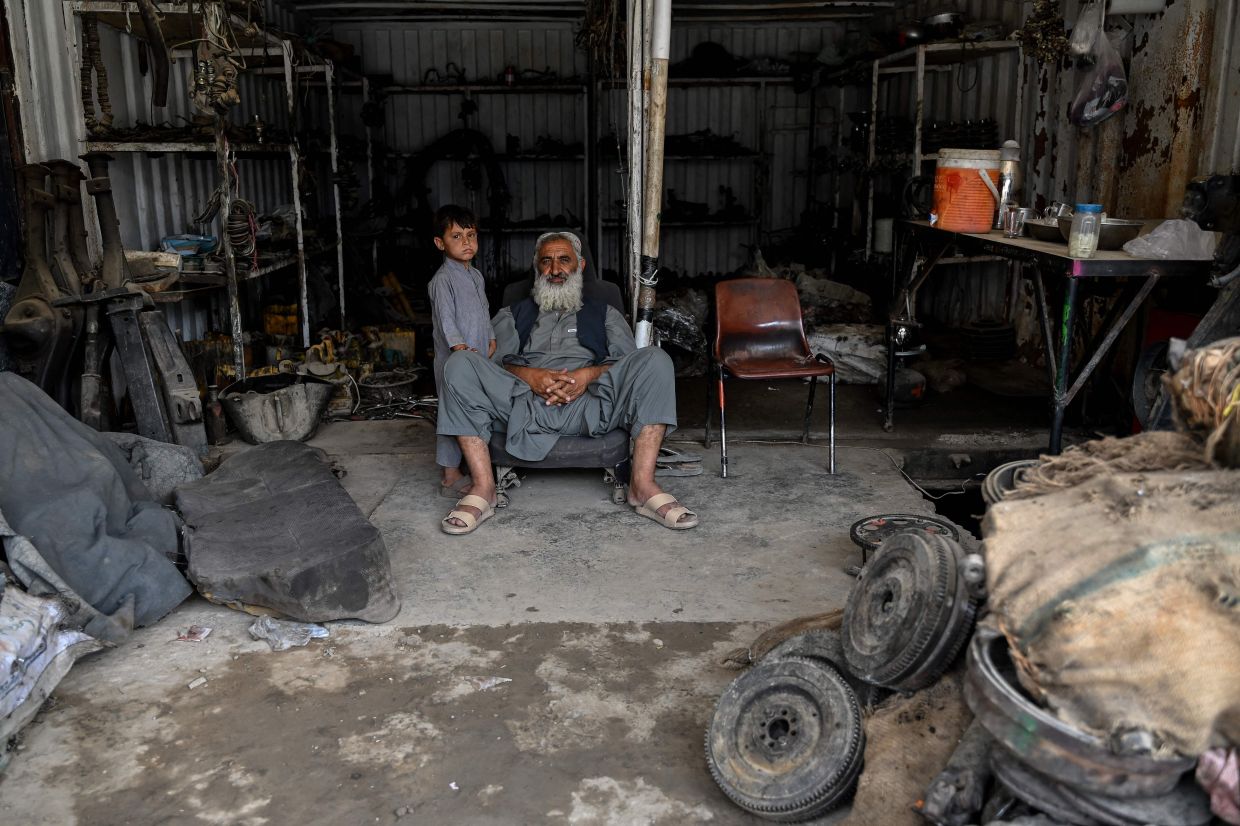
The collapse of Afghanistan's automotive parts trade illustrates how regional instability cascades through developing economies, with the southern Kandahar province experiencing a near-total shutdown of a business that once connected global suppliers to local markets. Spin Boldak, a border town that had functioned as the hub for importing and assembling vehicles, now stands eerily quiet, its workshops idle and its suppliers scrambling for survival in what traders describe as an unprecedented crisis.
The initial shock came in October when escalating cross-border violence between Afghanistan and Pakistan forced authorities to impose a near-total closure of their shared frontier. This barrier severed the traditional supply chain that had funnelled vehicle components from Japan and other distant manufacturing hubs through overland routes into Afghanistan. The closure initially forced traders to pursue alternative routes, a costly but viable workaround that allowed commerce to persist, albeit with significant added expense and logistical complexity. Abdul Baqi Bina, deputy head of the Kandahar Chamber of Commerce and Investment, explained that while traders pivoted to rerouting shipments through Iran's Bandar Abbas port, the difficulties mounted even as business limped forward.
The second catastrophic blow arrived in February with the outbreak of conflict in the Middle East, which disrupted the critical maritime corridor through the Strait of Hormuz—a chokepoint through which roughly one-third of the world's seaborne traded oil passes and where thousands of commercial vessels transit annually. This shipping disruption proved far more devastating than the Pakistan border closure because it collapsed the alternative routes on which traders had come to depend. Cargo vessels carrying vehicle components experienced unprecedented delays, with shipping companies issuing cautious guidance that normalizing operations would require months. For Afghan importers who had already endured months of disruption, this was a final blow to their already fragile logistics networks.
The financial impact on individual traders has been dramatic and measurable. Container shipping costs, the fundamental unit of trade in the automotive parts business, skyrocketed from approximately USD 2,000 per container before February to USD 8,000 afterwards. One importer who identified himself only as Asadullah, now sitting idle in his Spin Boldak office, described the price quadrupling as having "paralysed" his business entirely. He alone has over 30 containers stranded between Japan and the United Arab Emirates, many languishing at Dubai's Jebel Ali port, one of the world's busiest container terminals and a critical distribution hub for Middle Eastern and South Asian trade. The port itself became a bottleneck, with delays compounding the already elevated shipping costs into insurmountable obstacles for small and medium-sized Afghan traders.
Another parts importer, who goes by the single name Masoud, has made the agonizing decision to reverse-ship containers back to Japan rather than continue paying storage fees at ports in the UAE. His business, which once cycled dozens or even hundreds of containers monthly through Spin Boldak, now operates at precisely zero capacity. He has abandoned hope in finding alternative routes and accepts the financial writeoff as inevitable. The arithmetic of his dilemma captures the helplessness pervading the market: every week his containers remain in storage, their value erodes while his financial losses accumulate. For traders operating on razor-thin margins in a volatile region, such reversals represent business extinction rather than temporary pause.
The broader macroeconomic context intensifies the severity of this collapse. The World Bank reported in May that Afghanistan remains "highly exposed to external shocks," a vulnerability that the automotive sector now exemplifies. The institution warned of a "widening gap between imports and exports" that reached 70 per cent of Afghanistan's gross domestic product in the 2025 fiscal year—an unsustainable ratio that external supply disruptions only worsen. For a country already struggling with economic instability and limited foreign exchange reserves, the blockage of a significant import-dependent trade flow poses systemic risks beyond the sector itself.
The human consequences have become visible in the idle workshops of Spin Boldak. Samiullah, a workshop owner in his early thirties, operated a facility that assembled five to seven vehicles weekly before the disruptions began. Now his workspace sits empty, his crane operators underemployed, his mechanics with nothing to fabricate. He continues paying employee salaries despite zero production capacity, a situation unsustainable beyond a few more months. Mohammad Naeem, a 21-year-old crane operator, has already begun considering exit from the trade entirely, recognizing that idle workshops offer no future. The domino effect extends through dozens of interconnected trades: mechanics, welders, electricians, painters, parts distributors, and salespeople all depend on the continuous flow of imported components.
At car dealerships within the market, inventory sits unwanted. Noor Ali, a showroom owner surrounded by colourful vehicles built from imported Japanese parts, reported not a single sale in the past month as customers disappeared alongside the availability of new vehicles. His display becomes a museum of commerce frozen in time, awaiting a normalization that feels increasingly distant. The psychological toll on traders matches the financial devastation: optimism has ceded to resignation, and merchants speak of hoping merely that regional powers "reach an agreement" to restore the Strait of Hormuz to functioning capacity. Such passive language reflects the powerlessness of Afghan traders facing forces entirely beyond their control.
The crisis exposes Afghanistan's structural dependence on uninterrupted transit through unstable regions and waterways. Unlike nations with diversified supply networks or substantial domestic manufacturing capacity, Afghanistan imported virtually all its vehicle components, concentrating risk into narrow geographic corridors vulnerable to any disruption. The simultaneous closure of the Pakistan border and the Hormuz Strait eliminated redundancy from the system entirely, leaving traders without practical alternatives. Restoring this trade will require not merely the reopening of individual borders or shipping lanes but stabilization of multiple overlapping conflict zones—a timeline that remains uncertain and possibly measured in years rather than months.

