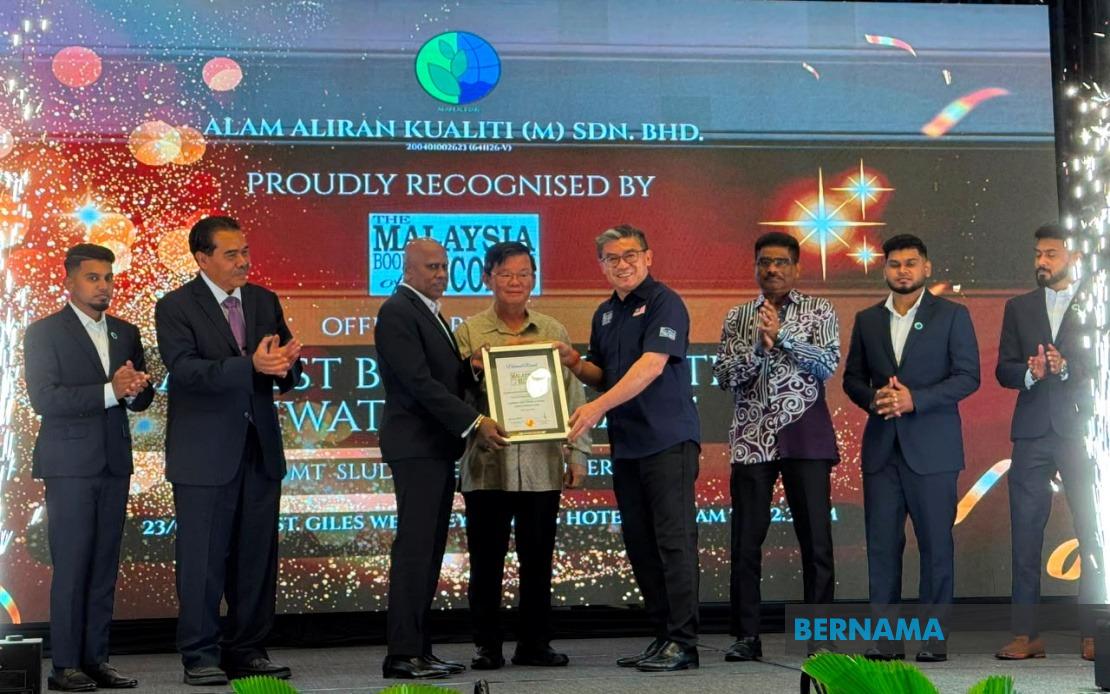
Alam Aliran Kualiti (M) Sdn Bhd (AAK) has been formally recognised by the Malaysian Book of Records (MBOR) for developing and operating the country's largest belt press system dewatering facility at its Sungai Dua installation in Penang. The milestone, presented during a ceremony in George Town, represents a significant achievement for domestic environmental engineering and underscores Malaysia's growing capability in delivering sophisticated water treatment infrastructure at scale.
The Sungai Dua Dewatering Plant, operated through a collaborative partnership with Perbadanan Bekalan Air Pulau Pinang (PBAPP), processes 10 million litres of water treatment residuals daily while handling approximately 450 tonnes of alum sludge—the byproduct of the water purification process. This operational capacity places it among the most efficient facilities of its kind in the region, demonstrating that domestic companies can compete with international standards in complex environmental engineering.
For AAK, the recognition signals more than a technical accomplishment. Company director Gokulaan Balan framed the MBOR honour as a milestone that validates Malaysian engineering expertise and opens pathways for future innovation. He emphasised that the achievement carries broader implications for the nation's environmental agenda, particularly in developing solutions that address the intersection of water security, waste management, and sustainable development. The director's remarks suggest that such recognitions can catalyse confidence in domestic engineering firms to pursue increasingly ambitious environmental projects.
The facility's design philosophy centres on circular economy principles, transforming what would ordinarily become landfill waste into valuable materials. The treated alum sludge is converted into Eco Green Cement Bricks, construction materials with environmental credentials superior to traditional cement products. Simultaneously, treated water recovered during the dewatering process is recycled back into the main treatment system, creating a closed-loop operation that minimises water loss—a crucial advantage for Penang, which has faced periodic supply constraints.
Penang Chief Minister Chow Kon Yeow highlighted the facility's broader significance within the state's water security strategy. He noted that daily processing of 10 million litres of treatment residuals, coupled with the recovery and recycling of processed water, directly strengthens Penang's resilience against future water shortages. For a state that has invested heavily in desalination and alternative water sources, the Sungai Dua plant represents an additional lever for securing supply—not through new extraction, but through optimisation of existing treatment infrastructure.
The circular economy dimension carries particular resonance for Malaysia's sustainability commitments. By converting scheduled waste classified as SW204 into commercial construction materials, the facility reduces reliance on virgin materials and landfill disposal simultaneously. Chow framed this transformation as evidence that sustainability investments deliver economic value rather than imposing net costs. Such framing is relevant for Malaysian policymakers and businesses currently evaluating the financial feasibility of environmental initiatives.
AAK itself was established in 2004 and has built a track record in environmental engineering and scheduled waste management. The Sungai Dua installation and its integrated Eco Green Brick Manufacturing Plant represent the company's flagship circular economy initiative. This positioning may offer competitive advantages as Malaysia gradually tightens environmental regulations and as both government procurement and private sector investment increasingly favour contractors demonstrating sustainability credentials and technological sophistication.
The involvement of senior figures—including Pengurusan Aset Air Berhad (PAAB) chairman Datuk Seri Jaseni Maidinsa and Penang's Chief Minister—signals political endorsement at state level. Such high-level participation in the recognition ceremony reflects growing awareness among Malaysian policymakers that environmental infrastructure projects merit the same strategic attention traditionally reserved for transport, energy, or telecommunications investments. This shift in political emphasis could have downstream effects on project funding, regulatory support, and recruitment of technical talent to the environmental engineering sector.
For Southeast Asian readers, the Sungai Dua plant offers a template for addressing common regional challenges. Countries throughout the region contend with rapid urbanisation, ageing water infrastructure, and mounting pressures on landfill capacity. The integration of advanced mechanical dewatering, waste recovery, and recycling demonstrates pathways for upgrading treatment infrastructure while simultaneously extracting economic value from waste streams. If AAK's model gains adoption across Malaysia and potentially throughout the region, it could reshape how water utilities approach sludge management.
Gokulaan's remarks characterising the MBOR recognition as a beginning rather than an endpoint warrant particular attention. They suggest the company and its stakeholders view this achievement as a platform for further innovation rather than a resting point. Whether this translates into expanded capacity, replication at other sites, or entirely new technological applications will significantly influence the facility's long-term impact on Malaysia's environmental infrastructure landscape.
The recognition also carries implications for Malaysia's international positioning. As the nation seeks to establish itself as a centre of environmental technology expertise, highlighting domestic successes in infrastructure development strengthens that narrative. The MBOR honour, while domestic in origin, provides a credential that AAK and PBAPP can leverage in discussions with water utilities and governments throughout Asia and beyond, potentially opening export markets for engineering expertise and manufactured products such as the Eco Green Bricks.
Penang's positioning as the site of this record-breaking facility aligns with the state's broader strategic pivot toward knowledge-intensive industries and environmental innovation. The state has invested in green technology initiatives and positioning itself as an attractive hub for clean technology companies. The Sungai Dua plant contributes materially to that narrative, offering tangible evidence of local capability in developing and operating cutting-edge environmental infrastructure.
Looking forward, the recognition of AAK's achievement may inspire similar initiatives within Malaysia's water and waste management sectors. Competitive pressures, combined with regulatory incentives and demonstrated technical feasibility, could prompt other operators to upgrade their facilities or develop comparable innovations. Such sectoral advancement would align with Malaysia's stated ambitions in sustainable development and circular economy transition, translating policy commitments into concrete infrastructure improvements that directly benefit consumers and communities.

