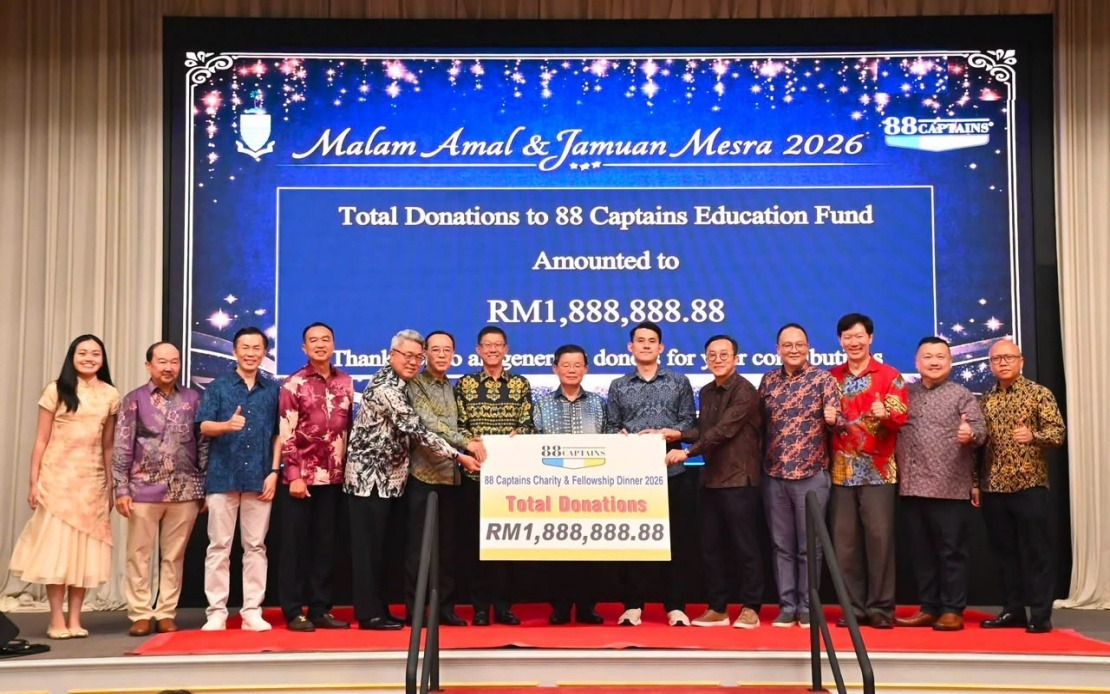
Penang's 88 Captains organisation has distributed more than RM1 million in scholarship assistance to 44 students drawn from five educational institutions, signalling an intensified push to identify and cultivate emerging talent across the state and Northern Region. The awards were announced at the group's Annual Charity Dinner 2026 in George Town, where leaders emphasised the broader mission extending far beyond simple financial relief for cash-strapped families.
Datuk Seri Dr Ooi Eng Hock, who chairs the Persatuan Kebajikan 88 Kapten Pulau Pinang, framed the initiative as part of a deliberate strategy to instil ambition, resilience, and social responsibility in the next generation. Rather than viewing scholarships as transactional handouts, he positioned them as catalysts for young people to pursue ambitious goals, demonstrate greater diligence in their studies, and ultimately become contributing members of their communities with the integrity necessary for long-term success. This philosophy reflects a growing recognition among Malaysian philanthropic bodies that talent development must encompass character formation alongside academic and professional advancement.
The organisation's recent fundraising efforts proved substantial. The evening's activities successfully garnered RM1.89 million, demonstrating considerable support from the business and professional sectors. The event drew significant political patronage, with Penang Governor Tun Ramli Ngah Talib and his spouse in attendance, alongside Chief Minister Chow Kon Yeow, underscoring the programme's alignment with state-level priorities around human capital investment.
Beyond scholarship cheques, 88 Captains has constructed an ambitious bridging mechanism between campus and workplace through its Apprenticeship, Internship, Reskilling and Upskilling programme, which debuted last year at Universiti Sains Malaysia. The initiative deploys a dedicated cohort of high-performing scholars from USM, ViTrox College, Tunku Abdul Rahman University of Management and Technology, and INTI International University as intermediaries. These young fellows engage directly with corporate executives and entrepreneurial founders to decode employer expectations, while simultaneously representing graduate perspectives and advocating for reasonable entry-level compensation—specifically the RM4,000 minimum they view as essential for cost-of-living adequacy in contemporary Malaysia.
This two-way dialogue model addresses a persistent friction point in the Malaysian talent pipeline: misalignment between what universities teach and what industry demands, coupled with persistent wage stagnation that discourages top graduates from remaining in the domestic job market. By institutionalising structured conversations between these constituencies, 88 Captains is attempting to reduce hiring friction and make local opportunities more attractive to high-potential individuals who might otherwise seek employment abroad.
Over four years of operation, 88 Captains has orchestrated a diversified portfolio of community initiatives that extends well beyond direct financial aid. The organisation has donated smart televisions to dozens of primary and secondary schools, implemented 5G-enabled Digital Libraries across 88 educational facilities, and actively supports the Special Education Integration Programme. These interventions reflect recognition that talent development requires infrastructure investment and inclusive systems capable of nurturing diverse learner populations, not merely identifying and funding the most obviously gifted students.
Chief Minister Chow explicitly linked these educational initiatives to Penang's economic development strategy. He noted that programmes strengthening connections between learning institutions and industry sectors support the state's deliberate positioning as a hub for advanced manufacturing, semiconductor fabrication, artificial intelligence innovation, and broader digital economy expansion. Penang's competitive future depends on graduates equipped with contemporary technical skills and industry-ready competencies, making talent pipeline investment a matter of regional economic strategy rather than purely charitable impulse.
The organisation has recently broadened its remit into mental health awareness and responsible artificial intelligence adoption in schools, launching a joint initiative earlier this week addressing these emerging concerns. This initiative arrives at a strategically significant moment, following introduction of the Anti-Bullying Act 2026, which establishes legal frameworks for protecting student wellbeing. Chow emphasised that legislation alone proves insufficient; schools, families, and communities must actively implement preventive approaches, train educators to recognise warning signs, and guide students toward conscientious technology use as AI becomes increasingly embedded in educational environments.
The timing reflects growing anxiety across Malaysia about student mental health challenges and the role that unregulated technology—particularly social media and emerging AI tools—might play in exacerbating vulnerability. By positioning schools as nodes in a comprehensive support ecosystem rather than isolated gatekeepers, 88 Captains' approach aligns with evidence-based public health practice that understands youth wellbeing as a multi-stakeholder responsibility.
Established in 2022, 88 Captains operates as a non-governmental charitable entity explicitly focused on supporting talented individuals across Penang and the Northern Region through financial assistance and structured development programmes. The organisation's relatively recent founding belies the scale of its impact, suggesting either substantial resource mobilisation or a tightly executed mission. Its fundraising capacity—demonstrated by the RM1.89 million raised in a single evening—indicates meaningful buy-in from corporate and high-net-worth constituencies who recognise talent development as a collective priority.
For Malaysian policymakers and educational leaders observing from other states, 88 Captains exemplifies an emerging model of public-private partnership in human capital development. Rather than awaiting government initiative, established business leaders have organised themselves into coherent structures capable of identifying gaps, mobilising resources, and implementing scaled interventions. The sustainability question remains whether such models can eventually transition toward greater government integration and public funding, thereby extending their reach beyond the relatively prosperous Northern Region.

