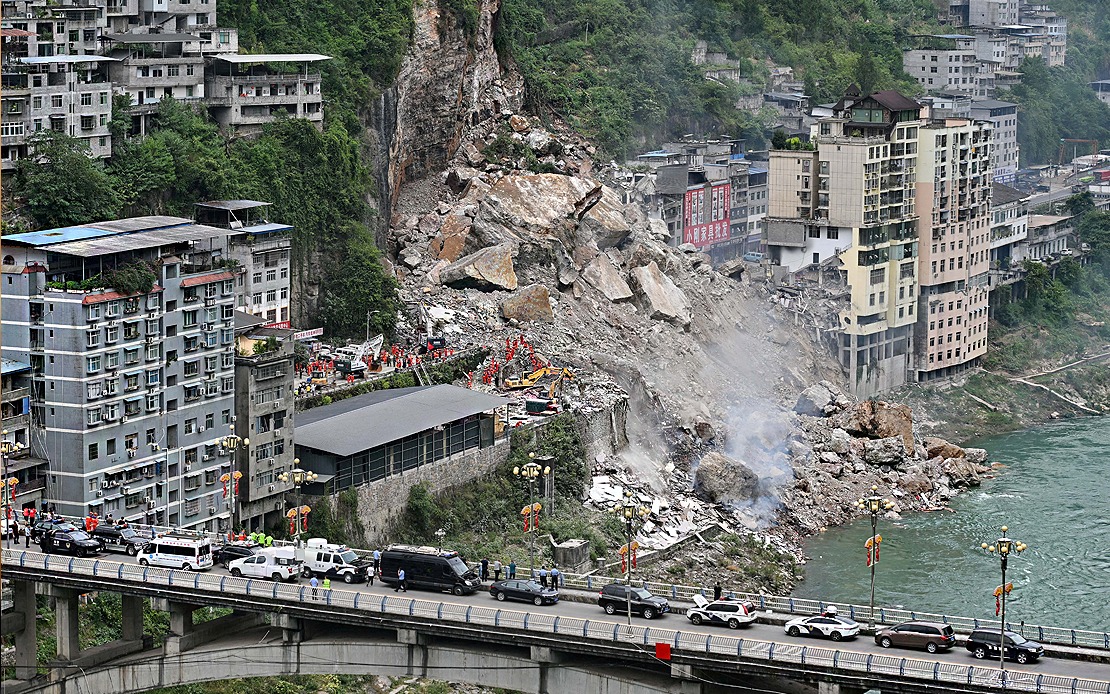
A catastrophic mountain collapse in Chongqing Municipality has left 51 people dead and 10 others unaccounted for, according to local authorities, with search and rescue operations continuing across the affected area in southwest China. The disaster, which unfolded on July 17 in Hanjia sub-district of Pengshui Miao and Tujia Autonomous County along the Wujiang River, buried more than 10 residential buildings under debris and prompted the evacuation of over 1,100 residents from surrounding communities.
The initial collapse occurred at 9.08 am, triggered by heavy rainfall that destabilised the mountainside overlooking the populated settlement. The scale of destruction was immediate and severe, with entire residential structures disappearing beneath cascading earth and rock. Among those rescued from the debris, three have already been discharged from hospital, providing a modest glimmer of hope amid the widespread tragedy. The remaining survivors continue receiving medical care as authorities process the ongoing recovery operation.
Response efforts have shifted in focus as ground-based search operations have now concluded at the primary site. However, the work of recovery is far from complete. Authorities have redirected resources toward underwater searches within the Wujiang River, recognising that the collapse may have displaced bodies and debris into the waterway. Simultaneously, cleanup operations along the riverbed continue as teams attempt to restore the area to some semblance of normalcy. These efforts underscore the complexity of managing disasters in mountainous terrain where collapsed material often impacts multiple environments.
The disaster highlights the particular vulnerability of settlements in China's southwestern regions, where rugged topography and seasonal monsoon patterns create recurring hazards. Pengshui Miao and Tujia Autonomous County, home to ethnic minorities, represents an area where infrastructure development has historically occurred in challenging geographical conditions. The concentration of residential buildings in the affected zone suggests population density in areas that may have limited geological stability assessment or adequate warning systems for such events.
For Malaysia and other Southeast Asian nations, the Chongqing collapse offers sobering lessons about natural disaster preparedness in mountainous regions. Many Southeast Asian communities face similar geographical and meteorological challenges, with rapidly developing areas in hilly terrain increasingly vulnerable to landslides and collapses during heavy rainfall periods. The scale of evacuation undertaken in Chongqing—exceeding 1,100 people—demonstrates the importance of rapid emergency response protocols and the capacity to mobilise large populations quickly from danger zones.
China's disaster response apparatus, despite the tragic toll, managed to evacuate substantial numbers before conditions worsened further, preventing what could have been significantly higher casualties. This coordination between local authorities, rescue teams, and emergency services reflects investment in disaster management infrastructure. However, the continuing search for ten missing persons indicates that even well-coordinated responses cannot entirely prevent loss of life in events of this magnitude and speed.
The rainfall-induced nature of this disaster underscores climate-related risks that are increasingly prominent across Asia. As weather patterns grow more volatile and intense precipitation events become more frequent, geological hazards in vulnerable terrain are likely to escalate. Building standards, land-use planning, and early warning systems in areas prone to such disasters will require constant refinement and investment to protect populations adequately.
The recovery timeline remains uncertain. Beyond the immediate search and body recovery efforts, authorities face the complex task of addressing structural stability concerns elsewhere in the region, determining root causes of the collapse, and preventing recurrence. Engineering investigations will likely examine whether the mountainside had shown prior warning signs, whether drainage systems were adequate, and whether building placements violated safety guidelines. Such investigations are crucial for implementing preventive measures.
For the surrounding communities and affected families, the disaster represents a profound disruption. The evacuation of 1,100 residents means displaced households, interrupted livelihoods, and psychological trauma that will persist long after the initial emergency phase concludes. Support systems for reconstruction and mental health services will become essential components of the recovery process, as communities work to rebuild infrastructure and restore confidence in their settlements' safety.
The Chongqing collapse serves as a reminder that natural disasters, regardless of a nation's development level or resources, can strike with devastating consequences when geological and meteorological factors align unfavourably. For policymakers across Southeast Asia, particularly in countries like Malaysia, Indonesia, and the Philippines where mountainous terrain and tropical rainfall patterns mirror some aspects of China's southwestern geography, sustained investment in hazard mapping, building standards enforcement, and community evacuation preparedness represents essential insurance against similar tragedies.

