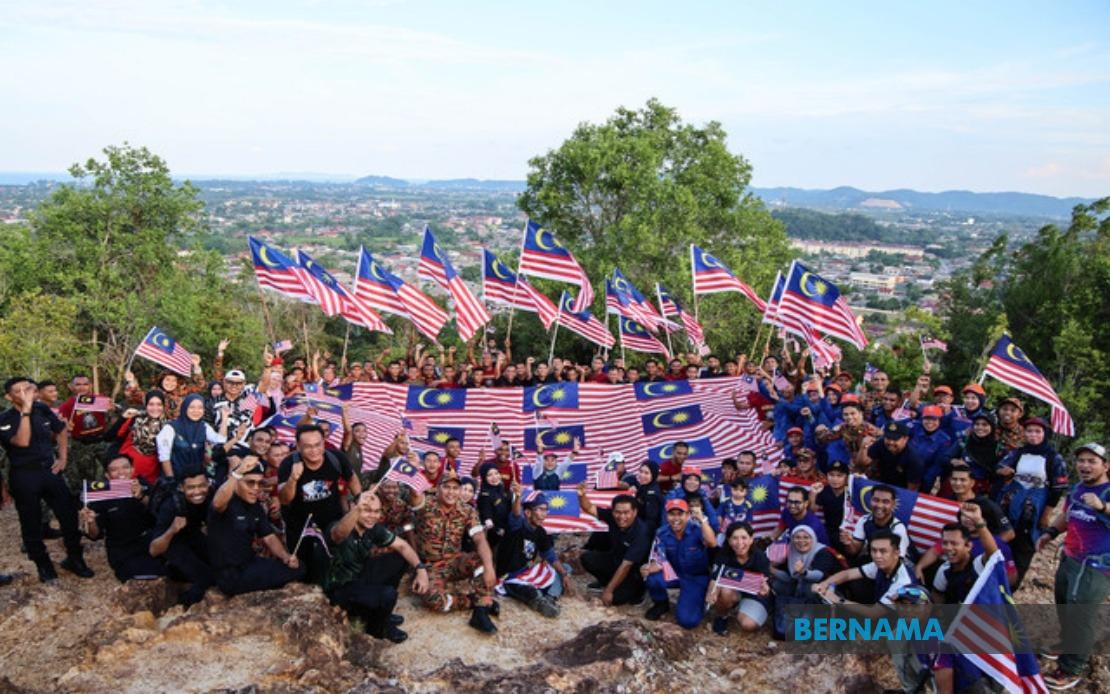
An inaugural patriotic hiking expedition in Kuala Terengganu on August 21 brought together 300 participants spanning the uniformed services, government agencies and media organizations in a coordinated celebration of National Month. The event, organized by METRA, demonstrated how diverse public institutions can unite around shared national values while strengthening professional bonds across traditionally separate operational spheres.
The summit climb drew representatives from a comprehensive cross-section of Malaysia's security and administrative apparatus. Participants included personnel from the Terengganu Fire and Rescue Department (JBPM), Malaysian Armed Forces (ATM), Road Transport Department (JPJ), Malaysian Anti-Corruption Commission (MACC), the Terengganu Ministry of Domestic Trade and Cost of Living (KPDN), Terengganu Royal Malaysian Customs Department (JKDM) and Malaysia Civil Defence Force (APM). This breadth of organizational participation underscores how patriotic initiatives can transcend typical departmental boundaries and create platforms for meaningful interaction between agencies that operate independently in their regular functions.
METRA president Mohd Zaid Mohd Noor characterized the expedition as a deliberate effort to harness media influence for communicating national pride. He emphasized that media practitioners carry particular responsibility in disseminating patriotic messaging across their various communication platforms and that the hiking initiative represented a proactive step toward fulfilling this duty. The framing suggests a recognition that National Month celebrations gain additional resonance when media professionals actively participate rather than merely document official proceedings.
The specific detail of unfurling a giant flag at the summit—mentioned but incomplete in available details—points to a carefully choreographed symbolic moment intended to capture both the physical achievement of the collective climb and the unified expression of patriotism. Such visual demonstrations have proven effective in Southeast Asian contexts where public gestures combining physical challenge with national sentiment generate meaningful community engagement and media coverage that extends far beyond the immediate participants.
Beyond its obvious patriotic dimension, the event functioned as a practical exercise in inter-agency relationship building. Mohd Zaid explicitly noted that strengthening connections between different government organizations while simultaneously promoting healthy lifestyle practices represented integral objectives. In Malaysia's complex administrative environment where coordination between security, customs, trade, infrastructure and civil defence functions often occurs through formal channels, informal settings like shared physical challenges create opportunities for personnel to develop personal relationships that can enhance cooperation during actual operational scenarios.
The emphasis on infusing patriotic values into health promotion reflects broader regional trends in public administration where wellness initiatives increasingly incorporate national identity elements. Rather than treating physical exercise and patriotism as separate concerns, the expedition merged them into a single meaningful activity that addressed multiple policy objectives simultaneously—an approach gaining traction across Southeast Asian governments seeking to maximize the impact of public initiatives.
Terengganu's selection as the venue for this inaugural event holds particular significance given the state's prominent positioning during Malaysia's National Month celebrations. The decision to organize such a high-profile gathering of security and government personnel in the state capital demonstrated commitment to distributing major patriotic events beyond Kuala Lumpur and amplifying national celebrations throughout Malaysia's regions. This geographic distribution helps ensure that National Month activities engage communities beyond the federal capital and reinforce national identity in states throughout the federation.
The participation of media practitioners as both organizers and participants reflects evolving dynamics in how news organizations engage with public institutions and national observances. Rather than maintaining strict distance, METRA members actively contributed to organizing and participating in the event, signaling a more integrated relationship between press and state institutions around matters of national significance. This approach contrasts with adversarial models of press-state relations and demonstrates how media organizations can maintain editorial independence while supporting uncontroversial patriotic initiatives.
The August timing of the event proved strategic, as it falls within Malaysia's National Month when public institutions increase programming celebrating national identity and achievements. By concentrating resources and personnel into a single well-coordinated event rather than scattering efforts across multiple smaller observances, organizers created a more memorable and impactful demonstration of institutional commitment to patriotic values. The concentration of 300 participants from multiple agencies produced a visual and symbolic statement that individual organizations alone could not achieve.
For Southeast Asian readers, this initiative offers insights into how Malaysia coordinates patriotic programming and inter-agency cooperation. The successful assembly of diverse security and civilian government personnel around a shared objective suggests that such cross-institutional initiatives, when properly structured and led, can overcome typical organizational silos. The event also demonstrates how media organizations throughout the region might position themselves as active participants in promoting national unity rather than passive observers, though this approach requires careful calibration to preserve journalistic credibility.
The initiative's emphasis on combining physical challenge with patriotic expression reflects recognition that meaningful national sentiment cannot be imposed through rhetoric alone but requires participatory experiences that create emotional resonance. By asking personnel to exert physical effort toward a collective goal while expressing national pride, organizers created a memorable experience likely to deepen participants' emotional connection to the patriotic message. Such experiential approaches to nation-building have proven more durable than passive consumption of patriotic messaging.

