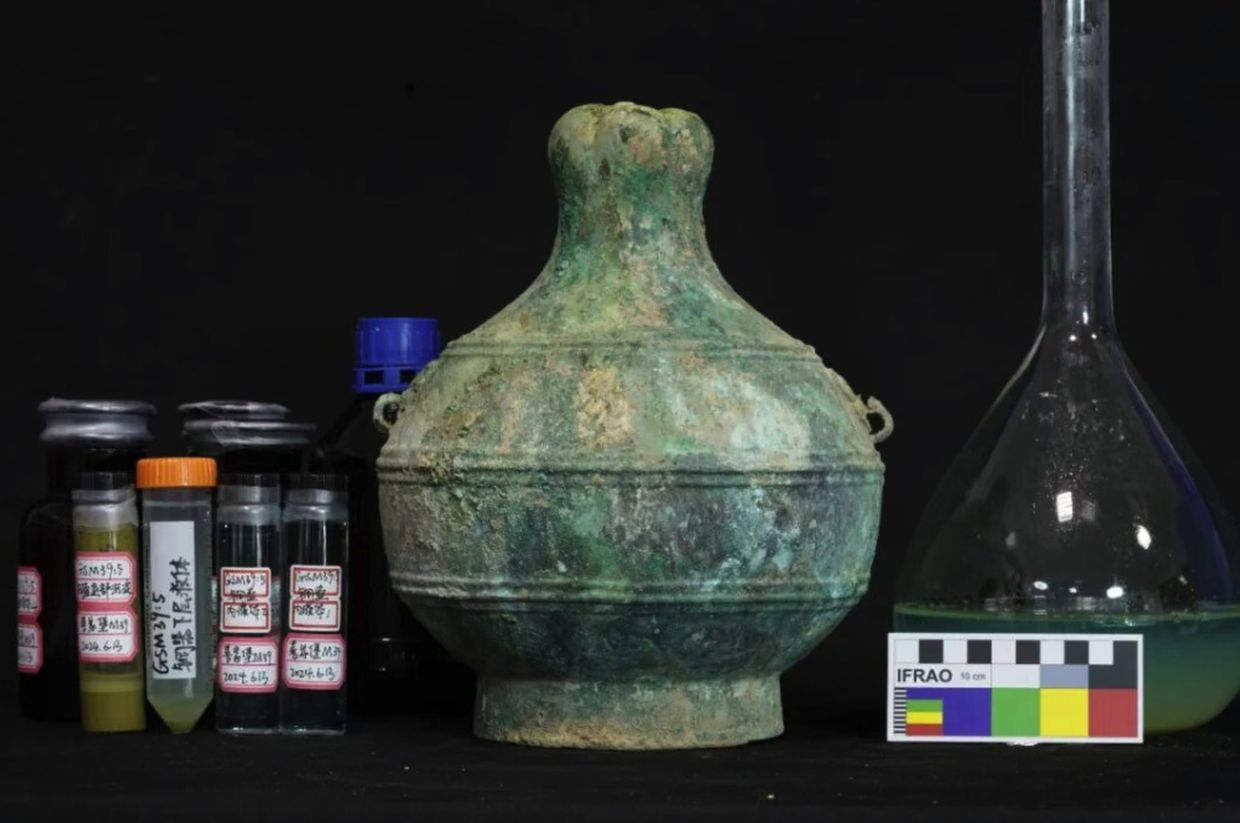
Nestled in a remote cemetery 2 kilometres from the Warring States Qin Great Wall in Gansu province lies one of China's most significant archaeological discoveries in recent memory: a bronze wine vessel that has remained sealed and virtually unchanged for more than 2,300 years. Unearthed from Tomb No. 39 at the Shanjiabao cemetery in Guyuan, the garlic-head-shaped pot contained 3,740 millilitres of ancient liquid residue that researchers have now confirmed as grain-based wine, offering unprecedented insights into the brewing practices of the Qin state during its formative period.
The significance of this find cannot be overstated, particularly within the context of Chinese archaeological studies. Wang Xiaoyang, the lead researcher directing the Shanjiabao cemetery archaeological project under the Ningxia Institute of Cultural Relics and Archaeology, described the discovery as the most comprehensively preserved and information-rich wine relic from the Qin period ever publicly documented in China. The vessel's survival is attributable to an ingeniously layered sealing method that combined a textile inner lining with an outer protective coating of organic clay, a dual-layer system that proved remarkably effective at preventing oxidation and contamination across millennia.
The broader context of this discovery reflects a remarkable pattern of archaeological findings across China. The nation stands as one of humanity's earliest centres of alcoholic beverage consumption, with an expanding catalogue of ancient alcoholic residues emerging from excavation sites nationwide. These discoveries have galvanised scholarly interest in understanding not merely when fermentation techniques first emerged, but how these technologies evolved and spread across different regions. The Shanjiabao find represents a crucial data point in this larger narrative, particularly for understanding how these practices manifested in frontier settlements along defensive fortifications.
The 170-kilometre stretch of Qin Great Wall in the region contained numerous military installations, from substantial forts to modest barrier outposts and garrison stations. The cemetery itself appears to have functioned as a communal burial ground serving the military personnel and civilian families residing within these fortified positions during the Warring States period. Archaeological excavations at Shanjiabao revealed 183 tombs in total, with 179 definitively attributed to Qin culture, suggesting this was a major settlement hub for border defence operations. The presence of wine vessels among burial goods indicates that fermented beverages held cultural and possibly ceremonial significance within these frontier communities.
The analytical work undertaken to understand the wine's composition revealed remarkable sophistication in ancient fermentation science. Researchers identified 24 distinct chemical compounds within the liquid, encompassing organic acids and their derivatives, amino acids and their derivatives, and carbohydrates. These molecular signatures provided crucial evidence for distinguishing the wine's category and origin. The distribution pattern of organic acids matched that of deliberately aged yellow wine, definitively establishing that this was a grain-based alcoholic beverage rather than a fruit-derived product such as grape wine.
Perhaps most revealing was the starch residue analysis, which demonstrated that over 92 per cent of the starch content derived from broomcorn millet. This finding illuminates a key distinction between brewing practices in northern and southern China during antiquity. While southern regions predominantly employed rice as their fermentation substrate, northern brewers developed their techniques around locally available grains such as millet and foxtail millet. The Shanjiabao discovery provides concrete archaeological validation for this geographical divide, suggesting that frontier garrison communities maintained brewing traditions aligned with their regional agricultural base.
The investigation represented a collaborative scholarly effort, with samples transmitted to Northwest University for comprehensive chemical and biological analysis. This interdisciplinary approach combined traditional archaeological methods with modern analytical chemistry, enabling researchers to reconstruct not merely what was in the vessel but to infer details about preparation methods, ingredient selection, and possibly fermentation duration. The level of compositional detail preserved in the liquid offered a window into ancient technological knowledge that written records from this period rarely capture with such specificity.
For Malaysia and Southeast Asian readers, this discovery carries implications beyond mere antiquarian interest. It demonstrates how ancient trade networks and cultural practices extended across vast distances, with northern Chinese frontier communities maintaining sophisticated agricultural and fermentation technologies. The emphasis on studying material cultures and everyday artefacts rather than exclusively focusing on elite records reflects a shift in how historians understand the ancient world. Understanding how common soldiers and garrison residents lived, what they consumed, and how they practised their crafts provides a fuller historical picture than traditional chronicle-based approaches.
The human dimension of this archaeological find adds poignant emotional weight to the scientific analysis. Somewhere over twenty-three centuries ago, a Qin garrison soldier or official—whose name remains forever unknown—lived at this remote Great Wall outpost. This individual possessed a treasured bronze wine vessel, sufficiently valuable that when death came, their family honoured them by filling it with precious wine to accompany their departed loved one into the afterlife. This burial custom reveals how fermented beverages transcended practical sustenance, becoming objects imbued with ceremonial meaning and emotional significance within Qin society.
The discovery fundamentally advances understanding of Warring States-era Qin production and consumption patterns, filling a previously substantial archaeological gap specific to the Ningxia region. Before this find, scholars possessed comparatively little direct evidence about how frontier communities managed food and beverage production under challenging environmental conditions. The presence of sophisticated fermentation technology at these remote garrisons suggests that the Qin state maintained surprisingly complex supply chains and manufacturing capabilities, supporting the defensive infrastructure that ultimately contributed to Qin's military and political consolidation.
Further research will likely extract additional information from the remaining chemical compounds in the preserved liquid. Future studies might determine fermentation duration, storage conditions, or even the precise seasonal timing of production. As analytical methods continue advancing, this remarkable vessel promises to yield insights that contemporary Qin documents cannot provide. The bronze pot stands as silent testimony to ancient ingenuity, demonstrating how ordinary people solved the practical challenges of preserving food and creating beverages that brought both sustenance and solace to their lives along the demanding frontier.

