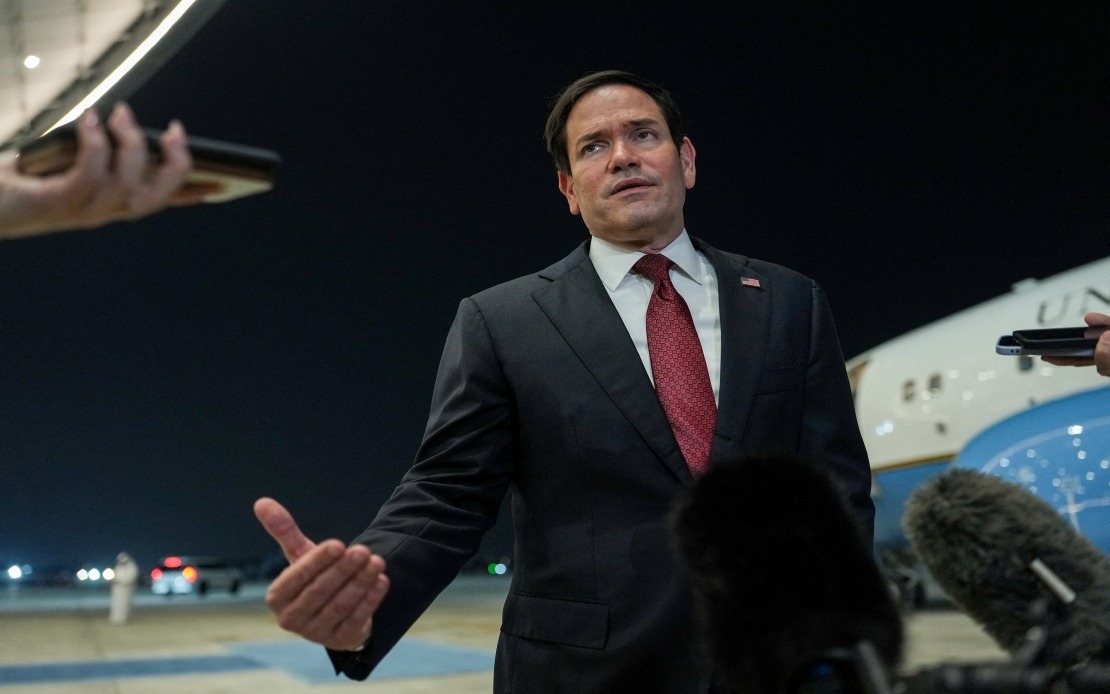
The United States will not contribute its own resources to any reconstruction fund established for Iran, according to Secretary of State Marco Rubio, who addressed mounting speculation about the financial architecture of renewed US-Iran relations during a Tuesday briefing with reporters. His remarks came as the two nations edge closer to resolving longstanding disputes through an intensive diplomatic process mediated by Qatar and Pakistan, signalling a complex evolution in Middle Eastern geopolitics that carries significant implications for regional stability and trade corridors vital to global commerce.
Rubio's unequivocal statement that "it won't be our government money" underscores the Biden administration's reluctance to risk domestic political capital by directly bankrolling Iranian development, a sensitive issue in American domestic politics where Iran remains viewed with considerable scepticism by substantial portions of the electorate. The Secretary of State acknowledged that discussions around potential contributions from Gulf Cooperation Council members remain preliminary, emphasising that no firm commitments have materialised regarding which actors might fund such an initiative. This measured approach reflects the administration's desire to maintain strategic ambiguity whilst pursuing diplomatic breakthroughs that could reshape regional power dynamics.
The distinction Rubio drew between hypothetical Gulf state investments and explicit American government participation reveals how Washington intends to facilitate reconstruction through indirect channels rather than direct assistance. By suggesting that Gulf nations might fill the financing gap, the administration appears to be leveraging wealthy Arab states' economic capacity whilst shielding itself from accusations of appeasement. This strategy potentially positions Middle Eastern capitals as architects of Iran's economic reintegration, thereby distributing both the financial burden and the political risk across multiple actors with varying strategic interests in Iranian stability.
Rubio's conditional framework for Iranian economic development—contingent upon progress on broader security concerns—establishes a sequential logic where reconstruction remains subordinate to resolution of military and nuclear issues. This hierarchical approach signals that Washington views economic opportunities for Tehran as leverage rather than an immediate reward, preserving negotiating leverage as discussions advance on contentious security matters that have poisoned bilateral relations for decades. The emphasis on "other security issues that have to be confronted" suggests the administration anticipates protracted negotiations before any substantial financial mechanisms take root.
The diplomatic breakthrough underlying these discussions emerged from a June 22 meeting in Burgenstock, Switzerland, where delegations led by US National Security Advisor J.D. Vance and Iranian Parliamentary Speaker Mohammad Bagher Ghalibaf conducted substantive negotiations under Qatari and Pakistani mediation. The fact that both American and Iranian officials subsequently announced tangible progress indicated movement beyond previous impasses, though the parties remain divided on specifics regarding implementation timelines and verification mechanisms. This Swiss venue, historically neutral ground for sensitive international negotiations, provided symbolic distance from both Washington and Tehran whilst facilitating private discussions away from domestic political pressures.
More significantly, Iran and the United States had remotely signed a memorandum of understanding just days before Rubio's statement, formally committing both sides to military de-escalation following the February 28 conflict that had threatened to spiral into broader regional conflagration. This foundational agreement establishes concrete timelines for American naval withdrawal from blockade positions whilst obligating Tehran to restore shipping operations through the Strait of Hormuz, a waterway through which roughly one-third of global maritime petroleum traffic flows. For Southeast Asian economies dependent on Middle Eastern energy supplies, the restoration of stable transit through these critical chokepoints carries enormous implications for energy security and freight costs.
The nuclear dimension occupies a separate negotiating track, with both parties committing to resolve the contentious issue of Iran's atomic programme through distinct discussions scheduled to conclude within sixty days. Iran's undertaking to refrain from acquiring nuclear weapons, coupled with the establishment of a dedicated negotiation schedule, suggests preliminary agreement on the architecture of any future nuclear accord whilst leaving technical verification questions for subsequent rounds. This bifurcated approach—splitting military de-escalation from nuclear matters—reflects sophisticated diplomacy recognising that conflating these issues would multiply complications and reduce prospects for comprehensive agreement.
From a Malaysian and broader Southeast Asian perspective, these developments warrant careful monitoring given the region's strategic vulnerability to Middle Eastern instability and dependence on predictable energy markets. The normalization of US-Iran relations would substantially reduce regional volatility and permit more efficient global energy trading, potentially stabilising petrol prices that directly affect Malaysian transportation costs, manufacturing competitiveness, and consumer purchasing power. Enhanced Iranian economic integration through reconstruction financing could also create fresh commercial opportunities for Malaysian enterprises seeking to establish footholds in Iranian markets previously constrained by comprehensive American sanctions regimes.
President Trump's earlier dismissal of reports concerning a three-hundred-billion-dollar reconstruction fund suggests persistent scepticism within American political leadership regarding the scale and feasibility of proposed financial commitments. Rubio's more nuanced framing—acknowledging possibilities whilst tempering expectations—reflects pragmatic recognition that reconstruction discussions remain premature absent resolution of foundational security concerns. This calibrated messaging protects administration credibility by avoiding overselling diplomatic achievements whilst maintaining sufficient ambiguity to sustain negotiations as both sides navigate the complex terrain of mutual verification and confidence-building measures.
The broader geopolitical significance extends beyond bilateral US-Iran relations into the architecture of regional power competition. Gulf states' potential financing role in Iranian reconstruction signals their increasing willingness to engage Tehran directly rather than exclusively through American patronage, potentially indicating a shift toward more autonomous regional diplomacy. Such developments could accelerate the multipolar reordering of Middle Eastern affairs, with implications for international oil markets, maritime security, and the constellation of alliances structuring global commerce and strategic competition.