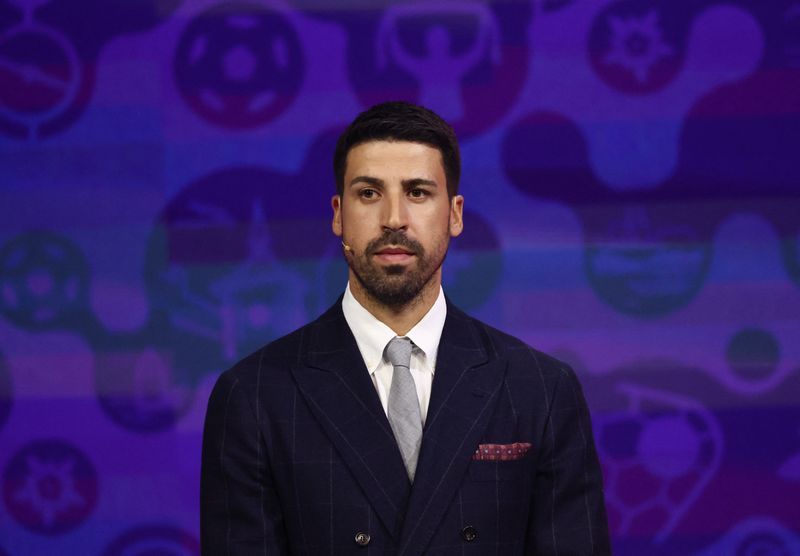
Sami Khedira has lived the reality of dual national identity his entire life. The German midfielder, who won the World Cup with his country in 2014, carries no conflict about his brother Rani representing Tunisia on football's biggest stage—his father's homeland. Rather than seeing this as problematic, Khedira views such arrangements as emblematic of contemporary sport, where migration, family ties, and personal choice weave together to create a richer tapestry of belonging.
When discussing the phenomenon at the Home of Football museum in New York, Khedira articulated a worldview increasingly common among elite athletes from multicultural backgrounds. He framed brothers wearing different shirts not as a liability or source of confusion, but as evidence of a genuinely global game where individuals can authentically embody multiple cultures simultaneously. This perspective challenges traditional notions that national football representation demands exclusive allegiance, suggesting instead that modern identity transcends the boundaries of a single passport.
Khedira's own experience illuminates why he holds this stance. Born and raised in Germany to a German mother and Tunisian father, he navigated questions throughout his career about where he truly belonged. Some questioned his Germanness based on his name and appearance, while in Tunisia he was sometimes perceived as fundamentally German. Rather than viewing these tensions as problematic, Khedira resolved them by accepting that both identities are equally valid and complementary. This dual consciousness, he argues, confers advantages rather than disadvantages, making individuals who bridge cultures uniquely positioned to understand different perspectives.
The 2026 World Cup will feature an unprecedented number of brothers competing in the tournament, with eight sets of siblings across the expanded 48-team format. Four pairs will play alongside each other—Theo and Lucas Hernandez for France, Jurrien and Quinten Timber for the Netherlands, and Laros and Deroy Duarte for Cape Verde—while another four sets represent separate nations. Among the latter, Inaki and Nico Williams took divergent paths despite both playing for Athletic Bilbao, with Inaki choosing Ghana and Nico selecting Spain. Similarly, Guela and Desire Doue split between Ivory Coast and France, while Derrick Luckassen and Brian Brobbey, brothers through their mother, represent Ghana and Netherlands respectively under their fathers' surnames. Harry and John Souttar's separation between Australia and Scotland completes this cohort of divided siblings.
Khedira witnessed a particularly poignant moment that crystallized his philosophy when the Doue brothers sang both national anthems before a France versus Ivory Coast friendly earlier this month. The image remained with him because it encapsulated something profound about football's capacity to transcend sport itself, communicating a message about multicultural societies and the possibility of honouring multiple identities simultaneously. He marvelled at what such moments convey to a global audience, recognizing that football possesses unique power to normalize and celebrate the complexity of modern belonging.
Beyond the emotional and philosophical dimensions, Khedira highlighted practical implications of the expanded World Cup format. The 48-team structure has enabled nations like Cape Verde, Curacao, and Haiti to demonstrate competitive capability on the world's premier stage, fundamentally shifting the tournament's competitive landscape. Khedira observed that African and Asian federations are progressively narrowing the traditional performance gap separating them from European and South American powerhouses, driven by investments in coaching education and infrastructure development.
Yet Khedira acknowledged an important caveat to this optimism. While developing regions benefit from dual-nationality players, Europe arguably bears responsibility for contributing to capacity-building at source rather than merely harvesting talent through players with familial connections. This tension raises questions about whether wealthy federations are adequately supporting global football development or simply exploiting heritage clauses for competitive advantage.
The weightiest consideration, however, concerns young players navigating federation approaches before fully comprehending the magnitude of their choices. Khedira emphasized that no decision regarding national representation can be ethically forced through political pressure, family heritage, or organizational coercion. Instead, he advocated for a more intuitive approach grounded in personal conviction rather than external influence. For Khedira, the authentic answer emerges from something deeply internal—a feeling that genuinely pulls an individual toward one community.
Reflecting on his own journey, Khedira recalled the intensity of making such decisions as an eighteen-year-old still developing emotionally and intellectually. He described the pressure as genuinely immense, acknowledging the difficulty young athletes face when required to commit to national identification at an age when many fundamental aspects of self remain unformed. Despite these challenges, Khedira expressed appreciation for contemporary systems allowing young players agency in these profoundly personal determinations, contrasting with historical periods when such choices were dictated by birthplace or ancestry alone.
Ultimately, Khedira's perspective suggests that rather than viewing dual national representation as fragmenting football's integrity, the sport might embrace it as evidence of a genuinely inclusive global community. The presence of brothers representing different nations at the World Cup becomes not a curiosity or complication but a statement about football's capacity to accommodate the complex, multifaceted identities characterizing the modern world. His message resonates particularly for Southeast Asian nations increasingly engaging with global labour migration and multicultural populations, where players face precisely these identity questions.