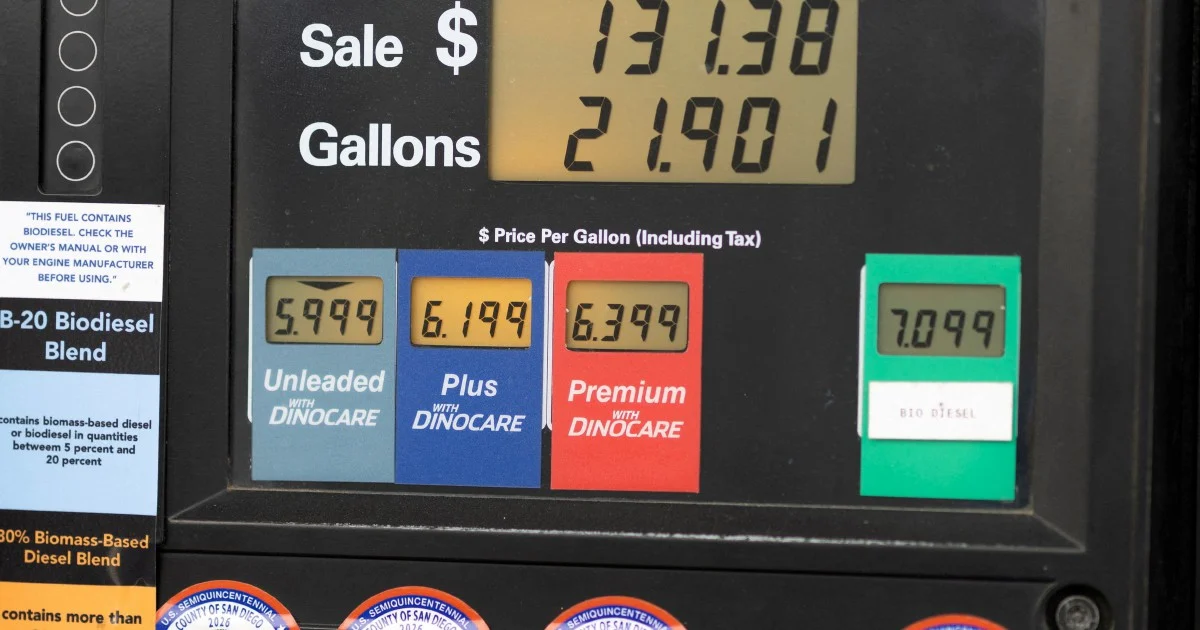
Donald Trump has initiated a formal investigation into America's major oil companies, citing frustration over gasoline prices that have refused to decline as rapidly as the administration anticipated. The announcement, made on Wednesday, reflects growing political pressure on the president as consumers continue to face elevated fuel costs at the pump, undermining his broader economic narrative ahead of critical political cycles.
The timing of Trump's directive is significant, arriving amid intensifying geopolitical tensions centred on Middle Eastern conflicts. Rising tensions in the region have traditionally prompted concerns about potential supply disruptions, yet markets have failed to respond in ways that have translated into lower prices for American drivers. This disconnect between Trump's policy expectations and market realities has created a political vulnerability that the president appears determined to address through direct government action against the oil industry.
Gasoline price movements reflect a complex interplay of global forces—crude oil production levels, refining capacity, geopolitical risk premiums, and consumer demand patterns—that resist simple policy interventions. For Malaysian readers, this dynamic carries particular resonance: Southeast Asia's energy markets remain deeply interconnected with global crude pricing, and any disruption to supply chains or production decisions by major American oil firms can ripple through regional fuel costs and industrial competitiveness.
Trump's investigation strategy mirrors previous political approaches to commodity pricing controversies, where administrations have questioned whether market actors are behaving rationally or exploiting crises. The probe will likely examine whether oil companies are deliberately constraining supply, maintaining elevated refining margins, or making investment decisions that limit production capacity. Such investigations often unearth complex supply-side factors but rarely yield decisive evidence of coordinated misconduct that satisfies political demands for immediate price relief.
The geopolitical context proves crucial to understanding this moment. Middle Eastern instability creates uncertainty that adds a risk premium to global crude prices, even without actual supply disruptions. Oil markets function on expectations as much as physical barrels, and traders responding to potential threats behave rationally within financial logic, though such responses frustrate policymakers seeking visible consumer benefits. The administration's frustration appears rooted in the gap between its expectations—that reassurance and stabilisation would yield tangible price declines—and market realities that operate on different timescales and variables.
For the broader American economy, sustained elevated gasoline prices complicate the administration's narrative around economic success. Fuel costs affect transportation, manufacturing, and consumer spending patterns across the economy, making them politically impossible to ignore despite being largely beyond direct presidential control. This reality has driven successive administrations toward investigating, regulating, or publicly pressuring oil companies, even when such measures produce limited results.
Investigations into oil industry pricing practices typically examine the structure of petroleum markets, competitive dynamics between major producers, and the relationship between crude prices and refined product margins. They may review whether companies coordinate on production decisions, whether refining bottlenecks exist, or whether speculative trading distorts prices. Previous such inquiries have occasionally produced modest policy adjustments, such as increased regulatory scrutiny or transparency requirements, but rarely deliver the dramatic price drops that politically motivate their initiation.
The Southeast Asian dimension warrants attention because regional refineries and fuel importers maintain complex relationships with American energy markets. Malaysia, Indonesia, and Singapore's energy sectors depend partially on crude access and pricing signals established in global markets where American policy decisions carry outsized influence. A sustained investigation affecting American oil production or export policy could have knock-on effects for regional energy costs and industrial planning across Southeast Asia.
Trump's investigation also signals frustration with an industry that traditionally enjoys considerable political support within conservative circles. This friction reflects the genuine difficulty of reconciling free-market principles with electoral pressures created by consumer pain points. The administration may hope that public investigation and pressure alone will encourage companies to boost production or accept lower margins, creating appearance of action without requiring legislative changes that face their own political obstacles.
The investigation's outcome remains uncertain, but history suggests that market dynamics will ultimately matter more than any investigative findings. Oil companies respond to long-term return expectations, capital availability, and global supply-demand fundamentals more than to political pressure, though they remain sensitive to regulatory risk and reputational concerns. Any investigation findings will likely highlight complexity rather than clear wrongdoing, leaving the administration's political problem partially unresolved.
For investors and market observers across the region, this episode underscores the interconnectedness of American political cycles with global energy pricing. When major consumer-economy presidents face electoral pressures around commodity prices, investigation and regulation often follow, adding regulatory uncertainty premiums to energy stocks and potentially shifting global investment patterns in fossil fuel infrastructure.
The probe also illustrates broader tensions between populist political demands for immediate consumer relief and the structural realities of global commodity markets operating on different timescales. While Trump's investigation may produce rhetorical satisfaction and investigative reports, delivering sustained lower gasoline prices requires either global supply increases—unlikely given current geopolitical constraints—or demand reduction, a politically unpalatable outcome that few administrations actively pursue.