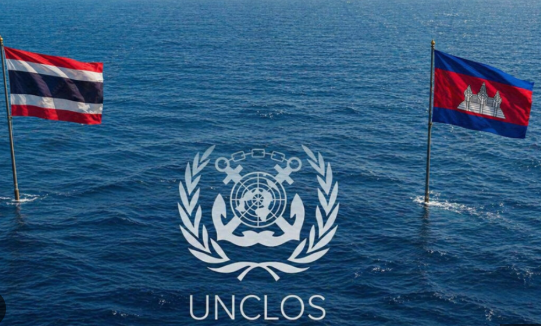
Thailand has formally accepted Cambodia's request for compulsory conciliation under the 1982 United Nations Convention on the Law of the Sea (Unclos) to resolve their long-standing maritime boundary dispute in the Gulf of Thailand. However, Bangkok has made clear that it views the process as fundamentally non-judicial in nature, explicitly rejecting any notion that the outcome will carry legal weight or override the countries' sovereign rights to negotiate directly. The Thai Ministry of Foreign Affairs submitted its formal response to Cambodia on June 19, following Cambodia's initial notification transmitted on June 2, establishing the framework for what could be a significant diplomatic exercise in Southeast Asia's contested waters.
The appointment of key officials to lead Thailand's participation signals the country's serious engagement with the process while maintaining strategic positioning on its ultimate aims. Deputy Prime Minister and Foreign Minister Sihasak Phuangketkeow was designated as Thailand's Agent in the conciliation proceedings, positioning him at the forefront of what may become extended negotiations. Songchai Chaipatiyut, currently serving as Thailand's ambassador to Kuwait and possessing extensive background in the Department of Treaties and Legal Affairs, was named as Deputy Agent, bringing technical legal expertise to the delegation. These appointments reflect Thailand's intention to blend high-level political representation with experienced legal counsel throughout the conciliation process.
Thailand selected two internationally respected arbitrators to represent its interests on the five-member conciliation commission. Judge Albert J Hoffmann of South Africa and Judge Rudiger Wolfrum of Germany, both acknowledged as leading experts in maritime law and the Law of the Sea, will join Cambodia's selected conciliators. The four appointees have a 30-day window from Thailand's formal response to select a fifth, neutral conciliator who will chair the commission. This structure, while appearing collaborative, also reflects the intricate diplomacy required when managing disputes between nations where direct resolution has proven elusive over decades.
The composition and expected timeline of the conciliation process reveal the measured pace at which maritime boundary disputes typically advance. The commission is anticipated to complete its work within approximately twelve months, though both parties retain the flexibility to extend this period by mutual agreement. This duration provides adequate time for comprehensive examination of each country's maritime claims, historical documentation, relevant geographical data, and the complex hydrocarbon resources in the contested areas. The process deliberately mirrors international best practices for resolving such disputes, emphasizing thorough fact-finding over rapid conclusion.
Crucially, Thailand has consistently reiterated that compulsory conciliation differs fundamentally from litigation or binding arbitration. The conciliators are not legal advocates for either side but rather neutral professionals tasked with comprehending the dispute's multifaceted dimensions, appreciating the context within which both nations' claims developed, and facilitating identification of mutually acceptable solutions. This distinction matters significantly because it preserves Thailand's flexibility to reject any recommendations that it determines do not adequately protect its interests or reflect its interpretation of international maritime law. The Thai government views the process as an intermediate step that may clarify positions and narrow disagreements, but not as a mechanism that compels acceptance of predetermined outcomes.
According to Thailand's reading of Unclos Annex V, the conciliation commission's report, conclusions, and recommendations carry no binding force on either party. This interpretation, while consistent with the treaty's plain language, underscores Thailand's strategic approach: participation signals commitment to peaceful resolution and international legal frameworks, yet preserves complete autonomy in determining whether to implement any recommendations. The report is envisioned as a potential foundation for resuming bilateral negotiations, essentially serving as an informed intermediary assessment that both countries may reference during direct talks. This framing transforms conciliation from a determinative process into a diplomatic tool designed to unlock progress where bilateral channels have stalled.
The underlying dispute concerns overlapping maritime claims in the Gulf of Thailand, an expanse believed to harbour substantial natural gas reserves and other hydrocarbon deposits. For both nations, the stakes extend beyond mere boundary demarcation; they encompass access to potentially lucrative offshore energy resources that could support development and energy security objectives. This economic dimension has long complicated negotiations, as delimitation of maritime boundaries inherently determines which country exercises jurisdiction and exploitation rights over specific areas. Thailand's emphasis that conciliation should focus solely on maritime delimitation, rather than encompassing provisional development arrangements or resource-sharing frameworks, reflects Bangkok's preference for separating the technical boundary question from the more complex negotiations regarding joint development.
Thailand's decision in May to terminate the 2001 memorandum of understanding with Cambodia (known as MoU 44) marked a significant recalibration of the bilateral framework governing maritime issues. Prime Minister Anutin Charnvirakul attributed the termination not to conflict but to the absence of meaningful progress over twenty-five years under that agreement's terms. The Thai government characterized the move as an adjustment intended to refresh the cooperation framework rather than terminate negotiations or damage bilateral relations. By allowing the 2001 MoU to expire and subsequently accepting Unclos conciliation, Thailand positioned itself as open to new mechanisms while signalling dissatisfaction with established processes that had failed to advance resolution.
Cambodia's initiation of compulsory conciliation following Thailand's MoU termination represents Phnom Penh's strategic response to Bangkok's recalibration. By invoking the Unclos dispute resolution mechanism, Cambodia asserted its commitment to peaceful, law-based approaches to resolving maritime disagreements, thereby claiming the diplomatic high ground whilst applying procedural pressure on Thailand. Cambodia framed the conciliation request as an avenue toward equitable settlement grounded in international law, positioning itself as the party championing international legal norms and impartial resolution. This tactical move also served notice that Cambodia would not passively accept the status quo or indefinite bilateral stalemate.
Thailand's acceptance of conciliation whilst simultaneously insisting on its non-binding nature reveals a nuanced diplomatic posture aimed at accommodating international expectations whilst preserving strategic flexibility. By agreeing to participate, Bangkok demonstrates respect for international law and commitment to peaceful dispute resolution, satisfying regional and global observers who value adherence to established frameworks. Simultaneously, by rejecting any binding character, Thailand maintains ultimate decision-making authority over its maritime sovereignty and resource access. This approach allows Bangkok to engage substantively with Cambodia without surrendering negotiating leverage or accepting outcomes it deems disadvantageous.
For Southeast Asian observers, this conciliation process underscores the persistent challenges in managing maritime disputes within a region where multiple overlapping claims, energy interests, and strategic considerations intersect. The Thailand-Cambodia case, while bilateral, reflects broader patterns evident in disputes involving Vietnam, the Philippines, China, and others in contested waters throughout Southeast Asia. The emphasis on non-binding recommendations and continued bilateral negotiation, whilst positioned as honoring international law, also reflects resistance to external determination of maritime boundaries. As the conciliation process unfolds over the coming months, it may illuminate whether such mechanisms can substantively advance resolution or whether they primarily serve diplomatic purposes without fundamentally altering positions on core sovereignty and resource questions.