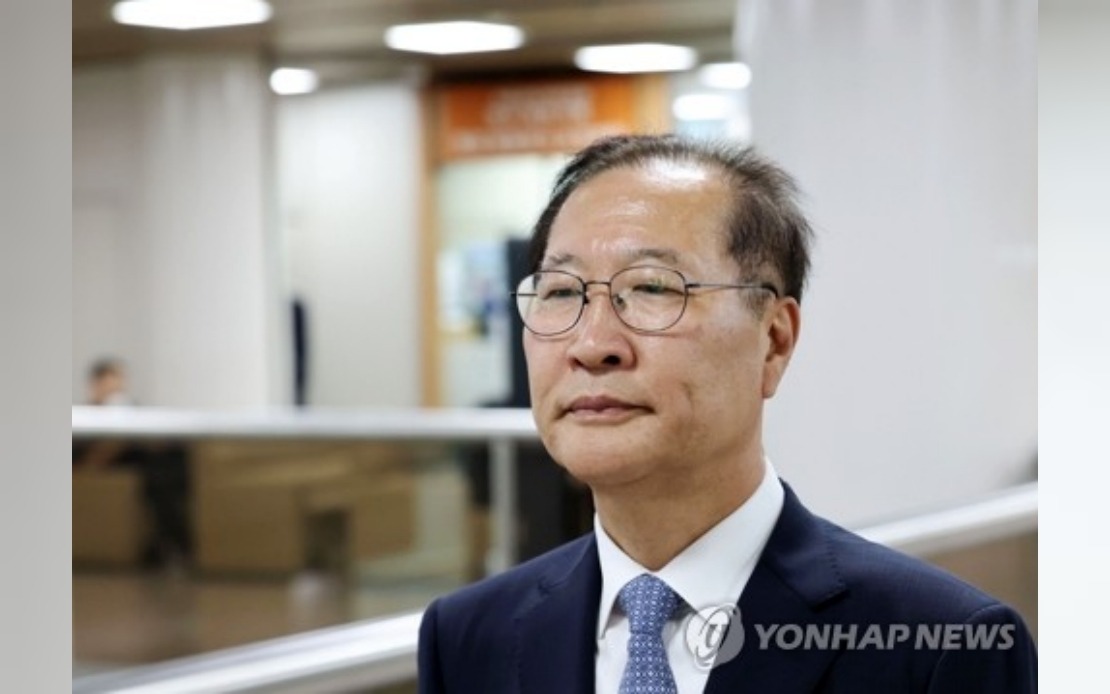
South Korea's judicial system delivered another significant verdict in the martial law crisis when a Seoul court on Monday convicted former Justice Minister Park Sung-jae and sentenced him to 25 years in prison. The Seoul Central District Court's decision exceeded the 20-year term recommended by the special counsel team, reflecting judicial concern about the severity of Park's actions in supporting what prosecutors characterised as an insurrectionary plot. The immediate placement of Park in custody underscores the court's assessment that he presents a risk of tampering with evidence, a determination that speaks to the gravity with which South Korean courts are treating this case.
Park's downfall represents another casualty in the constitutional crisis that unfolded when President Yoon Suk Yeol issued an emergency martial law decree on December 3, 2024. The decree, which lasted merely hours before being rescinded under parliamentary pressure, has triggered a cascade of legal proceedings against high-ranking officials accused of facilitating the controversial move. Park's role extended beyond passive compliance; the court found that he actively mobilised the Justice Ministry's resources to support the martial law infrastructure.
During the critical hours following Yoon's declaration, Park orchestrated a meeting of senior ministry officials and issued a series of directives that appeared coordinated with the broader martial law operation. According to the court's findings, Park specifically tasked officials with assessing the capacity of the nation's correctional facilities—ostensibly to prepare for the large-scale detention of politicians and other figures whom the Yoon administration apparently anticipated arresting under emergency powers. This assessment reveals a calculated administrative apparatus being marshalled in support of what the court characterised as an unconstitutional power grab.
The prosecution's case against Park, led by special counsel Cho Eun-suk's team, focused on two primary charges: playing a key role in insurrection and abusing his executive authority. The court's acceptance of both charges reflects a judicial determination that Park knowingly positioned himself within the machinery of an illegal constitutional overthrow. In his judgment, the court articulated a damning assessment of Park's conduct, stating that the defendant had abandoned his constitutional duty to defend the nation's legal order in favour of advancing what he apparently believed would be a successful power consolidation.
Beyond the martial law charges, prosecutors had also indicted Park on corruption allegations related to his conduct towards the prosecutors' office. Specifically, special counsel Cho's team asserted that Park had improperly directed subordinates in response to requests from Yoon's wife, Kim Keon Hee, concerning investigation details into her own suspected corruption. The court, however, determined that these anti-graft charges fell outside the special counsel's investigative purview and accordingly dismissed them, potentially leaving open the possibility of separate proceedings.
Park joins a growing roster of high-ranking officials convicted in connection with the December martial law episode. Former Prime Minister Han Duck-soo and former Defence Minister Kim Yong-hyun have already received convictions for their roles in advancing the insurrectionary scheme. Most significantly, President Yoon Suk Yeol himself was sentenced to life imprisonment in February for his leadership of the martial law imposition, though he has filed an appeal contesting the verdict. The cumulative weight of these convictions reflects a comprehensive judicial response to what courts have characterised as a coordinated attempt to subvert constitutional governance.
The implications for Malaysia and the Southeast Asian region merit consideration, as the South Korean proceedings demonstrate how democratic institutional safeguards—particularly an independent judiciary and special counsel mechanism—can operate to restrain executive overreach. The willingness of South Korean courts to convict cabinet-level officials and impose substantial sentences reflects a commitment to constitutional accountability that stands in contrast to political systems where such actions might be shielded by executive privilege or party loyalty. For Malaysian observers, the case illustrates both the capacity of judicial institutions to function independently and the necessity of maintaining institutional checks against concentrated executive power.
The special counsel office has signalled its satisfaction with the court's judgment, viewing the ruling as a vindication of its investigation and prosecution strategy. Rather than pursuing an appeal, Cho's team appears content with the verdict's affirmation of the principle that a justice minister bears an affirmative duty to resist unconstitutional declarations of emergency powers. This prosecutorial approach suggests a confidence that the conviction itself establishes the legal and constitutional boundaries that any future administration would transgress at substantial peril.
Park's legal representatives have announced their intention to appeal the conviction, characterising the sentence as lacking proper factual and legal foundation. Their challenge will face headwinds, however, given the careful documentation of Park's directive communications and the court's detailed analysis of his administrative actions. The appellate process may nonetheless offer additional opportunities to scrutinise the evidence and the scope of the special counsel's investigative authority, particularly concerning the dismissed anti-graft charges.
The broader constitutional ramifications of these proceedings extend beyond the immediate convictions. The South Korean judiciary's treatment of the martial law case establishes important precedents regarding the nature of insurrectionary conduct in modern democracies, moving beyond traditional armed rebellion to encompass sophisticated administrative mobilisation in support of constitutional violation. This jurisprudential development may influence how other democracies approach questions of executive overreach and institutional resistance to unconstitutional authority.