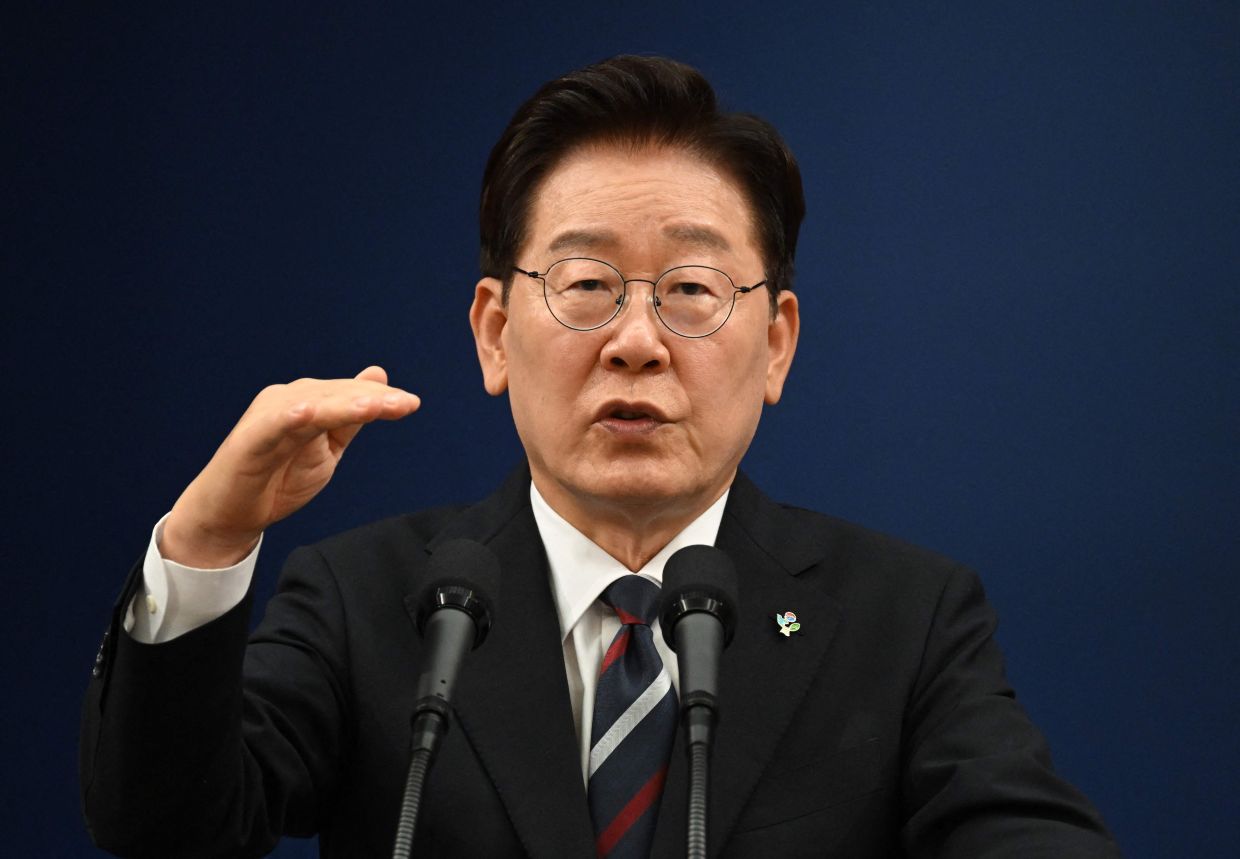
South Korean President Lee Jae Myung has experienced a significant political setback, with his approval rating dropping to 46.7 per cent in the latest polling survey released on June 22, marking the fifth consecutive week of decline and the first time disapproval has exceeded approval since he assumed office on June 4, 2025. According to Realmeter, a respected local polling firm, negative assessments of his performance now stand at 49.7 per cent, inching ahead of positive views despite remaining within the survey's margin of error. The crossover point represents a critical threshold in South Korean presidential politics, one that previous leaders have crossed with varying degrees of consequence during their tenures.
The trajectory of Lee's approval rating reveals a steady erosion of public confidence. The decline accelerated rapidly over recent weeks, falling from 60.5 per cent in early May through 59.3 per cent, 59.1 per cent, and 55.2 per cent in subsequent weeks before reaching its current nadir. The five-percentage-point collapse in a single week underscores the speed at which public opinion can shift when compounded crises emerge simultaneously. Notably, Lee reached this negative threshold considerably faster than his recent predecessors. Yoon Suk Yeol, his immediate predecessor, took six weeks to reach the same crossover point, while Park Geun-hye required 16 months and Moon Jae-in took 19 months, suggesting that current political and economic circumstances are exerting unusual pressure on presidential approval.
Analysts attribute the sharp decline to two converging crises affecting South Korean governance. The immediate trigger involves organisational failures during the June 3 local elections, which exposed ballot shortages and administrative breakdowns that became a public embarrassment for the government. Simultaneously, the Democratic Party of Korea finds itself consumed by factional disputes over its leadership direction ahead of an August 17 convention to elect a new party chair, a contest that has fractured the party's unity and damaged its credibility as a governing force. Realmeter specifically noted that these twin challenges have created a broader political malaise, though the pollster acknowledged that some positive developments—including Lee's well-received European diplomatic tour and a symbolic breakthrough of the Kospi index above the 9,000-point mark—have partially offset the damage.
Geographical analysis reveals significant regional variations in the decline, particularly troubling given the political landscape. Lee's approval rating experienced its steepest fall in Daegu and North Gyeongsang Province, traditionally conservative strongholds where his party should maintain strongest support, collapsing by 9.9 percentage points to just 34.6 per cent. In Greater Seoul—comprising Incheon, Gyeonggi Province, and the capital itself—approval fell 7.6 percentage points in both Incheon and Gyeonggi to 44.8 per cent, and dropped to 39.8 per cent in Seoul proper. These declines across supposedly friendly territory suggest that the election failures have transcended typical partisan divisions and struck at broader public expectations for competent administration.
Demographic breakdowns indicate that moderate voters and younger demographics have been particularly affected. Support among moderate voters declined 4.9 percentage points to 47.5 per cent, representing a critical loss since this centrist bloc often determines election outcomes. While liberal voters maintained stronger backing at 80.4 per cent despite a 3.2-percentage-point decline, the loss of moderate support proves more consequential politically. Conservative voters, meanwhile, showed relative stability with only a 0.7-percentage-point dip, suggesting that core supporters remain resilient despite the turmoil—a pattern typical of partisan polarisation in South Korean politics.
The separate survey measuring party support indicates that the tumult extends beyond the presidency to broader party dynamics. Support for the ruling People Power Party slipped 2 percentage points to 42.3 per cent, while the opposition Democratic Party gained 2.1 percentage points to reach 40.1 per cent, narrowing the gap to just 2.2 percentage points. Significantly, the People Power Party has haemorrhaged support among younger voters, losing 10.5 percentage points among those in their twenties to reach 48.6 per cent support, and dropping 5.1 percentage points among voters in their thirties to 47.4 per cent. This generational bleeding represents a strategic vulnerability for conservative politics in South Korea, where demographic trends already favour opposition parties.
The presidential office responded to the polling decline with a measured statement acknowledging the results while framing them as public assessment of both economic conditions and overall governance. The statement from Cheong Wa Dae expressed willingness to accept the numbers and promised greater attention to public concerns and expectations, a formulaic response that stops short of indicating any major policy recalibration or response to the underlying crises. Such muted reactions typically characterise early-stage presidential approval declines, before administrations determine whether the downturn represents temporary turbulence or structural loss of confidence.
Realmeter's analysis attributes the Democratic Party's relative rebound partly to a bipartisan crisis management approach, where a National Assembly investigation into election administration failures provided a unifying framework. The pollster suggested that despite factional tensions within the Democratic Party, an emphasis on party unity around government accountability has strengthened support among its traditional base. This dynamic—where perceived competent crisis management can partially restore political credibility—offers a potential pathway for recovery, though sustained improvement would require demonstrable progress in addressing the underlying failures.
For Malaysian and Southeast Asian observers, the situation underscores broader trends in East Asian governance where public expectations for administrative competence and transparent crisis management have risen significantly. The rapid decline in Lee's approval ratings suggests that South Korean voters, despite partisan divisions, converge around demands for effective government performance. This pattern mirrors public sentiment across the region, where protests and electoral shifts increasingly reflect frustration with governance rather than purely ideological preferences. The election management fiasco and subsequent factional infighting demonstrate how technical administrative failures can rapidly undermine political legitimacy, a lesson relevant across democracies facing public scepticism toward institutional competence.
The survey methodology, conducted among 2,517 voters aged 18 and above between June 15 and 19 using automated response systems, reflects modern polling practices common throughout East Asia. Realmeter's margin of error of plus or minus 2 percentage points means that while negative views currently exceed positive ones, the actual difference remains statistically marginal. Nevertheless, the symbolic importance of crossing the 50 per cent approval threshold cannot be discounted in South Korean politics, where media narratives around this figure shape subsequent political behaviour among both supporters and opponents.
Looking forward, the trajectory of Lee's approval will likely depend on whether the government can demonstrate competent handling of both the election crisis aftermath and economic concerns. The mentioned asset market disparities that appear to be eroding moderate voter support suggest that economic anxiety compounds political frustration. Without demonstrable improvement on multiple fronts—administrative accountability, party unity, and economic performance—approval ratings could decline further, potentially reaching levels that constrain the government's policy flexibility and legislative effectiveness throughout its five-year term.