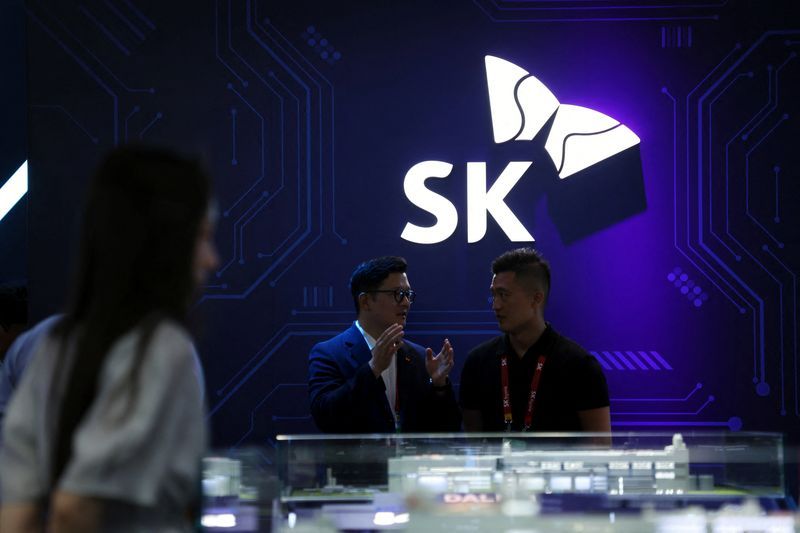
South Korea's SK Hynix announced plans on Wednesday to mobilise up to 45.45 trillion won ($29.43 billion) through an American Depositary Receipt listing, marking an ambitious effort to strengthen its financial footing and accelerate capacity expansion in the competitive memory chip sector. The company intends to list on the Nasdaq exchange on July 10, issuing 17.79 million new shares to back the ADR offering, with the final sum potentially subject to adjustment during the bookbuilding phase with institutional investors.
The capital raising underscores SK Hynix's determination to capture greater market share in artificial intelligence applications, where memory chips have become mission-critical infrastructure. By establishing a stronger presence in global capital markets through the Nasdaq listing, the company gains direct access to a broader investor base whilst simultaneously signalling confidence in its long-term strategic direction to the American financial community.
Proceeds from the offering will flow directly into three major capital projects that reflect SK Hynix's manufacturing ambitions. The company plans to construct a new chip fabrication plant in Yongin, develop an advanced packaging facility in Cheongju, and acquire essential chipmaking equipment including state-of-the-art Extreme Ultraviolet Scanners. These investments represent a substantial bet on capacity growth precisely when AI-driven demand for memory semiconductors continues expanding globally.
The ADR structure offers SK Hynix strategic flexibility in how American and international investors hold its shares. Each ADR will represent ownership equivalent to one-tenth of a common share, simplifying trading mechanics for Western financial institutions that traditionally prefer working with American depository instruments rather than navigating Korean stock market settlement procedures.
A consortium of major investment banks—BofA Securities, Citigroup Global Markets, Goldman Sachs, and JP Morgan Securities—will manage the offering, lending institutional credibility to the transaction. This selection reflects the scale and complexity of the deal, requiring coordinated effort from multiple leading underwriters to place such an enormous block of equity worldwide.
If the transaction achieves the upper end of its indicated price range, SK Hynix would establish a record for the largest-ever ADR offering by a significant margin. The previous benchmark was set in 2014 when Chinese e-commerce powerhouse Alibaba raised $21.8 billion during its inaugural New York listing. A successful execution at the top valuation would underscore the premium that global investors currently attach to semiconductor manufacturers positioned at the intersection of artificial intelligence infrastructure spending.
SK Hynix's prominence in AI ecosystems stems from its commanding position supplying high-bandwidth memory chips essential for machine learning and AI computing systems. Major customers including Nvidia and Alphabet's Google depend on SK Hynix's technological capabilities and production volume to sustain their own operations. This customer concentration, whilst strategically valuable, also reflects the company's deep integration into the world's most advanced technology platforms.
The company's trajectory has accelerated dramatically alongside the global AI explosion. Most notably, SK Hynix surpassed Samsung Electronics to become South Korea's most valuable company by market capitalisation on Monday, a historic milestone that reflects shifting economic dynamics within the country's technology sector. Where Samsung built its dominance across diverse consumer and industrial markets, SK Hynix's fortunes now rise and fall with AI adoption rates.
This listing arrives at a moment of considerable geopolitical sensitivity surrounding semiconductor manufacturing. Both Western governments and China have prioritised achieving greater control over memory chip production and supply chains, treating these technologies as strategic assets comparable to energy resources. SK Hynix's capital expansion plans, therefore, carry implications extending beyond corporate finance into broader questions about regional technology sovereignty and industrial policy.
For Malaysian and Southeast Asian observers, SK Hynix's expansion carries multiple significance layers. The region hosts substantial semiconductor manufacturing and assembly operations, and competition for talent, capital, and customer attention intensifies as major chipmakers invest elsewhere. Simultaneously, growing AI adoption across Southeast Asian industries increases local demand for the high-bandwidth memory products that SK Hynix manufactures, potentially supporting stronger pricing and supply security for regional technology companies.
The timing of the ADR listing also reflects confidence that memory chip market conditions remain favourable. Industry observers have noted cyclical volatility in semiconductor pricing, yet AI applications appear to be driving sustained demand growth that extends beyond traditional business cycles. SK Hynix's willingness to pursue such an aggressive capital raise suggests management believes current demand strength possesses durable foundations.
Success in this ADR offering would grant SK Hynix enhanced financial flexibility for acquisitions, research initiatives, and competitive positioning within a sector undergoing rapid technological evolution. The resulting expanded capital base may prove critical as competition intensifies, particularly from Chinese competitors increasingly investing in advanced memory manufacturing capabilities.
Looking ahead, investors will monitor not only whether SK Hynix achieves its fundraising target but also how effectively the company executes its manufacturing expansion plans and maintains technological leadership in memory chip design and production during an era of unprecedented AI infrastructure demand.

