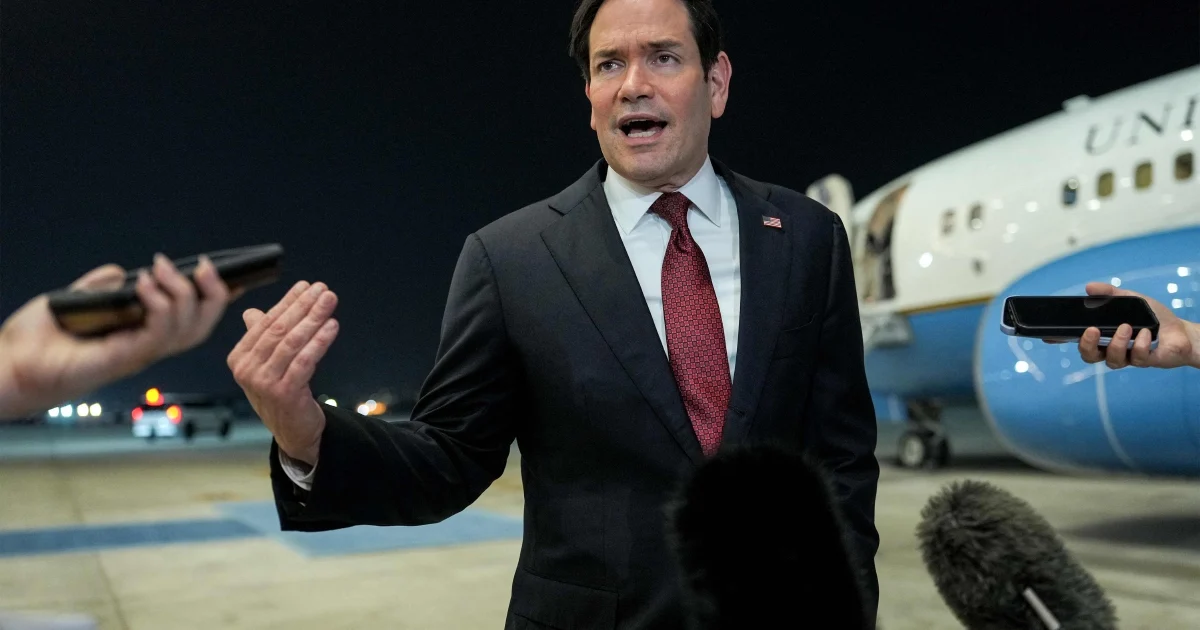
United States Secretary of State Marco Rubio has firmly rejected Iranian overtures to impose tolls or levies on shipping through the Strait of Hormuz, marking an early flashpoint in delicate diplomacy intended to bring an end to regional hostilities. The dispute over the strategic waterway, coupled with unresolved disagreements concerning nuclear inspections and weapons capabilities, reveals the formidable challenges facing negotiators as they attempt to chart a path toward conflict resolution.
Rubio's declaration came on Tuesday during discussions centred on establishing common ground between Washington and Tehran. The statement underscores a fundamental incompatibility between the two sides on maritime commerce, a position likely to resonate across Southeast Asia given the region's profound dependence on free passage through one of the world's most critical shipping lanes. For Malaysia and neighbouring trading nations, any restrictions or financial impediments imposed on Hormuz transit would directly elevate costs for energy imports and general merchandise bound for regional markets.
The Strait of Hormuz, nestled between Iran and Oman, serves as the chokepoint through which roughly one-third of global seaborne petroleum passes annually. This geographical reality means that Iranian assertions of authority over the waterway carry consequences far beyond Middle Eastern commerce. Malaysia, as a energy-importing nation with significant shipping interests, maintains a vested interest in ensuring the strait remains open and free from unilateral toll mechanisms. Regional economies throughout Southeast Asia would face inflationary pressures should Iran succeed in extracting fees from vessels navigating these waters.
The emergence of these disagreements at such an early stage of negotiations indicates that both parties harbour substantially divergent visions for a settlement. Iran's willingness to introduce the toll question suggests an attempt to extract economic concessions alongside any agreement. Conversely, the American rejection signals Washington's determination to prevent Iran from gaining leverage over global energy markets, a concern that extends beyond bilateral US-Iranian relations to affect international stability and economic predictability.
Beyond maritime tolls, the negotiating teams remain divided on matters of nuclear oversight and missile development. These technical questions have historically proven among the most contentious elements in US-Iran diplomatic efforts. Nuclear inspections represent a verification mechanism through which external powers seek assurance that proliferation commitments are honoured, while missile discussions touch upon Iran's capacity to project regional influence. Neither side appears inclined toward significant compromise on these foundational security concerns.
The timing of these negotiations carries particular significance for Southeast Asian observers. Regional stability depends substantially upon the containment of Middle Eastern conflicts within manageable bounds. Should tensions escalate, broader implications could emerge, ranging from energy price volatility affecting Malaysian petrochemical industries to potential disruptions in sea lanes used by ASEAN nations for critical trade flows. The outcome of these talks therefore warrants close attention from Malaysian policymakers and business leaders.
Previous diplomatic initiatives involving Iran have demonstrated the difficulty of bridging such fundamental gaps through conventional negotiation frameworks. The complexity deepens when multiple issue sets require parallel agreement—parties must simultaneously resolve maritime access, nuclear oversight, and armament restrictions while building sufficient mutual confidence to ratify any comprehensive accord. Historical precedent suggests that interlocking demands frequently derail efforts unless mediators successfully reframe disputes in terms amenable to package settlements.
The United States has articulated a clear redline concerning Hormuz tolls, reflecting perhaps the most immediate and non-negotiable demand within its negotiating position. This categorical rejection provides Iran little incentive to moderate its toll proposals unless compensated elsewhere in the agreement structure. Such zero-sum positioning, if it hardens on both sides, could rapidly render discussions unproductive and return the region to elevated tension.
For Malaysian observers, the emergence of these early obstacles carries several implications. First, peace negotiations in the Middle East rarely proceed smoothly or swiftly; the appearance of contentious issues weeks or months into talks should not be interpreted as signalling imminent agreement. Second, external economic actors like Malaysia should prepare contingency scenarios addressing energy supply disruptions and shipping cost increases. Third, regional diplomatic channels should amplify ASEAN concerns regarding freedom of navigation to relevant parties, ensuring that broader Southeast Asian interests receive consideration in multilateral discussions.
The negotiating process will likely extend considerably as both sides assess which positions merit compromise and which remain immovable. Rubio's firm stance on Hormuz tolls establishes one such immovable point for Washington, creating space for potential compromises elsewhere—perhaps in sanctions architecture or nuclear monitoring protocols. How creatively the negotiating teams reconstruct the bargaining landscape will determine whether these early strains metastasize into permanent fractures or become manageable obstacles overcome through persistent diplomacy.