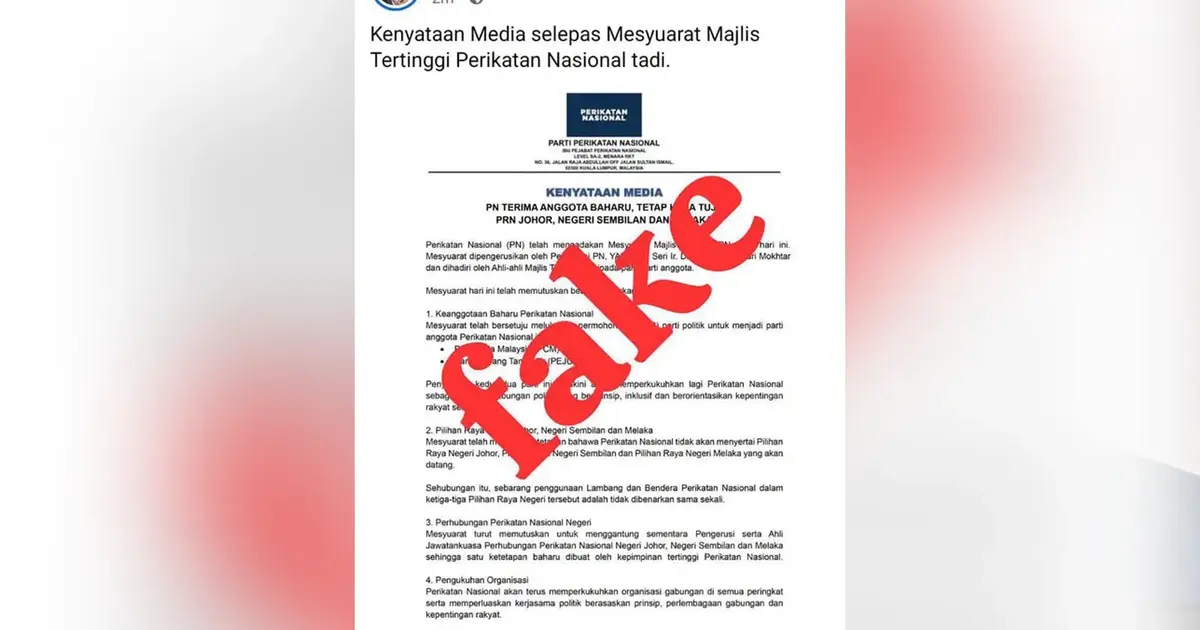
Perikatan Nasional has moved swiftly to counteract rumours suggesting the opposition coalition plans to sidestep participation in three forthcoming state-level electoral contests. The coalition issued a categorical denial, characterising the circulating statement as inaccurate and without foundation. This response comes amid heightened political scrutiny surrounding PN's electoral strategy heading into Malaysia's next cycle of state assembly polls.
The false claim appears to have originated from unverified sources circulating on social media platforms, a common vector for political misinformation in Malaysia's hyperactive online political discourse. Such unfounded allegations can carry significant weight in shaping public perception of major political movements, particularly when they pertain to fundamental questions about a coalition's commitment to democratic participation. PN's rapid rebuttal underscores the coalition's concern about narrative control during a period when its political positioning remains subject to intense scrutiny from both the ruling Barisan Nasional and Pakatan Harapan.
Peikatan Nasional's insistence on the statement's falsity reflects broader dynamics within Malaysia's opposition politics. Since its reconfiguration following the 2022 general election, PN has sought to establish itself as a credible electoral alternative while managing internal cohesion across its Malay-Muslim focused membership base. Any suggestion that the coalition lacks commitment to contesting elections would fundamentally undermine this project, signalling either loss of confidence in electoral prospects or strategic withdrawal that could be weaponised by political opponents.
The timing of such rumours may be strategically significant. State elections in Malaysia often serve as barometers of national political sentiment and test grounds for coalition strategies. Perakah, Selangor, Penang, and Pahang have rotated through electoral cycles, creating a consistent narrative of sub-national contestation that feeds national political calculations. For PN to publicly disavow any suggestion of non-participation signals determination to maintain pressure on both Barisan Nasional and Pakatan Harapan in every available electoral theatre.
Malaysian voters and observers have grown increasingly attuned to disinformation campaigns in the lead-up to elections. The spread of false narratives about major political actors' intentions has become sufficiently common that political parties now invest resources in rapid-response denial protocols. PN's quick dismissal aligns with standard crisis communication practice, yet the very necessity of such denials highlights vulnerability to reputational damage through coordinated or organic spread of misinformation across messaging platforms.
The coalition's response also carries implications for its supporters and allied organisations who monitor PN's strategic positioning. Clear public statements rejecting boycott claims reassure grassroots activists and state-level operatives that the national leadership remains committed to electoral contests. This matters significantly in Malaysian politics, where state-level party machinery often operates with substantial autonomy and requires confidence that central direction will be maintained.
From the perspective of Malaysian electoral politics more broadly, the emergence and circulation of such claims underscores ongoing fragmentation across the opposition landscape. Neither PN nor its competitors can afford to project weakness or vacillation regarding fundamental commitment to democratic participation. The fact that misinformation about electoral participation gained sufficient traction to require formal denial suggests audiences remain susceptible to narratives about opposition coalition instability.
Looking at the broader regional context, Malaysia's experience with political disinformation reflects patterns observable across Southeast Asia. Thailand, Indonesia, and the Philippines have all experienced intensification of false claims about electoral intentions and political party strategies. The region's reliance on digital communication, combined with substantial portions of politically engaged populations, creates conditions favourable for rapid information distortion. PN's situation exemplifies challenges facing opposition movements in democratic systems where misinformation can inflict rapid reputational damage.
The coalition's emphasis on the statement's inaccuracy rather than engaging substantively with underlying questions about electoral strategy reflects strategic discipline. By flatly rejecting false claims without elaborating detailed counter-explanations, PN avoids creating impression of defensive positioning. This communicative approach assumes audiences will distinguish between outright falsehoods and legitimate policy disagreements, though such assumptions remain contested in contemporary Malaysian political debate.
Moving forward, the incident illuminates persistent vulnerabilities in Malaysia's information environment. Political parties across the spectrum face ongoing challenges distinguishing organic rumours from coordinated disinformation campaigns. PN's experience also illustrates how rapidly claims about major political actors can circulate and gain apparent credibility, necessitating institutional capacity for rapid response. As Malaysia approaches future electoral cycles, the proliferation of false narratives about opposition intentions will likely continue shaping political messaging and public discourse.

