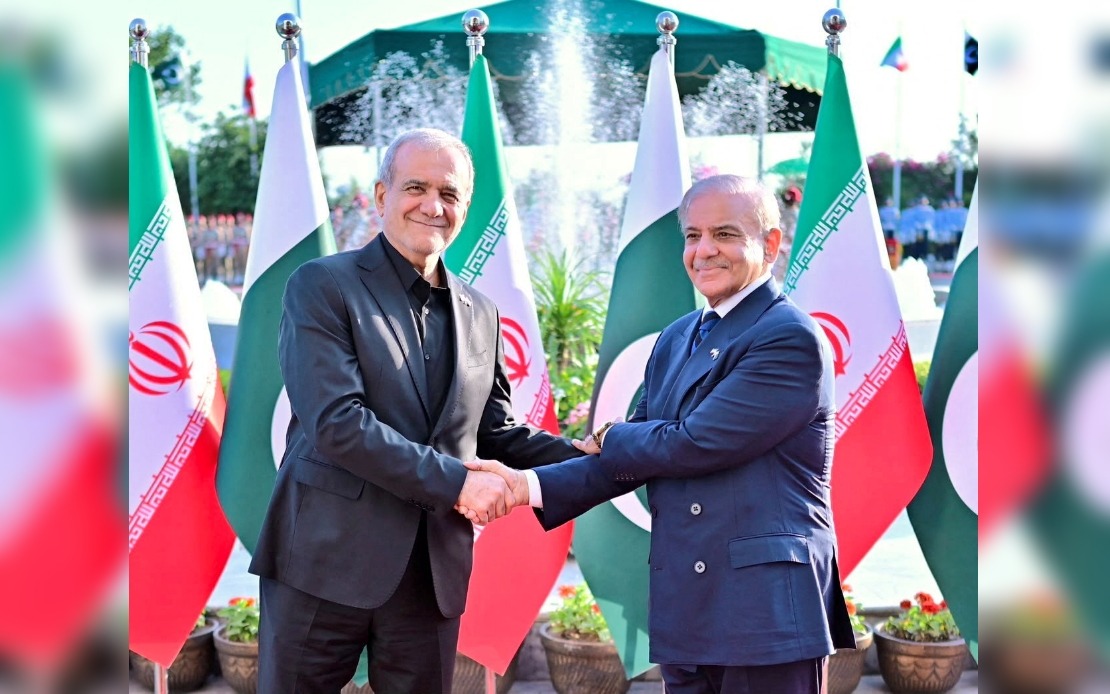
Pakistan's government has thrown its diplomatic weight behind Iran's contested ballistic missile programme, with Prime Minister Shehbaz Sharif rejecting international calls for restrictions on Tehran's weapons development. Speaking alongside Iranian President Masoud Pezeshkian during high-level talks in Islamabad on Tuesday, Shehbaz made clear that missile capabilities were deliberately excluded from the memorandum of understanding that Iran and the United States finalised on June 17 following months of behind-the-scenes mediation led by Islamabad.
The Pakistan premier's strong endorsement signals Islamabad's commitment to defending Tehran's security interests and reinforces the strategic partnership between the two neighbours. Shehbaz emphasised that the Iranian side had steadfastly refused to place its missile programme on the negotiating table, and that no international consensus existed for subjecting Iran to restrictions that other nations did not face. His language conveyed frustration with what he characterised as a pattern of discriminatory expectations toward Tehran, arguing that allowing some countries to maintain advanced weaponry while denying Iran equivalent capabilities would represent an unjust double standard in international affairs.
Iran has long viewed its ballistic missiles as fundamental to national defence, particularly following the February 28 attacks attributed to Israel and the United States. President Pezeshkian reinforced this calculus during the Islamabad talks, declaring that Tehran's defensive capabilities were non-negotiable for the nation's survival. He drew a stark comparison to Gaza, warning that without such deterrent systems, Iran would face an existential threat comparable to the humanitarian catastrophe unfolding in the Palestinian territory. This framing reflects Tehran's conviction that military strength underpins any meaningful security arrangement, a position that shapes how Iranian officials interpret agreements and negotiate with external powers.
Pakistan's mediation role in establishing the US-Iran ceasefire has positioned Islamabad as a crucial diplomatic intermediary in West Asian affairs. Deputy Prime Minister Ishaq Dar and Chief of Army Staff Field Marshal Syed Asim Munir played pivotal roles in the negotiation process, lending Pakistan's security establishment institutional weight to the diplomatic effort. Shehbaz publicly acknowledged Iran's trust in Pakistan's impartiality and commitment, framing the relationship through language of brotherhood and assured commitment—rhetoric that carries significant meaning in Pakistan-Iran bilateral dynamics and suggests Islamabad intends to maintain this elevated diplomatic engagement.
The timing of Pezeshkian's visit demonstrated Tehran and Islamabad's determination to consolidate recent diplomatic breakthroughs. Pakistan's military ceremonially escorted the Iranian president's aircraft with six Air Force fighter jets, while Shehbaz and President Asif Ali Zardari accorded him a state reception complete with a 21-gun salute. These symbolic gestures underscored the elevated status of the relationship and conveyed to regional and international audiences that Pakistan viewed Iran as a crucial strategic partner deserving of the highest diplomatic honours.
Notably, Shehbaz identified what he termed "spoilers" seeking to undermine the nascent US-Iran agreement, pointing obliquely to regional powers opposed to any reconciliation between Washington and Tehran. He specifically highlighted Israel's military actions in Lebanon and occupied Palestine as the primary obstacle to broader regional stability. This characterisation reflects a geopolitical assessment common in Pakistani foreign policy circles, which increasingly view Israeli actions as destabilising to the entire Middle East and incompatible with genuine regional peace efforts.
The statement is particularly significant given that US President Donald Trump has recently acknowledged Iran's legitimate interest in possessing ballistic missiles. Speaking in Paris on June 17, Trump conceded that if other nations maintained such weapons, preventing Iran from doing likewise would constitute unfair discrimination. While Trump's framing differs somewhat from the principle of non-proliferation traditionally championed by Washington, his acknowledgement provides diplomatic cover for countries like Pakistan to publicly defend Iran's military capabilities without appearing to defy American interests.
For Malaysia and Southeast Asian nations, Pakistan's diplomatic positioning carries implications for regional security frameworks and non-aligned movement politics. Pakistan's willingness to champion Iran's defence programme signals that major Asian powers remain willing to resist perceived Western efforts to constrain non-aligned states' military development. This stance influences how regional organisations deliberate on proliferation issues and shapes expectations about how larger powers will behave when smaller nations face external pressure to limit weapons systems.
The broader significance of these developments lies in how they reshape perceptions of post-agreement dynamics between the US and Iran. Rather than leading to Iranian concessions on weapons capabilities, the June 17 memorandum has instead been followed by explicit articulation that Tehran's military modernisation remains off-limits to international negotiation. Pakistani backing provides Iran with additional diplomatic legitimacy for this position and complicates any future Western efforts to resurrect restrictions on Iranian weapons through multilateral forums. For observers tracking Middle Eastern geopolitics, this pattern suggests that Iranian negotiators successfully protected their strategic autonomy while securing international acknowledgement of a temporary ceasefire.