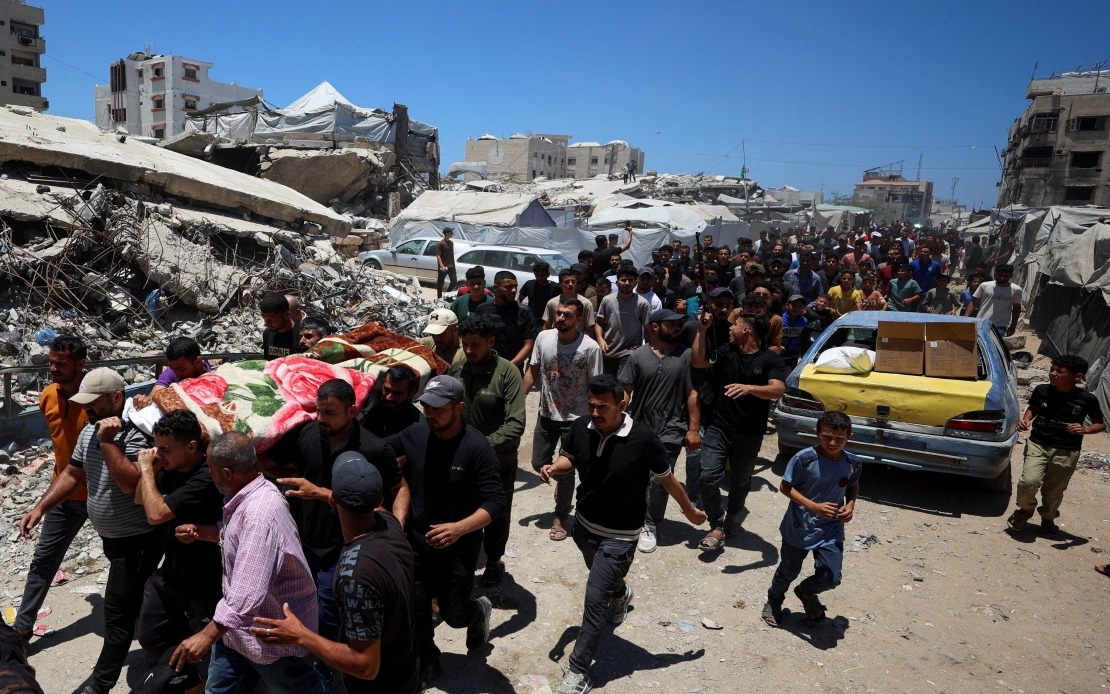
The Palestinian Prime Minister's Office has documented a grim continuation of casualties in Gaza despite the implementation of a ceasefire, with newly released figures indicating that 1,021 Palestinians have lost their lives since the agreement took effect. The cumulative death toll from the conflict that erupted in October 2023 now stands at 73,032 according to Tuesday's Situation Report issued from Ramallah, underscoring the scale of devastation that has unfolded across the densely populated enclave over the past nine months.
The persistence of violence following the ceasefire announcement reflects the fragile nature of the agreement and ongoing military operations that continue to impact civilian populations. Recent strikes have targeted multiple locations including Nuseirat, Al-Mawasi, Khan Younis and Gaza City, demonstrating that the conflict remains active in multiple zones across the territory. These operations have compounded an already catastrophic humanitarian situation characterised by severe resource constraints and damaged infrastructure.
Civilian infrastructure across Gaza has been devastated at an alarming rate, with Israeli military operations destroying or severely damaging approximately 76.6 per cent of the enclave's housing stock. This destruction has rendered nearly one million Palestinians homeless, forcing them to live in temporary tent settlements with minimal access to basic services. The scale of housing loss represents one of the most comprehensive infrastructure collapses in recent global conflicts and raises urgent questions about long-term reconstruction and resettlement possibilities for the displaced population.
Water scarcity has emerged as a critical public health emergency threatening the entire population. Most residents now depend entirely on limited humanitarian supply shipments to access clean drinking water, as the enclave's water infrastructure has been rendered largely non-functional. This dependency on external aid for essential services places the population in an extremely vulnerable position, particularly for vulnerable groups including children, the elderly and those with pre-existing health conditions who face heightened risks from waterborne diseases and malnutrition.
Children have suffered disproportionately throughout the conflict. The United Nations Children's Fund has documented that 265 Palestinian children have been killed and more than 400 wounded since the ceasefire was announced, highlighting the devastating toll on Gaza's youngest population. These figures underscore the long-term generational impact of the conflict, as the surviving children face ongoing trauma, displacement and disrupted education. The psychological and developmental consequences for an entire cohort of young people will likely shape Palestinian society for decades to come.
Humanitarian access restrictions continue to obstruct relief operations at critical junctures when civilian needs are most acute. International organisations including Oxfam have reported to the United Nations Security Council that Israeli restrictions systematically prevent the delivery of life-saving medical supplies, food and other essential assistance required to sustain the civilian population. These access barriers compound the effects of infrastructure destruction and create overlapping crises that threaten to push Gaza's population toward famine conditions and preventable disease outbreaks.
Palestinian territories beyond Gaza are experiencing concurrent crises involving forced displacement and property destruction. The United Nations Human Rights office has reported a significant surge in forced displacements across the occupied West Bank and East Jerusalem, driven by settler attacks, military home demolitions, movement restrictions and forced evictions. This expansion of the conflict to non-combat zones reflects broader patterns of territorial pressure that Palestinian residents increasingly face across their territories, creating cascading displacement pressures that extend beyond Gaza's borders.
Agricultural devastation adds another dimension to the humanitarian crisis. Palestinian agricultural officials have documented the destruction of 7,258 trees including 1,270 olive trees, with estimated financial losses reaching approximately US$5.17 million due to attacks by Israeli settlers and occupation forces. Attacks have also targeted religious facilities, including arson assaults on mosques in Jiljilya and Mazra' al-Nubani villages. This targeting of cultural and agricultural heritage simultaneously degrades civilian livelihoods and erodes the social infrastructure that sustains Palestinian communities.
Refugee camp populations in the West Bank have experienced intensive military operations that have displaced more than 33,000 Palestinians since January 2025. Jenin, Tulkarem and Nour Shams refugee camps have seen some of the most severe displacement, as military incursions have forced families from their homes with little opportunity to retrieve possessions or documentation. These operations have created new waves of internal displacement within Palestinian territories and strained already-limited resources within remaining communities.
Detention conditions for Palestinian prisoners have severely deteriorated according to institutional monitors. Overcrowding within Israeli detention facilities has created dangerous health conditions, with disease outbreaks reported across multiple facilities. The combination of overcrowding, inadequate sanitation and restricted access to medical care creates risks for both detainees and broader public health. These conditions raise serious questions about detention practices and prisoner welfare that have drawn international humanitarian law scrutiny.
Despite the overwhelming security and humanitarian challenges confronting Palestinian society, educational institutions have persevered with preparations for the General Secondary Education Examination involving approximately 91,000 students. Roughly 37,000 Gaza-based students are participating in the examinations for the third consecutive year using electronic formats, demonstrating remarkable institutional resilience amid ongoing conflict. This continuation of educational programming represents an assertion of normalcy and future-orientation even as present conditions deteriorate, though the ability to sustain educational quality under such extreme duress remains deeply uncertain.
For Southeast Asian observers, the Gaza situation presents important considerations regarding humanitarian access, civilian protection standards and the scale at which modern conflicts can displace entire populations. The international community's response to these developments, including whether established humanitarian law frameworks prove adequate to protect civilians in prolonged conflicts, carries implications extending beyond Palestine. Malaysia and other regional nations have consistently advocated for international humanitarian standards and civilian protection, making developments in Gaza relevant to broader discussions about conflict resolution and protection mechanisms in the region.