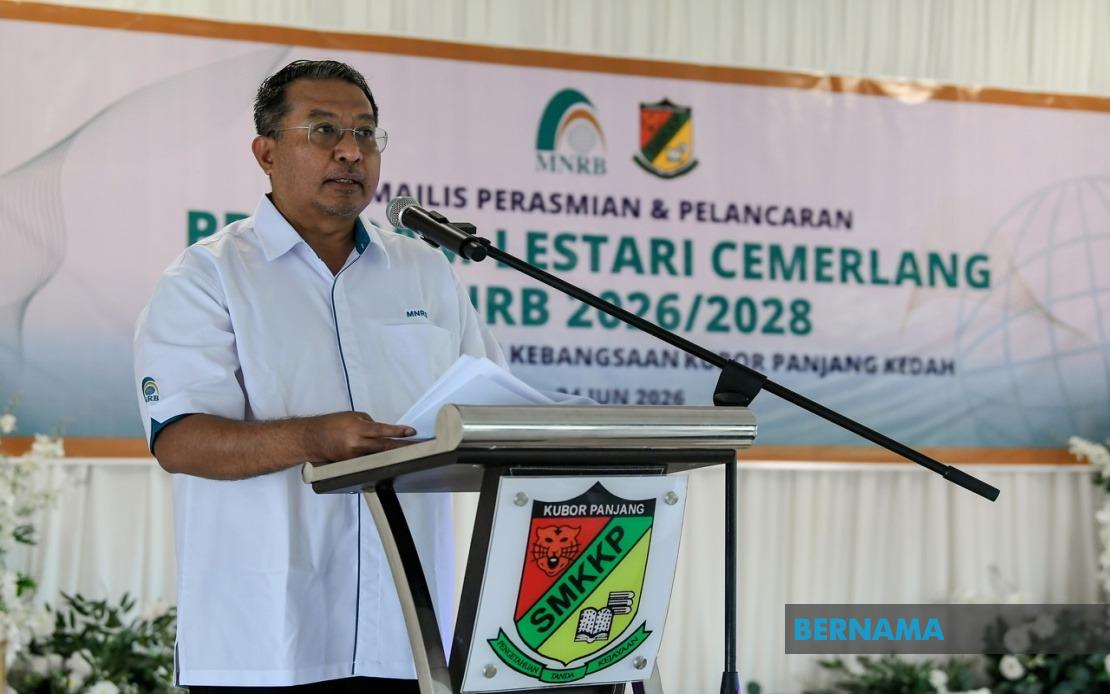
MNRB Holdings Berhad, a major investment holding company, has committed nearly RM600,000 to expand educational opportunities at six schools nationwide through its flagship Lestari Cemerlang Programme. The latest institution to benefit is Sekolah Menengah Kebangsaan Kubor Panjang in Pendang, Kedah, selected as the sixth school in the initiative. The programme launch, held at the school today, was officiated by Ishak Awang, deputy director of the Kedah State Education Department's Learning Sector, signalling strong government endorsement of the corporate initiative.
According to Datuk Rudy Rodzila Che Lamin, MNRB interim president and group chief executive officer, the adopted school model represents a cornerstone of the company's corporate social responsibility strategy, having operated continuously since 2011. The durability of the initiative underscores a long-term commitment to educational development rather than ad-hoc charitable gestures. What distinguishes the Lestari Cemerlang approach from conventional corporate giving is its holistic framework, which simultaneously targets academic achievement, character formation, and institutional excellence while intentionally prioritising rural and underserved communities where access to quality education remains constrained.
The geographical footprint of the programme spans multiple regions, with SMK Kubor Panjang representing the latest addition following successful implementations in Perak, Pahang, Negeri Sembilan, Melaka, and Selangor. This regional distribution reflects a deliberate strategy to address educational disparities across peninsular Malaysia rather than concentrating resources in urban centres. The progression from state to state suggests MNRB is building a scalable model that can be adapted to different socioeconomic and geographical contexts.
MNRB's approach transcends direct financial transfers by implementing layered interventions within each adopted school. The company sponsors intensive academic programmes, notably supplementary classes targeting Form Five students preparing for crucial national examinations. Motivational camps and student development workshops complement classroom learning, addressing the soft skills and resilience that employers increasingly demand. Infrastructure improvements extend to upgrading physical learning facilities and providing digital infrastructure, including a branded MNRB Smart e-Learning Room equipped with interactive television and internet connectivity at SMK Kubor Panjang. These technological enhancements carry particular significance for rural schools that may otherwise struggle to afford modern digital infrastructure.
Beyond campus-based interventions, MNRB sponsors practical support mechanisms that recognise the socioeconomic realities of students in target communities. The company provides financial assistance for sports jerseys, a seemingly modest contribution that removes financial barriers to student participation in co-curricular activities. Environmental stewardship features prominently through greening programmes, embedding sustainability consciousness into school culture. Collectively, these measures demonstrate understanding that educational excellence requires attending to material conditions, technological access, and psychological wellbeing alongside traditional academic instruction.
The scholarship component, managed through the Tabung Biasiswa MNRB initiative, operates as a complementary vertical that captures exceptional students and retains them within MNRB's ecosystem. Five top-performing students from SMK Kubor Panjang have been selected to receive sponsorship covering diploma, bachelor's, and master's level studies. This support aligns notably with MNRB's business interests, as recipients must pursue fields directly relevant to the company's operations—insurance, takaful, and finance. The strategy effectively transforms educational patronage into talent pipeline development, creating mutual benefit where talented young Malaysians gain access to funding while MNRB cultivates a pool of educated professionals aligned with its sector.
The programme's track record provides tangible evidence of effectiveness. Across the five previously adopted schools, fourteen students have received Tabung Biasiswa MNRB sponsorship, with eight subsequently securing employment at MNRB Group following graduation. This conversion rate demonstrates that the initiative achieves its stated objective of opening pathways to economic opportunity. For rural students in particular, institutional sponsorship that extends through higher education and translates into formal employment represents transformative opportunity that might otherwise remain inaccessible.
For Malaysian policymakers and education administrators, MNRB's model offers instructive lessons about private-sector engagement in public education. Rather than viewing corporate involvement as supplementary or tokenistic, the company integrates multiple intervention layers spanning infrastructure, academic support, character development, and post-secondary opportunity structures. The emphasis on rural locations directly addresses acknowledged disparities in educational resource distribution between urban and peripheral areas. The sustainability of the initiative since 2011 demonstrates that meaningful corporate commitment to education can be maintained over extended periods when structured strategically.
From a Southeast Asian perspective, MNRB's approach gains additional relevance given the region's ongoing challenges in delivering equitable, quality education across diverse geographical and socioeconomic contexts. Rural areas throughout Southeast Asia face similar constraints—limited facility investment, teacher shortages, insufficient digital infrastructure, and limited post-secondary opportunity pathways. Models that demonstrate how private institutions can systematically address these challenges through structured, long-term commitment offer potential templates for replication and adaptation across the region.
The Lestari Cemerlang Programme also reflects evolving corporate social responsibility expectations in Malaysia. Modern CSR increasingly emphasises measurable outcomes, strategic alignment with business objectives, and sustainable impact rather than episodic donations. By maintaining consistent support across multiple schools, anchoring interventions to quantifiable educational metrics, and creating documented pathways from secondary education through employment, MNRB demonstrates CSR as integrated business strategy rather than peripheral corporate expense.
Moving forward, the expansion to six schools suggests potential for further growth of the initiative. The evidence of positive outcomes at previously adopted institutions provides justification for scaling, while the demonstrated capacity to implement programmes across different states suggests feasibility of broader expansion. For the students at SMK Kubor Panjang now entering the Lestari Cemerlang Programme, the availability of comprehensive academic support, digital learning resources, and conditional scholarship pathways represents concrete expansion of their opportunity horizons. The programme ultimately articulates an implicit theory of development—that talent exists widely across all communities, and that systematic investment in capability building, combined with credible pathways to professional opportunity, can transform educational and economic trajectories for motivated young Malaysians.